
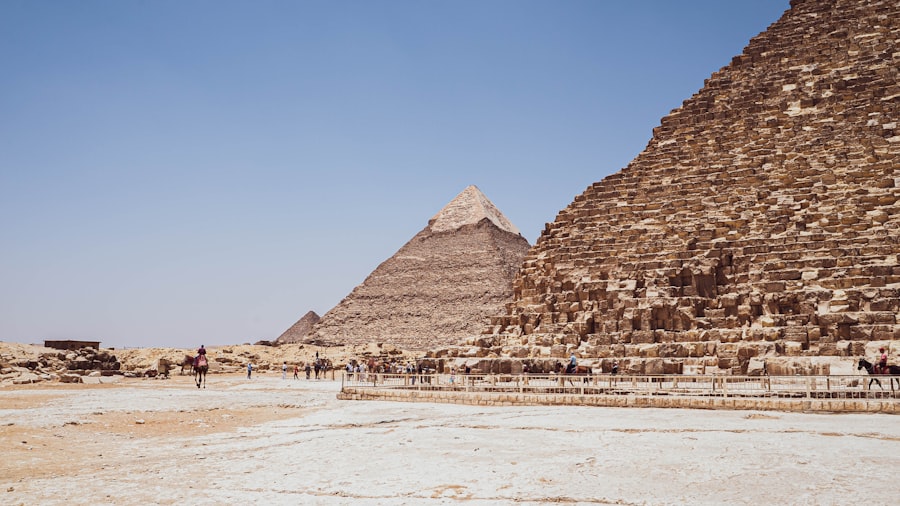
The Giza pyramid complex, an archaeological marvel situated on the Giza Plateau outside Cairo, Egypt, comprises the Great Pyramid of Giza (also known as the Pyramid of Khufu or the Pyramid of Cheops), the Pyramid of Khafre, and the Pyramid of Menkaure, along with their associated pyramid complexes and the Great Sphinx. Constructed during the Fourth Dynasty of the Old Kingdom of ancient Egypt, these monumental structures stand as a testament to the advanced engineering, organizational capabilities, and architectural ambition of a civilization flourishing millennia ago. The assertion that they were “built 5000 years ahead of schedule” serves as a rhetorical device to underscore the perceived incongruity between their sophisticated construction and the prevailing technological understanding of their era.
The construction of the Giza pyramids is firmly rooted within the chronological framework of ancient Egyptian history. The Old Kingdom, typically dated from approximately 2686 to 2181 BCE, represented a period of immense stability and centralized authority, which provided the necessary resources and societal structure for such colossal undertakings.
Dating and Attribution
Archaeological evidence, including hieroglyphic inscriptions, the discovery of workmen’s villages, and radiocarbon dating of organic materials found within the structures, consistently places the construction of the Great Pyramid of Khufu around 2580–2560 BCE. The pyramids of Khafre and Menkaure followed, built by Khufu’s son and grandson, respectively, within the same dynastic period. These dates are supported by detailed analyses of tomb records and king lists, which provide a robust framework for understanding the sequence of pharaonic reigns and major construction projects.
The Old Kingdom’s Architectural Precedents
It is crucial to understand that the Giza pyramids did not emerge in a vacuum. Earlier monumental architecture, such as the Step Pyramid of Djoser at Saqqara (built around 2670 BCE by Imhotep), represents a clear evolutionary path in pyramid construction. The Step Pyramid, a mastaba superimposed upon other mastabas, demonstrated the feasibility of building on a massive scale and served as a prototype for the true pyramid form. Subsequent pyramids, like the Bent Pyramid and the Red Pyramid at Dahshur built by Sneferu, Khufu’s father, further refined the techniques of quarrying, transport, and precise stone laying, effectively paving the way for the ultimate architectural expression seen at Giza. The technological leap, while significant, was a culmination of generations of architectural development rather than a sudden, inexplicable appearance.
Recent discoveries have suggested that the Giza pyramids may have been constructed 5,000 years earlier than previously thought, challenging long-held beliefs about ancient Egyptian civilization. This intriguing development is explored in detail in a related article, which delves into the implications of this timeline shift on our understanding of architectural advancements and societal organization in ancient Egypt. For more insights, you can read the full article here: Giza Pyramids Built 5000 Years Earlier.
Engineering and Construction Methodology
The engineering feats demonstrated in the construction of the Giza pyramids continue to fascinate and challenge modern understanding. The sheer scale of the undertaking, involving millions of precisely cut and placed stone blocks, demands a detailed examination of the methods employed.
Quarrying and Transportation of Materials
The primary building material for the core of the pyramids was local limestone, quarried from nearby areas on the Giza plateau itself. However, higher-quality Tura limestone, known for its bright white appearance, was quarried from across the Nile at Tura and used for the outer casing. Granite, particularly for internal chambers, sarcophagi, and some casing blocks, was quarried even further south at Aswan, hundreds of kilometers away. The logistics of moving these colossal stones, some weighing many tons, involved a combination of human labor, sledges, and potentially boats for river transport. Recent archaeological discoveries, such as the papyrus of Merer found at Wadi al-Jarf, have provided direct evidence of an organized system of water transport, detailing the movement of Tura limestone directly to a port near the Giza plateau. This discovery offers a tangible glimpse into the sophisticated logistical planning involved.
Precision and Alignment
Perhaps one of the most astonishing aspects of the Giza pyramids is their incredible precision and astronomical alignment. The Great Pyramid, for instance, is oriented with remarkable accuracy to true north, with an error of only a few arc-minutes. The sides are almost perfectly equilateral, and the foundation is meticulously leveled. How the ancient Egyptians achieved such accuracy without advanced surveying instruments remains a subject of ongoing research and debate. Theories include the use of astronomical observations (tracking stars like Thuban, the pole star of the era), water leveling, and the systematic use of plumb bobs and measuring ropes. The consistent angle of the pyramid’s sides, maintained over immense height, further suggests a deep understanding of geometry and a highly controlled construction process.
Ramp Systems and Lifting Mechanisms
The method by which the enormous blocks were lifted and placed remains one of the most persistent enigmas. No definitive record of the exact ramp system has been found, leading to various hypotheses. These include straight ramps, spiral ramps circling the pyramid’s exterior, or internal ramps. Each theory presents its own set of challenges, particularly concerning the structural integrity of ramps built to such heights and the space required for their operation. The most widely accepted models propose variations of straight or spiral ramps, potentially involving wooden levers or “rockers” to maneuver stones into position. The workforce, estimated to be tens of thousands of skilled laborers, artisans, and support staff, would have been organized into highly disciplined teams, working systematically to haul, lift, and place these colossal stones.
Social Organization and Workforce Management
The construction of the Giza pyramids necessitated an unprecedented level of social organization, resource mobilization, and workforce management. This was not merely a construction project but a national undertaking, reflecting the centralized authority of the pharaoh.
The Pyramid Builders’ Diet and Living Conditions
Far from being built by slaves, as popularized by later narratives, archaeological evidence suggests that the workforce comprised free Egyptians, including skilled craftsmen, artisans, and seasonal laborers. Excavations at the Giza plateau have uncovered extensive workers’ villages, complete with bakeries, breweries, and medical facilities. Analyses of human remains indicate a diet rich in protein (fish and meat) and beer, consistent with a well-fed and cared-for workforce. This was not unpaid servitude; workers received rations and were likely motivated by religious conviction, national pride, and the promise of a stable livelihood. The pharaoh was seen as a divine intermediary, and contributing to his eternal resting place was considered a sacred duty safeguarding the stability and prosperity of Egypt.
The Role of State and Religion
The Old Kingdom was characterized by a highly centralized state, with the pharaoh at its apex, considered a living god. The construction of the pyramids was intrinsically linked to the pharaoh’s divinity and the elaborate mortuary cult that ensured his successful transition to the afterlife. These monuments were not merely tombs but instruments of ideological control and national identity. The state had the authority to conscript labor, organize vast supply chains, and allocate immense resources for these projects. Religious beliefs provided the foundational impetus, while state power provided the organizational framework. The economic power of the pharaoh, derived from a highly efficient agricultural system and taxation, enabled the sustained funding of such long-term, resource-intensive endeavors.
The Great Pyramid: A Beacon of Antiquity

The Great Pyramid of Khufu stands as the quintessential representation of the Giza complex, unparalleled in its scale and the enduring fascination it evokes.
Dimensions and Scale
Upon its completion, the Great Pyramid stood approximately 146.6 meters (481 feet) tall, making it the tallest man-made structure in the world for over 3,800 years – a record unparalleled in human history. It covers an area of roughly 13 acres (53,000 square meters) and is estimated to contain about 2.3 million stone blocks, with an average weight of about 2.5 tons. Some of the larger blocks, particularly those used for the king’s chamber, weigh significantly more, reaching up to 80 tons. To walk around its base, the reader would traverse nearly a kilometer. This sheer scale is difficult to comprehend even today, hinting at the gargantuan effort involved.
Interior Chambers and Passageways
The interior of the Great Pyramid is a complex labyrinth of passages and chambers. The main known internal structures include the ascending passage, the Grand Gallery, the King’s Chamber, the Queen’s Chamber, and an unfinished subterranean chamber. The King’s Chamber, constructed entirely of red granite, is a marvel of ancient engineering, protected by several relieving chambers designed to redistribute the immense weight of the masonry above. The precision with which these internal spaces were carved and aligned within the massive structure, before being sealed, speaks to an extraordinary level of planning and execution. The “air shafts” leading from the King’s and Queen’s Chambers, once believed to be for ventilation, are now widely interpreted as symbolic channels for the pharaoh’s soul to ascend to the stars.
Recent discoveries have suggested that the Giza pyramids may have been constructed 5,000 years earlier than previously thought, challenging long-held beliefs about ancient Egyptian civilization. This revelation has sparked interest in the study of ancient architecture and its implications for understanding human history. For more insights into this fascinating topic, you can read a related article that delves deeper into the mysteries of ancient structures and their timelines. Check it out here.
Enduring Mysteries and Modern Reinterpretations
| Metric | Traditional Date | Revised Date (5000 Years Earlier) | Notes |
|---|---|---|---|
| Estimated Construction Year | c. 2580–2560 BCE | c. 7580–7560 BCE | Revised date suggests pyramids built during the Neolithic period |
| Age of Pyramids | Approx. 4500 years | Approx. 9500 years | Significantly older than previously believed |
| Historical Context | Old Kingdom of Egypt | Prehistoric Neolithic Era | Challenges current understanding of ancient Egyptian civilization |
| Construction Techniques | Advanced stone masonry and engineering | Unknown or primitive techniques assumed | Raises questions about technological capabilities of early humans |
| Archaeological Evidence | Hieroglyphs, tools, and tombs dated to Old Kingdom | Limited or no direct evidence from Neolithic period | New dating methods or interpretations required |
Despite centuries of study and exploration, the Giza pyramids continue to hold secrets, prompting ongoing research and inspiring both scientific inquiry and speculative theories.
Unexplored Voids and Chambers
Modern techniques, such as muon tomography and ground-penetrating radar, have revealed previously unknown voids within the Great Pyramid. The discovery of the “ScanPyramids Big Void” in 2017, a vast, previously unknown cavity above the Grand Gallery, sparked renewed excitement and underscored that even seemingly exhaustively studied structures can yield new insights. While its precise function remains speculative, it offers another tantalizing avenue for future research and exploration. These discoveries serve as a compelling reminder that the pyramids are not static monuments but dynamic subjects of ongoing scientific investigation.
The “Ahead of Schedule” Metaphor
The phrase “built 5000 years ahead of schedule” fundamentally hinges on a comparison with modern capabilities. It acknowledges that many aspects of pyramid construction – the mass movement of incredibly heavy objects, precise large-scale engineering, and monumental architecture – echo challenges faced in contemporary large-scale construction projects. While ancient tools were simpler, the organizational prowess, ingenuity, and understanding of basic physics (leverage, ramps, friction) demonstrated by the Egyptians were profoundly effective. The metaphor, therefore, is not an assertion of anachronistic technology, but rather a literary device to express awe at the scale and success of their endeavors, suggesting a level of achievement that seems to defy the conventional understanding of their technological baseline. It invites the reader to marvel at the human capacity for innovation and cooperation, even in the absence of advanced machinery. The Giza pyramids stand as a colossal testament to the timeless potential of organized human endeavor, a silent conversation between past and present, challenging our assumptions about what was possible in an ancient world.
FAQs
When were the Giza pyramids originally believed to have been built?
The Giza pyramids were traditionally believed to have been built around 4,500 years ago, during Egypt’s Fourth Dynasty, approximately 2580–2560 BCE.
What new evidence suggests the Giza pyramids might be 5,000 years older?
Recent geological and archaeological studies, including analysis of water erosion patterns and radiocarbon dating of organic materials, have led some researchers to propose that the pyramids could be as much as 5,000 years older than previously thought.
Who built the Giza pyramids according to mainstream Egyptology?
Mainstream Egyptology attributes the construction of the Giza pyramids to the ancient Egyptians during the Old Kingdom period, specifically under the reigns of Pharaohs Khufu, Khafre, and Menkaure.
What methods have been used to date the Giza pyramids?
Dating methods include radiocarbon dating of organic materials found in the mortar, analysis of historical records, and geological studies of erosion and sediment layers around the pyramids.
How has the hypothesis of an earlier construction date been received by experts?
The hypothesis that the Giza pyramids are significantly older than traditionally believed is controversial and not widely accepted among Egyptologists, who argue that the evidence is inconclusive and that the traditional dating aligns better with historical and archaeological data.