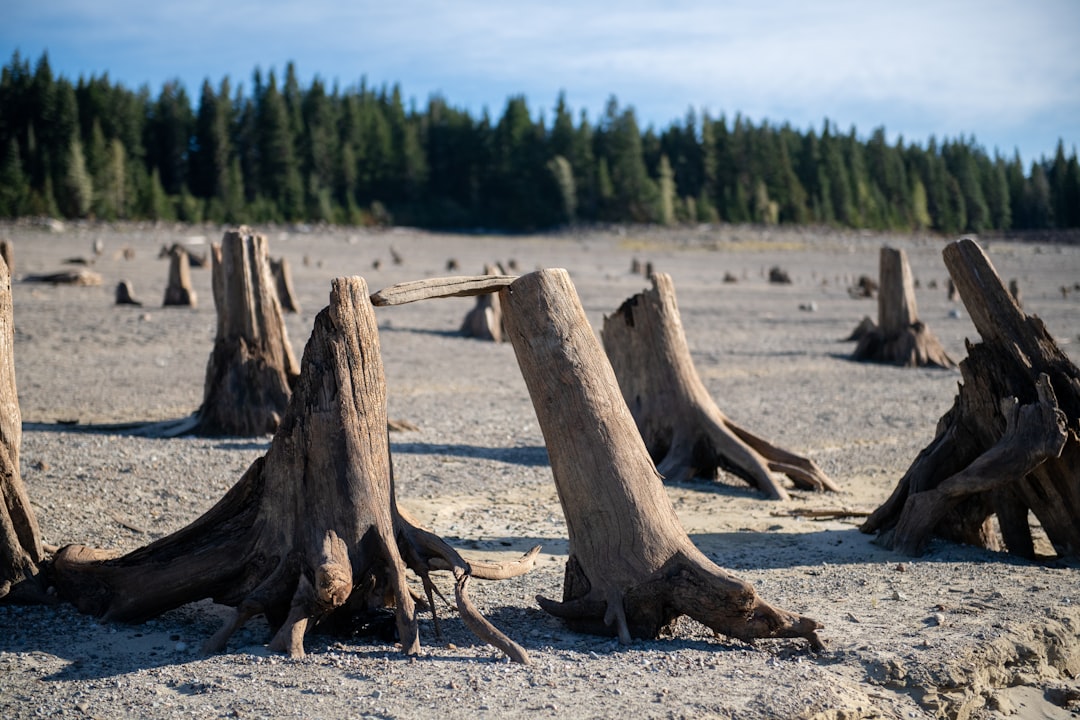
The ebb and flow of the ocean, a rhythm as old as time itself, has long captivated human curiosity and necessity. For coastal communities throughout history, understanding and predicting these tidal shifts was not merely an intellectual pursuit but a matter of survival, influencing fishing, trade, and travel. While sophisticated modern instruments now chart the ocean’s pulse, whispers of ancient methods persist, particularly the intriguing concept of “driftwood bands” as a rudimentary form of tide clock. While the scientific validity and widespread use of such a method remain subjects for exploration, the idea offers a fascinating glimpse into the ingenuity of our ancestors who sought to harness the ocean’s predictable, yet powerful, movements. Imagine a world where the shoreline itself was a giant timepiece, its markings etched by the very debris cast upon it by the sea.
The Ocean’s Unseen Hand: Tides and Human Adaptation
Driftwood bands, often found along coastlines, serve as fascinating natural indicators of time, much like ancient tide clocks that relied on the rhythmic ebb and flow of the ocean. These organic markers not only tell the story of the tides but also connect us to the broader historical context of maritime cultures. For a deeper understanding of how ancient civilizations interacted with their environments, you can explore the article on the geopolitical analysis of ancient empires at this link.
Understanding Tidal Cycles
Tides are the periodic rise and fall of sea levels, primarily caused by the gravitational forces exerted by the Moon and, to a lesser extent, the Sun. This gravitational pull, combined with the inertia of the water, creates bulges of water on opposite sides of the Earth. As the Earth rotates, different parts of the planet pass through these bulges, resulting in high and low tides. This celestial dance creates a predictable pattern, typically with two high tides and two low tides approximately every 24 hours and 50 minutes. The ‘extra’ 50 minutes arise because the Moon is also orbiting the Earth, meaning it takes slightly longer for the Earth to ‘catch up’ to the Moon’s position each day. Understanding this fundamental cycle was paramount for ancient mariners and coastal dwellers. The predictability, though not absolute due to various geographical and meteorological factors, was sufficient for many practical applications.
Early Navigation and Resource Management
Coastal populations throughout prehistory and antiquity relied heavily on the ocean for sustenance and commerce. Fishing expeditions, for instance, were often timed to coincide with specific tidal conditions, as certain fish species are more abundant or accessible during particular phases of the tide. The ebb tide could expose shellfish beds, while the flood tide might bring migratory fish closer to shore. Similarly, navigating shallow coastal waters or entering harbors often required knowledge of the tide’s height to avoid running aground. The precise timing of tides could also dictate when ships could be launched or beached, impacting trade routes and the movement of goods. Imagine a fisherman scanning the horizon, not just for the telltale signs of fish, but for subtle changes in the waterline, a silent indication of the ocean’s changing mood.
The Whispers of Ancient Technology: Driftwood Bands
Driftwood bands, often seen as ancient tide clocks, provide fascinating insights into the natural rhythms of coastal environments. These bands, formed by the layering of wood and sediment, can reveal historical changes in sea levels and tidal patterns. For those interested in exploring similar themes of ancient navigation and mapping, a related article discusses the intriguing aspects of historical cartography and its scientific implications. You can read more about it in this engaging piece that delves into the mysteries of the Piri Reis map and its significance in understanding our past.
Conceptualizing Driftwood as a Timekeeper
The concept of using driftwood bands as a tide clock suggests a method where the accumulation or displacement of driftwood along a specific stretch of coastline served as a visual indicator of tidal movement. Proponents of this idea posit that as the tide rises, it would deposit new layers of driftwood, or move existing debris further inland. Conversely, as the tide recedes, it would leave a distinct line of accumulated wood, marking the high tide line. Over successive tidal cycles, this accumulation could, in theory, create visible bands or markers on the beach. The size, type, and density of the driftwood would then form the ‘face’ of this natural clock. This would not be a precision instrument, of course, but rather a practical guide for immediate, localized tidal awareness. Think of it as a natural sundial, but instead of shadows, it uses the ocean’s relentless delivery system.
Variations and Potential Interpretations
The interpretation of “driftwood bands” could have varied significantly across different cultures and environments. In some areas, the focus might have been on the highest point the tide reached, marked by the uppermost debris. In others, it might have been on a distinct line of pebbles or shells interspersed with wood, left by the receding water. The presence of specific types of seaweed or marine organisms attached to the driftwood could also have provided additional layers of information about the duration or intensity of the tide. It is also possible that certain communities developed more sophisticated interpretations, observing the patterns of debris deposition over multiple tidal cycles. For example, they might have noted that a particular type of wave action, often associated with a specific tidal state, deposited a distinctive type of driftwood.
Archaeological and Anthropological Evidence: Seeking the Footprints
Challenges in Direct Archaeological Discovery
Direct archaeological evidence for the use of driftwood bands as intentional tide clocks is inherently difficult to find. Unlike stone tools or pottery fragments, driftwood is organic and prone to decomposition, erosion, and subsequent deposition by tides, wind, and currents. Any carefully arranged or marked driftwood would likely be dispersed or buried over time, leaving little to no traceable record. Furthermore, the “markers” themselves might have been ephemeral – simply a line in the sand or a temporary arrangement of debris. Without a clear artifact that demonstrably served this purpose, solid proof remains elusive. This is like trying to find a blueprint for a sandcastle that has long since been washed away.
Analogous Practices and Indirect Clues
Anthropological research into traditional coastal societies might offer indirect clues. Studies of communities that relied heavily on marine resources often detail their sophisticated understanding of the ocean’s rhythms, even if the exact mechanisms are not fully documented. Observing how indigenous peoples today utilize natural cues for navigation or resource gathering could provide analogous insights. For instance, some cultures have used the flight patterns of birds or the behavior of marine animals as indicators of tidal or weather conditions. While not directly driftwood bands, these practices highlight a reliance on observable natural phenomena for temporal understanding. The absence of direct evidence does not necessarily preclude the possibility, but rather emphasizes the need for creative interpretation of existing knowledge.
Potential Mechanisms and Methodologies
The Deposition and Erosion Process
The fundamental mechanism at play would involve the physical deposition of wood onto beaches by incoming tides and its subsequent displacement or leaving behind as the tide recedes. During high tide, waves would carry driftwood further up the beach. As the tide begins to ebb, the water level drops, leaving the driftwood stranded. Over time, consecutive high tides would create a layered effect, with newer deposits sitting atop older ones, provided the prevailing currents and wave action remained relatively consistent. Erosion and subsequent re-deposition would also play a role, constantly reshaping the beach and potentially obscuring older markers. The effectiveness of this method would be heavily dependent on the local topography, the consistency of wave energy, and the rate of driftwood accumulation.
Interpreting the “Bands”
The interpretation of these “bands” would require keen observation and a nuanced understanding of the local environment. A skilled observer might note differences in the color, size, or species of wood in different layers, indicating the passage of tidal cycles. The presence of seaweed, shells, or other debris trapped within the wood could also offer clues. For example, distinct bands of kelp deposited by a particularly strong high tide might be easily distinguishable from the smaller, more common driftwood fragments. Furthermore, the arrangement of the driftwood itself could be significant. Are there areas where the wood appears more deliberately placed or accumulated, suggesting a conscious human intervention? This would require a shift from passive observation to active interpretation, akin to reading a complex natural language.
Factors Influencing Accuracy and Reliability
Environmental Variability and Limitations
The reliability of driftwood bands as a tide clock would be significantly affected by environmental variability. Storm surges, for instance, could deposit large amounts of debris far beyond the typical high tide line, making it difficult to distinguish normal tidal markers from storm-induced accumulations. Seasonal changes in wave patterns and wind direction could also alter the deposition and distribution of driftwood. In areas with high rates of erosion or frequent coastal reshaping, any established “bands” could be quickly erased. The type and density of the coastline itself would also play a role; a rocky shore would likely accumulate driftwood differently than a sandy beach. Thus, any such tide clock would be inherently localized and subject to the vagaries of the immediate environment.
The Importance of Skilled Observation and Local Knowledge
The success of a driftwood band tide clock would ultimately hinge on the development of sophisticated observational skills and accumulated local knowledge. Individuals would need to learn to discern subtle patterns, understand the nuances of their particular coastline, and differentiate between natural processes and potential human-made markers. This knowledge would likely be passed down through generations, evolving and adapting to changing coastal conditions. It would be a deeply empirical system, honed by daily experience rather than abstract scientific principles. Imagine a seasoned elder teaching a younger generation, pointing out the subtle rustling of specific seaweed that accompanies a rising tide, or the way a particular type of driftwood always washes ashore with the midday ebb.
The Enduring Legacy and Modern Echoes
Beyond Simple Measurement: A Symbolic Connection
While the practical accuracy of driftwood bands as a tide clock may be debated, their conceptual significance is undeniable. They represent a profound human desire to find order and meaning in the natural world, to create tools and systems that facilitate coexistence with powerful forces like the ocean. The idea speaks to our ingenuity and our ability to observe and interpret our surroundings, even in the absence of advanced technology. It suggests a time when humanity was more intimately integrated with the natural rhythms of the planet, where the shoreline itself was a living, breathing calendar. This connection, even if largely metaphorical in modern times, continues to resonate. It’s a reminder that the largest and most complex systems can sometimes be understood through the simplest of observations.
Contemporary Relevance and the Spirit of Ingenuity
In an age of digital precision, the concept of driftwood bands serves as a humble reminder of the resourcefulness of our ancestors. It encourages us to look beyond the obvious and to consider the potential for information and guidance embedded in the natural world around us. While we may no longer rely on the beach for our primary timekeeping, the spirit of ingenuity embodied by such an idea remains relevant. It challenges us to think creatively about sustainable practices, to appreciate the subtle cues of the environment, and to recognize the deep well of knowledge that can be found in careful observation and a connection to the natural world. Perhaps, in some quiet corner of the world, someone still watches the driftwood, not for an exact hour, but for the comforting rhythm of the tide, a timeless echo of human ingenuity.
FAQs
What are driftwood bands and how do they form?
Driftwood bands are natural patterns or rings found in pieces of driftwood, created by the accumulation of wood layers over time. These bands form as trees grow and respond to environmental changes, and after the wood is carried by water and weathered, the bands become visible.
How can driftwood bands be used as ancient tide clocks?
Driftwood bands can serve as ancient tide clocks because their growth patterns may reflect tidal cycles and seasonal changes. By analyzing the spacing and characteristics of these bands, researchers can infer historical tidal rhythms and environmental conditions.
What scientific methods are used to study driftwood bands?
Scientists use dendrochronology (tree-ring dating), microscopy, and chemical analysis to study driftwood bands. These methods help determine the age of the wood, growth rates, and environmental influences recorded in the bands.
Why are driftwood bands important for understanding ancient environments?
Driftwood bands provide valuable information about past climate, sea levels, and tidal patterns. Studying these bands helps reconstruct ancient environmental conditions and understand how ecosystems and coastlines have changed over time.
Are driftwood bands reliable indicators of tidal cycles?
While driftwood bands can reflect tidal and seasonal influences, their reliability as precise tide clocks depends on various factors such as species, location, and preservation conditions. They are considered useful but should be corroborated with other geological and historical data.