The Sahara Desert, a name that evokes images of vast, undulating sand dunes stretching towards an endless horizon, is far more than just an arid expanse. It is a landscape steeped in millennia of shifting climates, human endeavor, and geological transformations. Its history is a complex tapestry woven from the threads of ancient oceans, lush savannas, and the relentless forces of nature, culminating in the extreme environment we recognize today. To understand the Sahara is to delve into a profound narrative of Earth’s dynamic past and the resilience of life in its most challenging forms.
The story of the Sahara’s transformation is fundamental to comprehending its current state. Billions of years ago, the landmass that now constitutes the Sahara was part of a supercontinent, Pangea. Over eons, tectonic plate movements broke apart this colossal landmass, and the region experienced significant geological upheavals. Mountain ranges rose and fell, and the very foundations of the land were reshaped. However, it is the more recent climatic shifts, occurring over hundreds of thousands of years, that truly sculpted the Sahara into its current form.
The African Humid Period: A Once-Green Sahara
Perhaps the most striking chapter in the Sahara’s history is its period as a verdant, life-sustaining region. For extended periods throughout the Quaternary era, primarily driven by Milankovitch cycles—long-term variations in Earth’s orbit—the Sahara was transformed into a region of lakes, rivers, and grasslands. These phases, known as the African Humid Periods, were characterized by increased monsoon rainfall, which lubricated the land and fostered thriving ecosystems.
The Role of Orbital Cycles
The Earth’s orbital parameters, including its axial tilt and the shape of its orbit around the sun, undergo predictable changes over tens of thousands of years. These variations, termed Milankovitch cycles, influence the amount and distribution of solar radiation reaching Earth’s surface. During specific orbital configurations, the Northern Hemisphere, including the Sahara, received more direct sunlight, leading to increased evaporation and a northward shift of the Intertropical Convergence Zone (ITCZ), the belt of clouds and rain that circles the globe. This increased moisture influx was the primary driver of the African Humid Periods.
Evidence of a Lush Past
The evidence of this forgotten Sahara is undeniable. Archaeological discoveries, notably rock art found in caves and shelters across the Sahara, offer vivid depictions of a lost world. These ancient paintings showcase a diverse fauna that once roamed the landscape, including giraffes, elephants, lions, crocodiles, and hippopotamuses – animals that are now entirely incompatible with the desert’s extreme aridity. Furthermore, geological surveys have revealed the fossilized remains of ancient lakebeds, river channels, and evidence of substantial groundwater reserves, all testament to a significantly wetter climate.
The Transition to Aridity
These humid periods were not permanent. As orbital configurations shifted, the amount of solar radiation decreased, and the ITCZ retreated southward. This led to a gradual drying of the landscape, the shrinking of lakes, and the eventual demise of the savanna ecosystems. The process of desertification, while appearing gradual on a geological timescale, was a profound transformation that dictated the fate of the region’s flora and fauna.
The history of the Sahara Desert is not only fascinating due to its ancient civilizations and trade routes but also because it provides critical insights into the current climate crisis. Understanding how the Sahara has changed over millennia can help us draw parallels to today’s environmental challenges. For a deeper exploration of these historical connections and their relevance to contemporary issues, you can read the article on historical parallels in the climate crisis at Learning from History: Historical Parallels in the Climate Crisis.
Early Human Migrations and Adaptations
The changing climate of the Sahara had a profound impact on early human populations. The transition from a verdant landscape to arid conditions spurred migrations, both within the region and out of it, and necessitated remarkable adaptations for survival.
The “Green Sahara” and Hunter-Gatherer Societies
During the African Humid Periods, the Sahara was a favorable environment for hunter-gatherer societies. Abundant game, plant life, and freshwater sources supported populations scattered across the vast landscape. These early inhabitants left behind lithic tools and archaeological sites that provide insights into their subsistence strategies and their intimate knowledge of the
environment.
The Great Sahara Exodus
As the climate began to dry, around 8,000 to 5,000 years ago, human populations were forced to adapt or migrate. Many moved towards more permanently humid zones, such as the Nile Valley or the Sahelian region to the south. This period likely contributed to the dispersal of early human groups across Africa and potentially beyond, playing a crucial role in the peopling of the continent.
Domestication and New Lifestyles
In areas where water remained accessible, or where people developed innovative ways to access it, new lifestyles emerged. The domestication of animals, particularly cattle, became increasingly important as societies transitioned to more mobile pastoralism. Evidence suggests that cattle were domesticated in the Sahara during the early Holocene, and their presence is often depicted in the aforementioned rock art, highlighting their significance in early Saharan cultures and economies.
The Rise of Trans-Saharan Trade and Civilizations
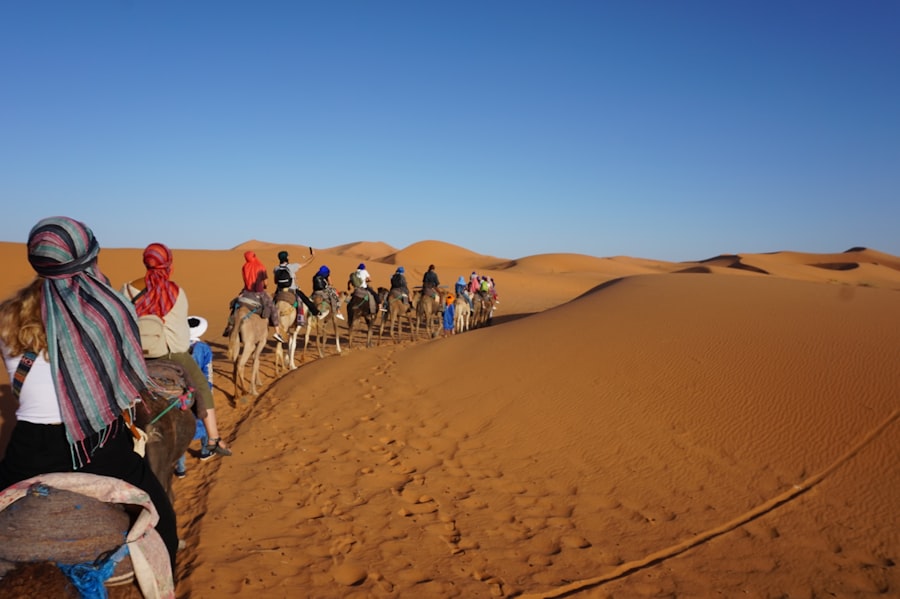
As the Sahara solidified into its arid form, it did not become an impenetrable barrier. Instead, it transformed into a challenging but navigable expanse, fostering the development of complex trade networks and powerful civilizations that harnessed its unique challenges and opportunities.
Nomadic Cultures and Oasis Settlements
The Sahara’s aridity favored the development of nomadic and semi-nomadic cultures, adept at traversing vast distances in search of pasture and water. Groups like the Tuareg, with their distinctive indigo robes and mastery of camel husbandry, became synonymous with the desert landscape. Alongside these mobile peoples, oasis settlements emerged as crucial nodes of human activity. These fertile pockets, sustained by underground water sources, provided vital stops for travelers and became centers of agriculture and commerce.
The Camel: A Desert Revolution
The introduction and widespread adoption of the camel were revolutionary for trans-Saharan travel. Their physiological adaptations, including the ability to withstand extreme heat, conserve water, and traverse sandy terrain, made them the indispensable mode of transport for long-distance journeys across the Sahara. This facilitated trade and communication on an unprecedented scale.
The Dawn of Trans-Saharan Trade Routes
From antiquity onwards, the Sahara became crisscrossed by a complex network of trade routes. These routes connected North Africa with sub-Saharan Africa, facilitating the exchange of goods such as salt, gold, slaves, ivory, textiles, and manufactured items. This trade was not merely an economic endeavor; it was a conduit for cultural exchange, the spread of ideas, and the diffusion of technologies.
The Garamantes Kingdom
One of the most remarkable civilizations to emerge in the Sahara was the Garamantes, who flourished in present-day Libya from roughly 500 BCE to 700 CE. They developed sophisticated irrigation systems, including subterranean channels known as foggaras, to cultivate crops in the harsh desert environment. Their capital, Garama, was a significant trading center, and their influence extended across large swathes of the central Sahara.
The Gold of Ghana and Mali Empires
Further south, the Ghana Empire (c. 300-1240 CE) and its successor, the Mali Empire (c. 1235-1670 CE), rose to prominence on the back of control over trans-Saharan gold routes. Gold, mined from sources in West Africa, was traded northwards for salt, a commodity as valuable as gold in the ancient world due to its essential role in preserving food and in human physiology. These empires amassed considerable wealth and political power, their fortunes intrinsically linked to the desert’s economic potential.
The Sahara in the Age of Exploration and Colonialism
The Sahara’s allure and strategic importance did not diminish with the advent of new global powers. The Age of Exploration and subsequent colonial expansion brought new forces to bear upon the desert and its inhabitants, leading to further transformations and conflicts.
European Encounters and Exploration
European explorers, driven by curiosity, scientific interest, and economic ambition, began to penetrate the Sahara in earnest from the 18th century onwards. Figures like Mungo Park and René Caillié ventured into the interior, charting unknown territories and documenting the lives of Saharan peoples. These expeditions, though often perilous, contributed significantly to Europe’s geographical understanding of the continent.
The Scramble for Africa and Saharan Territories
The late 19th century witnessed the “Scramble for Africa,” a period of intense European colonization. Major European powers, including France, Britain, Spain, and Italy, carved up the continent, and the Sahara was no exception. France, in particular, established a vast colonial domain in North and West Africa, encompassing much of the Sahara.
Colonial Administration and its Impact
Colonial administrations imposed new political boundaries, often disregarding existing ethnic and tribal divisions. They sought to exploit the Sahara’s resources and strategic locations, often with little regard for the indigenous populations. The imposition of new taxation systems, the disruption of traditional trade routes, and forced labor practices had profound and often detrimental effects on Saharan communities.
Resistance and Rebellion
Saharan peoples resisted colonial rule in various ways, from passive resistance to armed rebellion. The Tuareg, for example, mounted significant uprisings against French authority for decades. These conflicts highlight the enduring spirit of resistance among the peoples of the Sahara and their determination to maintain their autonomy in the face of external domination.
The history of the Sahara Desert is a fascinating subject that reveals much about the changing climate and human civilization over thousands of years. From ancient trade routes to the impact of colonialism, the Sahara has played a significant role in shaping the cultures of North Africa. For those interested in exploring how historical events influence modern geopolitics, a related article discusses the complexities of international relations in a different context, specifically focusing on space exploration. You can read more about it in this insightful piece on Russia’s role in the new moon race.
The Modern Sahara: Challenges and Future Prospects
“`html
| Time Period | Key Events |
|---|---|
| Neolithic Period | Early human settlements and rock art |
| Ancient Times | Trade routes, rise of ancient civilizations |
| Medieval Era | Spread of Islam, trans-Saharan trade |
| Colonial Period | European exploration and colonization |
| Modern Times | Environmental challenges, conservation efforts |
“`
In the contemporary era, the Sahara continues to be a region of immense significance, facing a complex interplay of environmental, political, and socio-economic challenges. Yet, it also holds potential for innovation and development, particularly in the realm of renewable energy.
Environmental Challenges and Climate Change
The Sahara, like much of the world, is increasingly susceptible to the impacts of climate change. Rising global temperatures can exacerbate already extreme heat, further reducing water availability and impacting delicate ecosystems. Desertification, a long-standing process, can be accelerated by these changes, posing a threat to agricultural lands and nomadic livelihoods.
Water Scarcity and Management
Water scarcity remains the defining challenge for human and ecological survival in the Sahara. Managing existing water resources, both surface and groundwater, is paramount. Innovative technologies for water conservation, desalination, and efficient irrigation are crucial for sustaining populations and supporting agriculture in this arid environment.
Geopolitical Significance and Resource Potential
The Sahara occupies a strategically important location, bridging North Africa, West Africa, and the Middle East. Its vast expanse holds significant mineral resources, including oil, natural gas, and phosphates, which have attracted international attention and investment. The discovery of these resources has brought both opportunities and challenges, often leading to geopolitical tensions and debates over resource distribution.
The Quest for Renewable Energy
The Sahara’s immense solar potential has made it a prime candidate for large-scale solar energy development. Projects like the Noor Ouarzazate Solar Power Station in Morocco are pioneering efforts to harness the sun’s energy to power both local communities and potentially export electricity to Europe. This represents a significant opportunity to transition towards a more sustainable energy future and mitigate the impacts of climate change.
Cultural Heritage and Preservation
Despite the harshness of the environment, the Sahara is rich in cultural heritage, from ancient rock art sites to the traditions of its indigenous peoples. Preserving this heritage, including languages, art forms, and nomadic lifestyles, is vital for understanding the region’s past and fostering cultural diversity for the future. The challenges of preservation are often exacerbated by the remoteness of many sites and the impacts of climate change and human activity.
The history of the Sahara Desert is a testament to the planet’s ever-changing nature and the enduring adaptability of life. From its watery past to its current arid grandeur, this vast landscape has witnessed the rise and fall of civilizations, the ebb and flow of human migrations, and the profound impact of climatic shifts. As the Sahara navigates the complexities of the 21st century, its future will undoubtedly be shaped by both the challenges it faces and the innovative solutions it embraces, continuing its long and fascinating story.

The Ancient World Buried Beneath the Sahara
FAQs
1. What is the Sahara Desert?
The Sahara Desert is the largest hot desert in the world, covering an area of approximately 3.6 million square miles across North Africa. It is characterized by its vast sand dunes, rocky plateaus, and sparse vegetation.
2. How old is the Sahara Desert?
The Sahara Desert is believed to have formed around 2-3 million years ago, during the late Miocene epoch. It was once a lush and fertile region, but gradually transformed into the arid desert landscape we see today.
3. What is the history of human habitation in the Sahara Desert?
The Sahara Desert has a long history of human habitation, dating back to prehistoric times. Ancient rock art and archaeological evidence suggest that early humans lived in the region as far back as 10,000 years ago. Over the centuries, various civilizations, such as the Berbers, Phoenicians, and Romans, have inhabited and traversed the desert.
4. How has the Sahara Desert’s climate changed over time?
The Sahara Desert’s climate has undergone significant changes over the millennia. It is believed that the region was once a savanna with abundant flora and fauna. However, due to natural climate fluctuations and human activities, the Sahara gradually transformed into a desert environment, experiencing periods of both extreme aridity and more temperate conditions.
5. What are some notable historical events and landmarks in the Sahara Desert?
The Sahara Desert has been the site of several notable historical events, including trade routes that connected sub-Saharan Africa with the Mediterranean region, as well as the spread of Islam across North Africa. Additionally, the desert is home to iconic landmarks such as the ancient city of Timbuktu, the rock formations of Tassili n’Ajjer, and the historic oasis towns of the Libyan Desert.