The Khmer Empire, a civilization that once dominated Southeast Asia, stands as a testament to human ingenuity, architectural prowess, and sophisticated societal organization. Its ascendance from humble beginnings to a sprawling imperial power, centered around the magnificent city of Angkor, is a saga of ambition, innovation, and ultimately, decline. Understanding its rise requires delving into the foundational elements that propelled its growth and the strategic brilliance that cemented its dominance.
Foundations of Power: From Local Kingdoms to Imperial Ambition
The seeds of the Khmer Empire were sown in the fertile lands of what is now Cambodia, a region rich in water resources and strategically positioned along vital trade routes. Before the empire’s consolidation, the area was characterized by numerous smaller kingdoms, often vying for influence and resources. The unification of these disparate entities under a single banner was a monumental undertaking, requiring strong leadership and the ability to forge alliances.
The Role of Jayavarman II: The Great Unifier
The historical consensus points to Jayavarman II as the pivotal figure in the founding of the Khmer Empire. Emerging in the early 9th century CE, he is credited with initiating a process of unification that laid the groundwork for imperial expansion. His reign is particularly significant for its religious reforms and the strategic assertion of independence from Javanese overlords, a common practice at the time.
The Geopolitical Landscape of the Early 9th Century
To appreciate Jayavarman II’s achievements, it’s crucial to understand the regional dynamics of the era. Southeast Asia was a complex mosaic of kingdoms, with influences from India and China shaping political and cultural landscapes. The Majapahit Empire in Java, and various Mon-Khmer kingdoms, were prominent players. Jayavarman II’s success lay in his ability to navigate these often turbulent waters, asserting Khmer sovereignty and laying the foundation for a distinct Khmer identity.
The Symbolic Act of Devaraja: Divine Kingship
A defining moment in Jayavarman II’s reign was the establishment of the devaraja cult. This doctrine elevated the king to a semi-divine status, linking his authority to Shiva, a principal Hindu deity. The ritualistic enshrinement of a lingam on Mount Kulen in 802 CE marked the declaration of an independent kingdom, free from foreign influence. This concept of divine kingship provided a powerful ideological framework, fostering loyalty, and legitimizing the ruler’s absolute power, which was essential for mobilizing resources and consolidating authority.
The Importance of Irrigation and Agriculture
The economic backbone of any burgeoning empire is its ability to sustain its population and generate surplus. For the Khmer, this was facilitated by a revolutionary approach to water management. The intricate network of canals, reservoirs, and barays, developed and expanded over centuries, allowed for unprecedented agricultural productivity.
The Ingenuity of the Baray System
The barays, massive rectangular reservoirs, were engineering marvels. These colossal bodies of water not only stored vast quantities of water for irrigation, particularly during the dry season, but also served to control floods during the monsoon season. Their construction required immense labor mobilization and sophisticated planning, showcasing the organizational capabilities of the early Khmer rulers.
Rice Cultivation: The Staple of Khmer Society
These advanced irrigation systems enabled intensive rice cultivation, which formed the cornerstone of the Khmer diet and economy. The ability to produce surplus rice meant a larger population could be supported, freeing up labor for monumental construction projects and military campaigns. This agricultural surplus also provided a basis for trade, both within the empire and with neighboring regions.
The history of the Khmer Empire is a fascinating subject that delves into the rise and fall of one of Southeast Asia’s most powerful civilizations. For those interested in exploring how trade dynamics have shaped various empires throughout history, a related article can provide valuable insights. You can read more about the shifting trade relationships in the modern world by visiting this link: Mexico Surpasses China as Top Trading Partner. This article highlights contemporary trade patterns that echo the historical significance of trade in the development of empires like the Khmer.
The Golden Age of Angkor: Architectural Splendor and Imperial Reach
The period from the 9th to the 15th centuries is largely synonymous with the Angkorian era, a time of unparalleled architectural achievement and imperial expansion. The capital city of Angkor became the spiritual and political heart of a vast empire, its temples and structures reflecting the immense wealth and power of its rulers.
The Majestic City of Angkor: A Planned Metropolis
Angkor was not merely a city; it was a meticulously planned urban center designed to embody the celestial order on earth. Its layout, its waterways, and its magnificent temples were all intended to reflect the grandeur of the Hindu and Buddhist cosmos.
The Urban Design and Infrastructure
The grandeur of Angkor was not confined to its religious monuments. The city was crisscrossed by a complex network of canals and causeways, facilitating movement and trade. The vast scale of the city and its infrastructure speaks volumes about the empire’s organizational capacity and the sheer manpower it could command.
Early Angkorian Temples: The Foundations of Grandeur
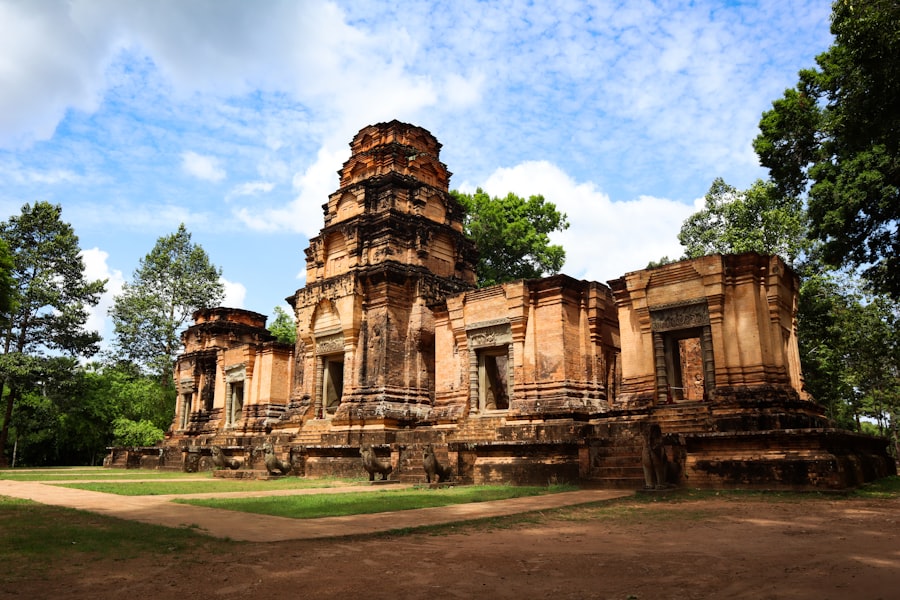
The early temples of Angkor, such as Preah Ko and Bakheng, showcased the evolving architectural styles and religious practices of the Khmer. These structures, while impressive, were precursors to the colossal and intricately carved masterpieces that would define the empire.
The Zenith of Architectural Achievement: Angkor Wat and Angkor Thom
The 12th century witnessed the construction of two of the most iconic structures in the world: Angkor Wat and Angkor Thom. These monumental complexes represent the peak of Khmer architectural and artistic achievement, reflecting both religious devotion and imperial ambition.
Angkor Wat: A Universe in Stone
Dedicated to Vishnu, Angkor Wat is the largest religious monument in the world. Its five lotus-bud towers, intricate bas-reliefs depicting Hindu epics and historical events, and its moat symbolize Mount Meru, the mythical abode of the gods. The sheer scale and artistry of Angkor Wat are awe-inspiring, a testament to the devotion and skill of its builders.
Angkor Thom: A City of Grand Statues and Bayon’s Enigma
Angkor Thom, built by Jayavarman VII, a devout Buddhist king, was the last and most enduring capital city of the Khmer Empire. Its centerpiece, the Bayon temple, is renowned for its enigmatic smiling faces that adorn its towers. This city, once bustling with life, now stands as a silent monument to a glorious past.
Expansion and Influence: A Dominant Regional Power
The Khmer Empire’s influence extended far beyond its capital. Through military might, diplomatic maneuvering, and cultural diffusion, it exerted dominance over a vast swathe of Southeast Asia.
Military Campaigns and Territorial Control
The Khmer military, while not always on the scale of later empires, was effective in securing its borders and expanding its territory. Campaigns were launched against neighboring kingdoms, including the Champa and the Dai Viet, solidifying Khmer control over key trade routes and strategically important regions.
Cultural Hegemony and Artistic Diffusion
The cultural influence of the Khmer Empire was profound. Khmer art, architecture, and religious practices spread to neighboring regions, leaving an indelible mark on the art and architecture of Thailand, Laos, and Vietnam. The dissemination of Sanskrit and Khmer script, along with the adoption of Indian religious and political concepts, further cemented its cultural dominance.
The Internal Dynamics of the Khmer Empire: Society, Religion, and Economy
The longevity and magnificence of the Khmer Empire were not solely due to military prowess or architectural genius. A complex societal structure, a dynamic interplay of religious beliefs, and a robust economy underpinned its success.
The Hierarchical Society and the Role of the King
Khmer society was rigidly hierarchical, with the divine king at the apex. Below him were the aristocracy, priests, merchants, artisans, and a large class of peasants who formed the backbone of the agricultural labor force.
The Power of the Priesthood and Religious Institutions
Religious institutions, both Hindu and later Buddhist, played a crucial role in Khmer society. Temples served not only as places of worship but also as centers of economic activity, education, and administration. The priesthood wielded considerable influence, often advising the king and managing vast temple estates.
The Peasantry and the Labor Force
The vast majority of the population consisted of peasants who toiled in the rice fields, their labor essential for the empire’s sustenance. The construction of monumental temples and irrigation systems relied heavily on their organized labor, often conscripted and managed through a system of corvée.
The Interplay of Hinduism and Buddhism
The religious landscape of the Khmer Empire was characterized by a dynamic and often syncretic blend of Hinduism and Buddhism. While Hinduism, particularly Shaivism and Vaishnavism, was dominant in the early period, Mahayana Buddhism gained prominence under rulers like Jayavarman VII.
The Influence of Indian Religions
The arrival of Indian traders and Brahmins brought with them Hindu deities, scriptures, and philosophical concepts, which were readily adopted and adapted by the Khmer elite. These religious beliefs provided both spiritual guidance and a framework for political legitimacy.
The Rise of Mahayana Buddhism
Jayavarman VII’s conversion to Mahayana Buddhism marked a significant shift. His reign saw the construction of numerous hospitals, rest houses, and the eventual transformation of Angkor Wat into a Buddhist temple. This shift reflects the evolving spiritual landscape and the ruler’s personal devotion.
The Economy of Empire: Trade, Agriculture, and Tribute
The Khmer economy was primarily agrarian, but it was also supported by a thriving system of trade and the collection of tribute from its vassal states.
Trade Routes and Mercantilism
The empire’s strategic location allowed it to participate in regional and intercontinental trade networks. Goods such as rice, spices, precious metals, and textiles were exchanged, contributing to the empire’s wealth and the cosmopolitan nature of its cities.
Tribute and Taxation
The collection of tribute from subordinate kingdoms and the imposition of taxes on its own population provided the state with the resources needed to fund its ambitious construction projects and maintain its army. This system of tribute collection was a crucial element in maintaining imperial dominance.
The Seeds of Decline: Internal Stresses and External Pressures
No empire, however grand, is immune to the forces of change and eventual decline. The Khmer Empire, after centuries of prosperity, began to experience a gradual weakening, a slow erosion of its power and influence that would ultimately lead to its fall.
Environmental Degradation and Resource Strain
The very systems that had sustained the empire’s growth eventually began to falter. The immense demands placed on the environment, coupled with natural climatic shifts, contributed to a decline in agricultural productivity.
The Over-Reliance on Irrigation Systems
While revolutionary, the extensive irrigation systems required constant maintenance and repair. A decline in the ability or willingness of the ruling elite to invest in these systems, perhaps due to financial constraints or a shift in priorities, could have led to their deterioration and a subsequent decrease in food production.
Climate Change and its Impact
There is growing evidence suggesting that the Khmer Empire may have been impacted by periods of prolonged drought and intense monsoons. These climatic fluctuations would have severely strained the agricultural systems and the ability of the empire to feed its population, leading to social unrest and weakening its overall stability.
Internal Strife and Leadership Issues
The cohesion of an empire is often dependent on strong and unified leadership. As the Khmer Empire matured, evidence suggests a growing internal fragmentation and perhaps a decline in the effectiveness of its rulers.
Succession Disputes and Court Intrigue
Periods of weak or contested succession could have led to internal power struggles and instability within the ruling elite. This internal friction would have diverted resources and attention from crucial matters of governance and defense.
The Shifting Religious Landscape and its Political Implications
The transition from a Hindu-dominated worldview to Buddhism, while representing a spiritual evolution, may have also had political implications. The massive investment in Buddhist temples and institutions, especially under Jayavarman VII, could have shifted economic priorities and potentially created new power bases that challenged the traditional authority structures.
The Khmer Empire, known for its remarkable architectural achievements and sophisticated society, has been the subject of extensive research and exploration. One fascinating aspect of historical cartography that can provide context to the understanding of ancient civilizations is the Piri Reis map, which offers insights into the geographical knowledge of its time. For those interested in the intersection of history and cartography, you can read more about this intriguing topic in the article found here. The Khmer Empire’s legacy continues to inspire curiosity and scholarly inquiry into the complexities of its culture and influence.
The Fall of Angkor: The End of an Era
The final centuries of the Khmer Empire were marked by a series of external invasions and internal weaknesses that gradually dismantled its power and led to the abandonment of its magnificent capital.
External Invasions and Shifting Power Dynamics
The rise of new powers in the region, particularly the Siamese kingdoms, posed a significant threat to the Khmer Empire. Repeated invasions and the loss of territory chipped away at its strength and prestige.
The Siamese Ascendancy and the Sack of Angkor
The Kingdom of Ayutthaya, a rising power to the west, launched increasingly successful incursions into Khmer territory. The repeated invasions culminated in the sacking of Angkor, an event that is often seen as the symbolic end of the Khmer Empire’s dominance. This devastating event, likely occurring in the 15th century, led to widespread destruction and the eventual abandonment of the capital.
The Loss of Trade Dominance and Economic Decline
As the empire weakened, its control over lucrative trade routes diminished. The rise of maritime trade and the growing influence of European powers further marginalized the land-based Khmer Empire, contributing to its economic decline.
The Abandonment of Angkor and the Rise of Successor States
The sack of Angkor and the subsequent decline in resources and security led to the gradual abandonment of the capital. The Khmer people dispersed, establishing new centers of power in different regions, marking the end of an era and the fragmentation of the once-mighty empire.
The Khmer Diaspora and Cultural Survival
Despite the fall of Angkor, the Khmer people and their rich cultural heritage did not disappear. The surviving Khmer kingdoms, though diminished in power, continued to preserve their traditions, language, and religious practices. The legacy of Angkor endured in the collective memory and the continued artistic expressions of the Khmer people.
The Enduring Legacy of Angkor
The ruins of Angkor, though now a UNESCO World Heritage site and a major tourist destination, are more than just archaeological marvels. They are a profound testament to the ingenuity, ambition, and artistry of a civilization that once stood at the pinnacle of its power. The rise and fall of the Khmer Empire serves as a compelling historical narrative, offering insights into the complexities of empire-building, the dynamics of societal change, and the enduring power of human achievement.

The Machine That Kept Angkor Alive
FAQs
1. What was the Khmer Empire?
The Khmer Empire was a powerful state in Southeast Asia, centered in present-day Cambodia. It existed from approximately the 9th to the 15th century and was known for its impressive architecture, particularly the famous temple complex of Angkor Wat.
2. What were the major achievements of the Khmer Empire?
The Khmer Empire was known for its advancements in art, architecture, and engineering. The construction of massive temple complexes like Angkor Wat and Bayon, as well as extensive irrigation systems, are among its most notable achievements.
3. What led to the decline of the Khmer Empire?
The decline of the Khmer Empire is attributed to a combination of factors, including environmental degradation, political instability, and invasions from neighboring states. The empire gradually lost power and influence, eventually leading to its collapse in the 15th century.
4. What is the significance of the Khmer Empire in history?
The Khmer Empire is significant for its cultural and architectural legacy, particularly the stunning temples that still stand as a testament to its achievements. It also played a crucial role in shaping the history and culture of Southeast Asia.
5. What is the legacy of the Khmer Empire today?
The legacy of the Khmer Empire can be seen in the rich cultural heritage of Cambodia, including its language, customs, and religious traditions. The temple complexes of Angkor continue to be a source of national pride and a major tourist attraction.