The Mississippi River, a ribbon of life carving through the American heartland, has witnessed the rise and fall of civilizations. Yet, none capture the imagination quite like Cahokia, a sprawling metropolis that once dominated the landscape near present-day St. Louis. At its zenith, Cahokia was a bustling hub of activity, a testament to the ingenuity and organizational prowess of the Mississippian culture. Among its many monumental constructions, one enigmatic feature stands out: Woodhenge. More than just a collection of posts, this sophisticated arrangement of wooden timbers is increasingly understood as Cahokia’s ancient astronomical calendar, a celestial clock that governed the rhythms of life for its inhabitants.
The Enigma of Cahokia: A Lost Civilization Rediscovered
Cahokia, a UNESCO World Heritage site, was not a single settlement but a vast urban center encompassing an estimated 20,000 people at its peak, around 1100 CE. The scale of its construction is staggering. Dominating the landscape was Monk’s Mound, a colossal earthen pyramid larger at its base than the Great Pyramid of Giza. Surrounding it were hundreds of smaller mounds, plazas, and residential areas, all meticulously planned and interconnected. For centuries, the existence of such a complex society in North America was met with disbelief, often attributed to foreign colonizers or mythical races. However, archaeological evidence has firmly established the indigenous Mississippian people as the architects of this remarkable city.
The Rise of a Mississippian Metropolis
The Mississippian culture, which flourished from roughly 800 to 1600 CE, was characterized by its advanced agricultural practices, complex social hierarchies, and monumental earthwork construction. Cahokia emerged as the undisputed political and religious center of this widespread culture. Its influence extended across a vast territory, shaping the beliefs and practices of numerous communities. The reasons for Cahokia’s eventual decline remain a subject of scholarly debate, with theories ranging from environmental degradation to social unrest.
Unearthing the Secrets: The Role of Archaeology
The rediscovery and ongoing excavation of Cahokia have been a painstaking process, revealing layer upon layer of history. Early investigations, often driven by a desire to find evidence of “lost white tribes,” were marred by destructive practices. However, modern archaeological techniques, employing meticulous excavation, radiocarbon dating, and sophisticated mapping, have provided a far more nuanced and accurate understanding of Cahokian life. It is through this lens that the significance of Woodhenge has begun to crystallize.
The Woodhenge at Cahokia is an intriguing archaeological site that serves as a prehistoric calendar, showcasing the advanced understanding of astronomy by the Mississippian culture. For those interested in exploring how ancient civilizations utilized natural phenomena for their societal structures, a related article discussing the implications of government actions on property rights can be found here: Is Real Estate Safe from Government Seizure?. This article provides insight into modern-day issues of land ownership and government intervention, drawing a parallel to the historical significance of land and its use in ancient cultures.
Woodhenge Revealed: A Circle of Celestial Significance
The story of Woodhenge’s discovery is as fascinating as its purpose. In the 1960s, archaeologist Warren L. Wittry, while examining aerial photographs of the Cahokia site, noticed a series of circular depressions. These depressions, arranged in a near-perfect circle, suggested the former presence of large wooden posts. Subsequent excavations confirmed Wittry’s suspicions, unearthing post molds that indicated a large, circular structure composed of numerous upright timbers.
The Discovery and Reconstruction
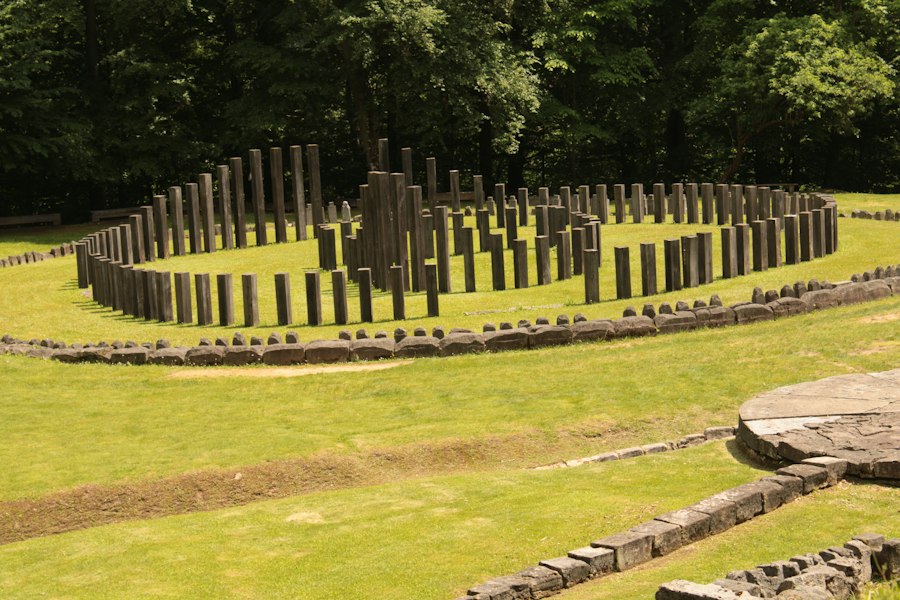
Wittry’s initial work identified a central post and 47 outer posts, forming a circumference of approximately 400 feet. The spacing between the posts was not uniform, hinting at a deliberate arrangement. Based on the preserved post molds, archaeologists were able to hypothesize the original size and placement of the timbers. This led to the ambitious project of reconstructing a portion of Woodhenge, a tangible reminder of Cahokia’s past that visitors can experience today. The reconstruction, while a valuable educational tool, is an approximation based on the available evidence, as the original wooden posts have long since decayed.
The Purpose of the Circle: Beyond mere Structure
The circular arrangement of posts immediately sparked questions about Woodhenge’s function. Early theories ranged from a ceremonial space to a defensive palisade. However, the precise alignment of certain posts with significant astronomical events began to point towards a more profound purpose: that of an astronomical observatory and calendar.
Celestial Alignments: Reading the Sky at Cahokia
The key to understanding Woodhenge lies in its careful alignment with the movements of the sun. Archaeologists and archaeoastronomers have meticulously studied the post positions and their relationship to the horizon. The results are compelling, revealing a sophisticated understanding of celestial mechanics and a system designed to track the passage of time and seasons.
The Solstices: Anchors of the Calendar
The most striking alignments at Woodhenge are with the summer and winter solstices. The sunrise on the summer solstice, the longest day of the year, is precisely framed by two specific posts. Similarly, the winter solstice sunrise, the shortest day, is marked by another pair. These alignments would have provided the Cahokians with unambiguous markers for the turning points of the year, signals that likely dictated agricultural cycles, ceremonial practices, and important societal gatherings.
Equinoxes and Other Celestial Events
While the solstices are the most prominent, evidence suggests that Woodhenge was also used to track other celestial phenomena. The equinoxes, when day and night are of equal length, are also believed to be marked by specific post alignments. Furthermore, the precise spacing of some posts may have allowed for the observation of lunar cycles or the heliacal rising of certain stars, though these interpretations are more speculative and require further investigation.
The Cahokian Calendar: A Rhythm of Life
The astronomical observations made at Woodhenge were not abstract scientific pursuits. They were deeply integrated into the daily lives and spiritual beliefs of the Cahokian people. The calendar served as a unifying force, providing a shared understanding of time and its significance.
Agricultural Cycles and Sustenance
The success of any agrarian society is intrinsically linked to understanding the seasons. Woodhenge would have provided crucial information for planting, harvesting, and managing agricultural resources. The predictable arrival of the solstices and equinoxes would have signaled the optimal times for various farming activities, ensuring the sustenance of Cahokia’s large population.
Religious and Ceremonial Practices
The celestial events tracked by Woodhenge were undoubtedly intertwined with Cahokian religious beliefs. The solstices and equinoxes, with their inherent symbolism of change, renewal, and balance, likely formed the basis of many important ceremonies and festivals. The precise timing of these events would have been crucial for maintaining cosmic harmony and appeasing the divine.
Social Organization and Governance
Beyond agriculture and religion, Woodhenge may have also played a role in the social and political organization of Cahokia. The shared knowledge and observance of celestial events could have fostered a sense of community and collective identity. Important societal decisions, such as the timing of major festivals or political gatherings, could have been guided by the astronomical calendar.
The Woodhenge at Cahokia is a fascinating example of how ancient civilizations utilized their environment to create complex calendars and astronomical alignments. This remarkable structure, made of wooden posts, served as a solar calendar, helping the Cahokians track the changing seasons and plan agricultural activities. For those interested in exploring more about the innovations of ancient cultures, you can read a related article that delves into the technological advancements of lost civilizations. This article provides insights into how these societies, much like the Cahokians, harnessed their surroundings to develop sophisticated systems. You can find it here: uncovering ancient tech.
The Legacy of Woodhenge: A Testament to Ancient Wisdom
Woodhenge stands as a powerful testament to the intellectual and observational capabilities of the Mississippian people. It challenges preconceived notions about pre-Columbian North America and highlights the sophisticated scientific understanding that existed long before European arrival. The ongoing study of Woodhenge continues to yield new insights, solidifying its place as one of the most significant archaeoastronomical sites in the world.
Enduring Mysteries and Future Research
While much has been learned about Woodhenge, its mysteries are far from fully unlocked. The exact number of posts and their precise functions are still debated, and the possibility of other celestial observations beyond solar events remains an area of active research. Future archaeological investigations and the application of advanced analytical techniques will undoubtedly shed further light on the intricacies of this ancient calendar.
A Window into a Lost World
Woodhenge is more than just a collection of post molds; it is a window into the minds of a sophisticated ancient civilization. It reveals a people deeply connected to the cosmos, who meticulously observed the heavens and integrated that knowledge into every aspect of their lives. By unlocking the mysteries of Woodhenge, we gain a deeper appreciation for the ingenuity, complexity, and enduring legacy of Cahokia and the Mississippian culture. It serves as a poignant reminder that the story of human achievement is not confined to a single continent or a single era, but is a rich tapestry woven across time and space. The silent stones of Woodhenge, illuminated by the rising and setting sun, continue to whisper tales of a world long past, a world that understood the profound connection between the earth and the stars.

A City Bigger Than London Once Stood in America. Then It Vanished.
FAQs
What is Woodhenge at Cahokia?
Woodhenge at Cahokia is a circular arrangement of wooden posts located in Cahokia, Illinois. It was likely used as a calendar or astronomical observatory by the Mississippian culture around 1,000 years ago.
How was Woodhenge used as a calendar?
Woodhenge is believed to have been used to track the movements of the sun and moon. The posts were aligned with the sunrise and sunset during the solstices and equinoxes, allowing the ancient people to mark the changing seasons and agricultural cycles.
What is the significance of Woodhenge at Cahokia?
Woodhenge is significant because it provides evidence of the advanced astronomical knowledge and cultural sophistication of the Mississippian people. It also demonstrates their ability to create and use complex calendars for agricultural and ceremonial purposes.
How was Woodhenge discovered?
Woodhenge was discovered in the 1960s during excavations at Cahokia by archaeologists. The circular arrangement of wooden posts was found buried beneath the earth, and its purpose as a calendar or astronomical observatory was later determined through further research and analysis.
Can visitors see Woodhenge at Cahokia today?
Yes, visitors to Cahokia Mounds State Historic Site can see a reconstructed version of Woodhenge. The site also features interpretive panels and guided tours that provide information about the history and significance of Woodhenge and the Mississippian culture.