For generations, the surname Miller had been a constant thread in the tapestry of Sarah’s family history. She knew the names of her grandparents, great-grandparents, and even some distant ancestors, piecing together their stories through faded photographs, worn journals, and oral traditions passed down through the matriarchs of the family. Yet, a nagging curiosity always lingered, a sense that a piece of the puzzle was missing, a branch on the family tree that remained shrouded in obscurity. This feeling, shared by many who delve into their ancestry, would eventually lead her down a path illuminated by the most fundamental code of life itself: DNA.
The Spark of Inquiry: A Long-Held Question
Sarah’s quest for understanding wasn’t born of a sudden impulse, but rather a slow burn fueled by inconsistencies and unanswered questions. Her maternal grandmother, Eleanor, often spoke of a beloved aunt who had passed away young, before Sarah was born. Her name was always mentioned with a wistful sigh, a touch of sadness that suggested a deeper, perhaps unspoken, narrative. Eleanor would recall shared childhood memories, but the details were often vague, the aunt’s life story seemingly truncated. There were no surviving siblings from that generation to offer concrete details, and the older generations who might have known more had long since passed.
The Unspoken Absence
The absence of extensive family lore surrounding this aunt was, in itself, a curious phenomenon. While other branches of the family tree were rich with stories, anecdotes, and even photographs, information about this particular aunt was scarce. Sarah had scoured her grandmother’s belongings, poring over dusty photo albums and old letters, but found little beyond a few faded portraits and brief mentions in diaries. This lack of tangible evidence created a void, a gap in the narrative that Sarah felt compelled to fill. It was more than just a genealogical curiosity; it felt like a personal responsibility to honor this forgotten relative.
The Allure of Genetic Genealogy
The rise of direct-to-consumer DNA testing offered a new and tantalizing avenue for genealogical research. Initially, Sarah viewed it as a tool to confirm existing lines of descent or to connect with distant cousins. She had performed a DNA test a few years prior, primarily out of curiosity, and had a growing list of matches. However, the mystery surrounding her grandmother’s aunt continued to niggle at her. Could DNA, the very blueprint of life, hold the key to unlocking this decades-old secret? The idea, once considered a fanciful notion, began to take root.
Recent advancements in DNA analysis have revealed previously undocumented relationships, shedding light on the intricate connections within families and communities. This fascinating development is part of a broader exploration of how technology can enhance our understanding of human connections. For those interested in the intersection of technology and defense, a related article discusses the role of artificial intelligence in autonomous space defense, highlighting how innovative technologies are shaping our future. You can read more about it here: AI’s Role in Autonomous Space Defense.
Embarking on the DNA Journey: Testing and Analysis
Sarah decided to take a more targeted approach to her DNA journey. She knew that to uncover potentially undocumented ties, she would need to delve deeper than a general ancestry search. This meant not only testing herself but also considering the possibility of testing other close relatives, particularly those on her maternal grandmother’s side of the family, where the mystery resided.
Expanding the Genetic Pool
Sarah encouraged her mother to take a DNA test. While her mother’s results would largely mirror her own, having a second close relative tested could help to differentiate between shared maternal and paternal DNA segments, a crucial step in isolating specific lines of descent. Furthermore, it offered the potential for discovering unexpected matches on her mother’s side that Sarah might not have otherwise encountered. The process was straightforward, involving simple saliva samples mailed back to the testing company.
The Waiting Game and Initial Discoveries
The weeks that followed were filled with anticipation. As the DNA results began to trickle in, Sarah meticulously studied her match lists. She was already connected with numerous cousins on known branches of her family tree. However, there was a cluster of matches, particularly on her maternal side, that seemed to be outliers. These individuals shared a significant amount of DNA with her and her mother, yet their stated family trees did not align with any known branches of the Miller lineage or their closely related families.
Unfamiliar Surnames Emerge
As Sarah reached out to these new matches, a pattern began to emerge. Many of them shared surnames that were entirely unfamiliar to her family’s known history. Surnames like “Anderson,” “Hayes,” and “Thompson” started appearing with increasing frequency in the family trees provided by these DNA matches. This immediately suggested a connection that was not recorded in her family’s traditional genealogical research.
The Crucial Triangulation
The key to deciphering these new connections lay in the concept of “triangulation.” This is a fundamental principle in genetic genealogy where three or more individuals share identical DNA segments inherited from a common ancestor. By comparing her DNA with her mother’s, and then with the DNA of these new matches, Sarah could identify shared segments. If Sarah and a new match shared a DNA segment, and her mother also shared that same segment, it indicated that the segment was inherited from Sarah’s maternal grandmother. This process was instrumental in narrowing down the potential ancestral line.
Following the Genetic Breadcrumbs: Piecing Together the Narrative
The initial triangulation results were both exciting and perplexing. The shared DNA segments pointed to a common ancestor, but who was this person? And how did they connect to the Miller family? Sarah’s traditional research had yielded no obvious candidates. This was where the real detective work began, painstakingly cross-referencing genealogical records with the clues provided by DNA.
The Anderson Connection: A Surprising Revelation
One particular DNA match, a woman named Carol, stood out. Carol’s family tree prominently featured the surname Anderson. Carol mentioned that her paternal grandmother was born in the same small town as Sarah’s maternal grandmother, a town that had been a focal point of Sarah’s own research. Carol’s grandmother, a woman named Margaret Anderson, had a brother named John Anderson. The dates of birth and death for John Anderson were in a range that piqued Sarah’s interest, and a quick search of local records revealed that Margaret Anderson had a sister who passed away in childhood. This sister’s name was Elizabeth.
The “Lost” Aunt Reappears
Sarah’s heart began to pound. Elizabeth Anderson. The name echoed faintly in her grandmother Eleanor’s stories. Eleanor had spoken of a beloved aunt named Elizabeth, who had died young. Could this Elizabeth Anderson be the same person? The dates of birth and death of Elizabeth Anderson, as found in genealogical databases, eerily aligned with the vague recollections of Eleanor’s aunt.
The Hayes and Thompson Intersect
Further investigation into Carol’s Anderson family tree revealed a marriage between Margaret Anderson’s parents, William and Mary Anderson. Mary Anderson’s maiden name was Hayes. And William Anderson’s sister, Sarah, had married a man named Thompson. Suddenly, the other unfamiliar surnames began to fall into place. The Hayes and Thompson families were not entirely alien; they were connected to the Anderson family, which now seemed to be the missing link.
Untangling the Interwoven Branches
Sarah meticulously traced the Hayes and Thompson lines backward, looking for any connections to her own known family history. She found that the Hayes family had intermarried with other families in the same geographical region where her maternal grandmother’s ancestors had lived. The Thompsons also had a presence in that area. The puzzle was becoming clearer: it wasn’t a single undocumented ancestor, but rather a series of interconnected families through marriages and births that had somehow been lost to time in her family’s oral history and written records.
The Unforeseen Marriage: A Hidden Union
The DNA evidence strongly suggested a direct maternal line connection. The shared segments were significant enough to indicate a close relationship, likely an aunt or great-aunt. The consistent appearance of the Anderson surname, and the tentative identification of an “Elizabeth Anderson” with dates that matched Eleanor’s lost aunt, became the focal point of Sarah’s intense research. The question then became: how did Elizabeth Anderson, and the Anderson family, connect to Sarah’s known Miller lineage?
The Miller and Anderson Crossroads
Sarah painstakingly combed through marriage records, birth certificates, and census data for the relevant time periods and geographical locations. She was looking for a marriage between an Anderson and a Miller, or a closely related family that had later married into the Millers. It was a tedious process, filled with dead ends and false leads. However, by cross-referencing the individuals mentioned in Carol’s Anderson family tree with the Miller family records, a surprising discovery emerged.
A Secret Vow: The Marriage Certificate
Sarah found a marriage certificate for a Mr. Robert Miller and a Miss Elizabeth Anderson, dated in the early 20th century. Robert Miller was the son of Sarah’s great-grandfather, William Miller. Elizabeth Anderson was indeed the younger sister of Margaret and John Anderson, the very Elizabeth who Eleanor had spoken of with such sadness. The marriage had been largely forgotten, or perhaps intentionally omitted, from family lore. There was no photographic evidence, no mention in family letters, and the children of Robert and Elizabeth were not readily apparent in existing family trees.
The Children of Robert and Elizabeth: A Silent Generation
The discovery of the marriage certificate opened up a new line of inquiry: the children of Robert Miller and Elizabeth Anderson. If they had children, it would explain the significant DNA matches Sarah had found. However, their offspring were not listed in the main Miller family records Sarah had access to. This suggested that Robert and Elizabeth’s children, or at least some of them, might have been raised under a different surname, or perhaps there was a deliberate severing of ties.
The Legacy of a Different Name
Through further genealogical research, aided by the DNA matches and their family trees, Sarah began to identify descendants of Robert and Elizabeth Miller who were using the surname “Thompson.” This was a critical breakthrough. Sarah’s research had indicated that Robert Miller’s paternal aunt, Sarah Miller, had married a Mr. Thompson. It seemed that after Elizabeth Anderson’s untimely death, Robert Miller’s children, perhaps due to circumstances unknown, were raised by or closely associated with the Thompson family, eventually adopting that surname as their own. This explained the Thompson surname appearing in the DNA matches’ trees.
Recent advancements in DNA analysis have revealed previously undocumented relationships, shedding light on familial connections that were once thought to be lost. This fascinating development not only enhances our understanding of genetics but also raises important questions about privacy and the implications of genetic testing. For further insights into how legislation is evolving to address issues related to personal data and financial crimes, you can read more in this related article on emergency asset seizure legislation here.
The Emotional Resonance: Reconnecting with Lost Kin
The uncovering of this undocumented family tie was more than just an academic exercise; it was an emotional journey of discovery and reconnection. Sarah had not only found a missing branch on her family tree but had also potentially identified a whole new set of relatives, a lost segment of her family that had been living their lives, unaware of the deep historical connections that bound them.
The Granddaughter’s Joy
When Sarah finally connected with Carol, who was a granddaughter of John Anderson (Elizabeth’s brother), the shared excitement was palpable. Carol had also been aware of a mysterious connection to the Miller family, having encountered some distant Miller cousins through her own genealogical explorations, but the exact nature of the link had remained elusive. The DNA had provided the missing pieces, confirming their shared ancestry and bridging the gap of generations.
A Shared Past, A New Future
The conversations between Sarah and Carol were filled with awe and wonder. They shared stories about their respective families, comparing anecdotes and traditions. It was a poignant reminder of how easily threads of connection can be lost over time, yet how resilient the bonds of family can be, waiting to be rediscovered. They discovered shared personality traits, similar life experiences, and an uncanny resemblance in some of the older photographs that were exchanged.
The Whispers of Eleanor’s Aunt
For Sarah, the discovery brought a profound sense of closure regarding her grandmother Eleanor’s lost aunt. The vague memories and the lingering sadness now had a concrete explanation. She could now share the story of Elizabeth Anderson with her mother and other family members, giving a voice to the forgotten relative and honoring her memory in a way that had been impossible before. The mystery that had shadowed Eleanor’s stories was finally resolved, bringing a sense of peace and completeness.
A Legacy Reclaimed
The story of Elizabeth Anderson and Robert Miller, and their descendants who adopted the Thompson surname, became a cherished part of Sarah’s family history. It served as a powerful testament to the enduring nature of family ties, even when obscured by time and circumstance. The DNA, once a simple code, had become a key to unlocking the whispers of the past, revealing a hidden chapter of her family’s narrative and forging new connections for the future. This journey, born of a simple genealogical question, had blossomed into a profound revelation of belonging and rediscovered heritage.
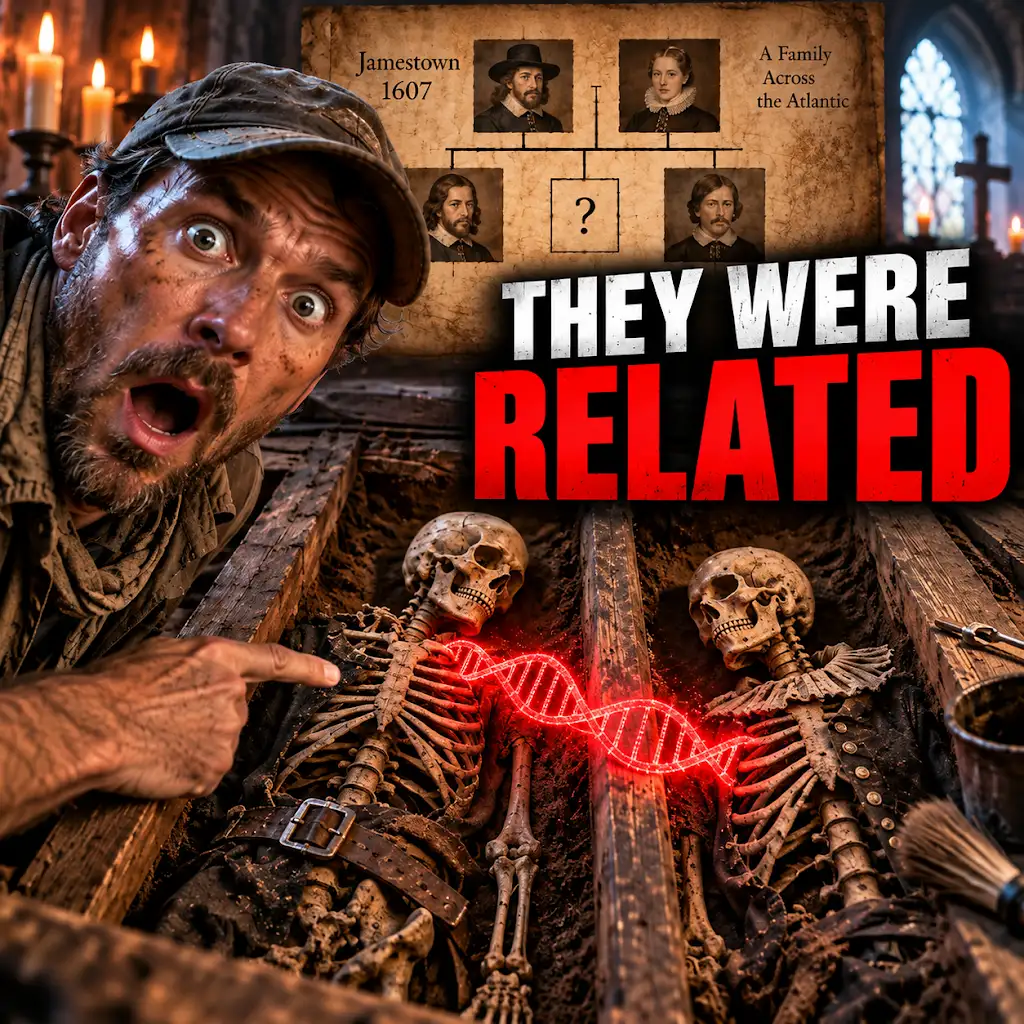
Jamestown DNA Revealed a Family Secret Hidden for 400 Years
FAQs
What is the significance of DNA in uncovering undocumented relationships?
DNA can provide concrete evidence of biological relationships between individuals, helping to confirm or refute suspected connections.
How does DNA testing work in determining relationships?
DNA testing compares specific genetic markers between individuals to determine the likelihood of a biological relationship, such as parentage or siblinghood.
Can DNA testing reveal unexpected relationships?
Yes, DNA testing can sometimes uncover unexpected relationships, such as previously unknown siblings, half-siblings, or other close relatives.
Are there limitations to what DNA testing can reveal about relationships?
While DNA testing is a powerful tool, it may not always provide definitive answers due to factors like incomplete genetic information or complex family dynamics.
How can DNA testing impact individuals and families in light of undocumented relationships?
DNA testing can have profound emotional and practical implications for individuals and families, potentially leading to new connections, revelations, or challenges in understanding one’s identity and family history.