The rumble started subtly, a low hum that vibrated not just through the theater’s seats, but seemingly through the very fabric of reality. As the screen flickered to life, a breathtaking vista unfolded: a molten inferno, a river of incandescent rock, flowing with terrifying beauty. This was the opening of “Journey to the Core: Deep Earth Exploration,” a documentary that dared to peer into the planet’s most inaccessible realms, promising a visual and intellectual odyssey unlike any other.
The film, a collaborative effort between leading geologists, geophysicists, and cutting-edge CGI artists, eschewed speculative fiction for hard science, meticulously reconstructing the Earth’s interior based on decades of seismic data, drilling samples, and theoretical modeling. It wasn’t just about showing what might be there; it was about presenting the most scientifically sound interpretation of what is there, bringing to life a world far removed from our everyday experience, yet intrinsically linked to our very existence. The narrative followed a hypothetical expedition, guided by the collective knowledge of humanity, that ventured deeper than any human has ever gone, not in a physical vessel, but through the lens of sophisticated simulation and visualization.
The ambition of “Journey to the Core” was evident from its opening moments. It promised to demystify the Earth’s internal architecture, to move beyond textbook diagrams and abstract concepts, and to offer a visceral understanding of the forces that shape our planet. The documentary’s creators understood that the Earth’s core is not merely a geological curiosity, but the engine of our planet’s magnetic field, the driver of plate tectonics, and a fundamental component of Earth’s formation and evolution. This film aimed to make that complex reality accessible, engaging, and profoundly awe-inspiring.
The documentary began by establishing the familiar, the crust upon which we live. But even here, the film’s detailed animations and expert narration quickly revealed the dynamic nature of this seemingly solid surface. The thin, brittle shell of the Earth, a mere fraction of the planet’s radius, was depicted as a stage for constant geological drama.
The Crust: A Dynamic Surface
The filmmakers presented a vivid portrayal of the Earth’s crust, not as a uniform blanket, but as a mosaic of tectonic plates in perpetual motion. The H3 subtitle “Continental vs. Oceanic Crust” highlighted the stark differences between these two fundamental types of crust. Continental crust, thicker and less dense, was shown as the ancient foundation of landmasses, sculpted by eons of erosion and uplift. Oceanic crust, thinner and denser, was depicted as the younger, ever-renewing skin of the ocean floors, born at the mid-ocean ridges and destined to subduct back into the mantle.
The H3 subtitle “The Dance of Plate Tectonics” brought the theory of plate tectonics to life. The documentary employed breathtaking CGI to illustrate the slow, inexorable creep of these colossal plates. Viewers witnessed the formation of mountain ranges as continents collided, the creation of new crust at divergent boundaries, and the destructive power of subduction zones, where one plate plunges beneath another, triggering earthquakes and volcanic eruptions. The film emphasized that the processes occurring at the surface, from the formation of the Grand Canyon to the eruption of Mount Vesuvius, are direct consequences of these deep-seated movements.
The Lithosphere and Asthenosphere: A Delicate Balance
Transitioning from the crust, the film delved into the lithosphere, the rigid outer shell of the Earth that includes the crust and the uppermost part of the mantle. The H3 subtitle “Rigidity and Mobility” explained how the lithosphere, while seemingly solid, is actually broken into pieces – the tectonic plates. The documentary’s visuals depicted this fracturing and movement with striking clarity, showing how stresses build up at plate boundaries, leading to seismic events.
Immediately beneath the lithosphere lay the asthenosphere, a region of the upper mantle characterized by its semi-fluid, ductile nature. The H3 subtitle “The Slippery Mantle” provided a visual representation of this crucial layer. Unlike the rigid lithosphere, the asthenosphere behaves like a very thick, viscous fluid over geological timescales. This property is essential for plate tectonics; the lithospheric plates essentially float and slide upon the asthenosphere. The film used sophisticated visualizations to show how mantle convection currents, driven by heat from the Earth’s core, churn slowly within the asthenosphere, acting as the conveyor belts that move the tectonic plates. The subtle ebb and flow of this immense layer was portrayed with a sense of patient power, a stark contrast to the violent dynamism of the surface.
In the realm of deep Earth exploration, a fascinating documentary sheds light on the mysteries beneath our planet’s surface, revealing insights into geological processes and their implications for climate change. For those interested in understanding the broader context of Earth’s history and its climatic shifts, the article “Uncovering Ancient Climate Collapse Cover-Up” offers a compelling perspective on how ancient events continue to influence our environment today. To explore this intriguing connection further, you can read the article here: Uncovering Ancient Climate Collapse Cover-Up.
Plumbing the Depths of the Mantle
As the hypothetical expedition plunged deeper, the scale and composition of the Earth’s mantle came into sharp focus. This vast, enigmatic region, comprising the bulk of the planet’s volume, was no longer a simple geological layer but a complex, multi-zoned environment governed by immense pressures and temperatures.
The Upper Mantle: A Convective Engine
The documentary dedicated significant attention to the upper mantle, the portion extending from the base of the lithosphere down to about 660 kilometers. The H3 subtitle “Convection Currents: The Planet’s Thermostat” delved into the intricate mechanisms of mantle convection. The film’s CGI illustrated plumes of hot, less dense material rising from deeper within the mantle, creating upwellings that can lead to volcanic activity and the formation of mid-ocean ridges. Conversely, cooler, denser material was shown sinking back down, creating downwelling currents. This continuous cycle of rising and falling material was presented as the primary driver of plate tectonics, a colossal, slow-motion engine that continuously reshapes the planet’s surface.
The H3 subtitle “Compositional Variations: Peridotite and Beyond” explored the likely chemical makeup of the upper mantle. The documentary explained that it is primarily composed of silicate rocks, rich in magnesium and iron, with peridotite being a dominant mineral. While direct sampling is impossible, seismic wave data provides crucial insights into the density and composition of these deep rocks. The film used animated visualizations to represent the gradual changes in mineral structure and density as temperature and pressure increase with depth, illustrating how olivine and pyroxene transform into denser phases.
The Transition Zone: A Realm of Phase Changes
Further down, the filmmakers introduced the transition zone, a distinct region between approximately 410 and 660 kilometers depth. The H3 subtitle “Pressure-Induced Transformations” explained the critical role of pressure in this zone. Here, the minerals that make up the upper mantle undergo significant phase changes, transforming into denser crystalline structures to accommodate the ever-increasing pressure. For instance, olivine transforms into wadsleyite and then into ringwoodite. The documentary used stunning visual effects to depict these molecular reorganizations, showing how the same elements can arrange themselves in entirely different ways under extreme pressure, altering the seismic wave velocities that travel through this region. This zone was presented as a crucial buffer, influencing the flow of heat and material between the upper and lower mantle.
The Lower Mantle: A Deep, Stable Expanse
Below the transition zone lies the lower mantle, extending to the core-mantle boundary. The H3 subtitle “Enormous Pressures and Temperatures” emphasized the immense conditions in this vast region. Temperatures here reach thousands of degrees Celsius, and pressures are millions of times that at the Earth’s surface. The documentary conveyed the sheer scale of this domain, portraying it as a largely stable, yet incredibly dynamic, powerhouse. The filmmakers suggested that while convection continues, it is much slower and more viscous than in the upper mantle.
The H3 subtitle “Bridgmanite: The Dominant Mineral” highlighted the most abundant mineral in the lower mantle. At these extreme pressures, common upper mantle minerals like olivine are no longer stable. Instead, a mineral called bridgmanite, a high-pressure polymorph of (Mg,Fe)SiO3, becomes the dominant constituent. The film’s visualizations showed the unique crystal structure of bridgmanite, explaining how its density and properties influence seismic wave propagation through the lower mantle, providing crucial clues to its composition. The documentary also touched upon the possibility of other high-pressure phases and mineral reservoirs within the lower mantle, suggesting that our understanding is still evolving.
The Core-Mantle Boundary: A Fiery Interface

The journey’s descent culminated at the boundary between the mantle and the core, a region of extreme contrast and profound significance for the entire planet. This interface, roughly 2,900 kilometers below the surface, was depicted as a battleground of immense heat and pressure, a frontier where the planet’s inner furnace meets its rocky shell.
Heat Transfer and Chemical Reactions
The H3 subtitle “The Interface of Extremes” painted a dramatic picture of the core-mantle boundary (CMB). The documentary explained that this is where heat generated from the cooling of the Earth’s core transfers into the lower mantle, driving the mantle convection that powers plate tectonics. The visual representation showed colossal plumes of superheated material rising from the core, interacting with the cooler mantle rock above. The film also alluded to ongoing research into chemical reactions that might occur at the CMB, potentially influencing the long-term evolution of both the mantle and the core.
The H3 subtitle “The Source of Mantle Plumes and Hotspots” delved into a fascinating phenomenon directly linked to the CMB: mantle plumes. These colossal upwellings of hot rock originate from deep within the mantle, possibly even from the CMB itself, and rise through the mantle to breach the surface, creating volcanic hotspots like Hawaii and Yellowstone. The documentary’s CGI illustrated these plumes as immense, fiery columns, visually connecting the planet’s deep interior to its volcanic surface activity. The film suggested that the stability and location of these plumes are key areas of ongoing scientific investigation.
Anomalies and Heterogeneities
The H3 subtitle “Seismic Shadows and Anomalies” highlighted the complexities revealed by seismic studies of the CMB. While generally depicted as a relatively smooth boundary, seismic waves passing through this region sometimes exhibit unusual behavior, suggesting the presence of significant variations in temperature and composition. The documentary explained how seismologists use “seismic shadows” – regions where earthquake waves are attenuated or absent – to infer the presence of denser, cooler regions, and conversely, areas of faster wave propagation could indicate hotter, less dense zones. These anomalies, often referred to as Large Low Shear Velocity Provinces (LLSVPs), were presented as major puzzles, potentially representing ancient remnants of the Earth’s formation or vast reservoirs of different material.
The H3 subtitle “The Core-Mantle Boundary: A Reservoir of Unanswered Questions” acknowledged the limits of current knowledge. Despite advancements, the precise nature of the material at the CMB, the details of heat transfer, and the origins of its observed heterogeneities remain subjects of intense scientific debate. The film positioned the CMB as a frontier of exploration, where future research will undoubtedly uncover even more about our planet’s inner workings.
The Earth’s Core: The Heart of the Planet
The ultimate destination of this simulated journey was the Earth’s core, a realm of unimaginable heat and pressure, responsible for the planet’s protective magnetic field. The documentary presented this region not as a solid mass, but as a dynamic, molten sphere.
The Outer Core: A Dynamic Ocean of Iron
The film’s depiction of the outer core was nothing short of spectacular. The H3 subtitle “A Molten Iron-Nickel Dynamo” explained that this layer, extending from approximately 2,900 to 5,150 kilometers depth, is believed to be composed primarily of liquid iron and nickel, with smaller amounts of other elements. The crucial insight was how this conductive, swirling liquid generates Earth’s magnetic field. The documentary’s CGI visualized a complex dynamo process: the movement of the molten metal, driven by convection and Earth’s rotation, creates electrical currents, which in turn produce a powerful magnetic field that extends far into space, shielding us from harmful solar radiation. The visual spectacle of this churning, incandescent ocean was a testament to the raw power residing within our planet.
The H3 subtitle “Convection and the Geodynamo” elaborated on the mechanics of the geodynamo. The filmmakers explained that heat from the inner core, along with chemical differentiation (the separation of lighter elements from heavier ones), drives convection in the outer core. This convective motion, combined with the Coriolis effect from Earth’s rotation, organizes the electrical currents in a complex pattern, creating the dipole magnetic field we experience. The documentary used intricate animations to show the swirling eddies and currents within the liquid metal, illustrating the fundamental principles of electromagnetism on a planetary scale.
The Inner Core: A Solid Heart of Iron
As the expedition theoretically descended further, they reached the Earth’s innermost region: the inner core. The H3 subtitle “A Solid Sphere of Iron and Nickel” revealed that despite temperatures comparable to the surface of the Sun, the immense pressure at this depth causes the iron and nickel to solidify. The documentary’s visuals depicted this as a solid, crystalline sphere, about 1,220 kilometers in radius. While seemingly static compared to the outer core, the inner core is also believed to be a dynamic entity, growing very slowly as heat from its formation continues to radiate outwards.
The H3 subtitle “Growth and Crystal Structure” touched upon the ongoing debate about the inner core’s precise growth mechanism. The film suggested that as the outer core cools, iron precipitates onto the inner core, causing it to grow. The documentary also explored current research into the crystal structure of the inner core, suggesting it is not perfectly uniform and may exhibit anisotropy, meaning its properties vary depending on the direction. This internal structure is thought to influence the way seismic waves travel through it, offering clues to its formation and evolution. The film presented the inner core as the ancient, steadfast heart of our planet, the bedrock upon which the dynamic forces of the outer core and mantle play out.
In the fascinating realm of deep Earth exploration, a recent documentary sheds light on the mysteries hidden beneath our planet’s surface. This captivating film not only delves into geological formations and seismic activities but also touches on the intriguing implications of polar shifts. For those interested in this topic, an insightful article titled “Evidence of a Pole Shift” provides further context and details about the phenomenon. You can read it here. The intersection of these subjects reveals the dynamic processes that shape our Earth and the potential consequences for our environment.
The Future of Deep Earth Exploration
| Metric | Value | Description |
|---|---|---|
| Documentary Title | Journey to the Center: Deep Earth Exploration | Name of the documentary |
| Duration | 90 minutes | Total runtime of the documentary |
| Release Year | 2023 | Year the documentary was released |
| Depth Explored | 12 km | Maximum depth reached during exploration |
| Number of Experts Interviewed | 15 | Geologists, seismologists, and engineers featured |
| Filming Locations | 5 | Number of different geological sites featured |
| Viewership | 2 million | Number of viewers within first 6 months |
| IMDB Rating | 8.2/10 | Audience rating on IMDB |
| Scientific Accuracy Score | 9/10 | Rated by independent geoscience reviewers |
“Journey to the Core: Deep Earth Exploration” concluded not just with a sense of awe, but with a profound understanding of the vast unknowns that still lie beneath our feet. The documentary skillfully bridged the gap between established scientific knowledge and the frontiers of current research, inspiring a sense of ongoing discovery.
Technological Advancements and Future Prospects
The H3 subtitle “Next-Generation Seismic Imaging” highlighted how advancements in seismology are continuously improving our ability to probe the Earth’s interior. The film showcased how denser networks of seismometers, combined with sophisticated data processing algorithms, are providing increasingly detailed images of the planet’s internal structure. The documentary suggested that techniques like seismic tomography, which uses earthquake waves to create 3D maps of the Earth’s interior, will become even more powerful.
The H3 subtitle “Theoretical Modeling and Laboratory Experiments” emphasized the crucial role of theoretical physics and high-pressure laboratory experiments in understanding deep Earth processes. The documentary explained how scientists use supercomputers to model the behavior of materials under extreme conditions, simulating the formation of planets and the dynamics of their interiors. Complementing these theoretical efforts are laboratory experiments that recreate the immense pressures and temperatures of the Earth’s core and mantle using diamond anvil cells and other specialized equipment. These experiments allow scientists to directly observe the phase transitions and properties of minerals under conditions that mimic those found deep within the Earth.
Unanswered Questions and the Quest for Knowledge
The H3 subtitle “The Earth’s Formation and Evolution” underscored that much about our planet’s early history remains a mystery. The documentary posed fundamental questions about the processes that led to the Earth’s differentiation into distinct layers, the origin of its water, and the initial formation of its magnetic field. The film suggested that understanding the deep Earth is key to unlocking the secrets of planetary formation throughout the cosmos.
The H3 subtitle “The Interconnectedness of Earth Systems” concluded with a powerful message about the interconnectedness of Earth’s systems. The documentary emphasized that the processes occurring in the deep Earth—mantle convection, the geodynamo, and the dynamics of the core—are not isolated events but are intrinsically linked to the surface processes that shape our climate, drive geological hazards, and ultimately, sustain life. “Journey to the Core” was more than just a documentary; it was a compelling invitation to continue the exploration, to push the boundaries of our knowledge, and to deepen our appreciation for the extraordinary planet we call home. The final scenes, returning to the familiar surface with a new perspective, left the audience with a profound sense of wonder and a renewed curiosity about the hidden world that lies beneath.
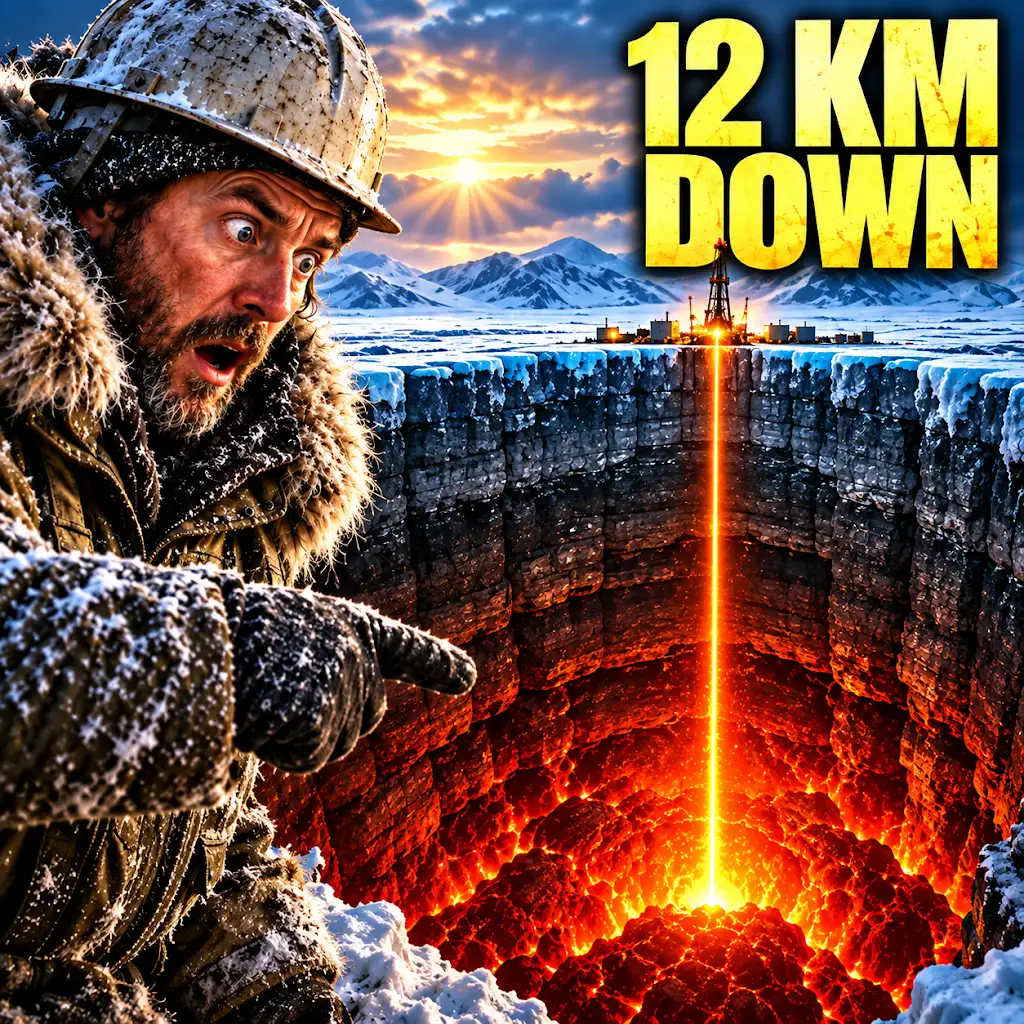
They Drilled 12 KM Into Earth — Then Everything Changed
FAQs
What is the deep Earth exploration documentary about?
The deep Earth exploration documentary focuses on showcasing the cutting-edge technology and scientific research used to explore the depths of the Earth’s interior.
Who is involved in the deep Earth exploration documentary?
The documentary features a team of geologists, seismologists, engineers, and other experts who are at the forefront of deep Earth exploration.
What are some key discoveries highlighted in the deep Earth exploration documentary?
The documentary highlights key discoveries such as new insights into the Earth’s mantle, the discovery of deep-sea hydrothermal vents, and the mapping of subterranean geological structures.
How was the deep Earth exploration documentary filmed?
The documentary was filmed using state-of-the-art underwater cameras, drones, and other specialized equipment to capture the stunning beauty and complexity of the deep Earth environment.
Where can I watch the deep Earth exploration documentary?
The deep Earth exploration documentary is available for streaming on various platforms such as National Geographic, Discovery Channel, and online streaming services like Netflix or Amazon Prime Video.