The vast, arid expanse of the Arabian Desert, a realm sculpted by wind and time, holds within its sandy embrace a silent testament to a civilization that once thrived amidst its harsh beauty: the Nabateans. These ancient desert dwellers, renowned for their mastery of water management and their pivotal role in ancient trade routes, also possessed an artistic sensibility that is etched into the very rock faces of their domain. Among their most captivating legacies are the thousands of camel petroglyphs, intricate carvings that adorn desert outcrops and canyons, offering a window into their culture, their livelihoods, and their profound connection to the iconic animal that defined their existence. These stone etchings, more than mere decoration, represent a rich tapestry of Nabatean life, their beliefs, and their deep understanding of the desert ecosystem.
The Nabatean Footprint in the Desert
The Nabateans, a nomadic Arab people, rose to prominence from around the 4th century BCE. Initially pastoralists, they gradually established a sophisticated network of trade routes that traversed the Arabian Peninsula, connecting the Arabian Sea with the Mediterranean. Their ingenuity in constructing cities like Petra, carved directly into sandstone cliffs, and their ability to harness scarce water resources through elaborate systems of dams and cisterns, allowed them to flourish in an environment that would defeat most others. While their monumental architecture often draws the most attention, it is their smaller, more intimate art, particularly the camel petroglyphs, that truly reveals the fabric of their daily lives and their intimate relationship with the desert. These carvings are not confined to a single location but are scattered across a wide geographical area, from the Jordanian desert to parts of Saudi Arabia and Sinai, testifying to the extensive reach of their culture and their widespread reliance on camel caravans. The sheer volume and variety of these petroglyphs suggest a deep cultural significance attached to the camel, an animal that was indispensable for their survival and prosperity.
Origins of Nabatean Rock Art
The practice of creating rock art is as old as humanity itself, and the Nabateans were inheritors of a long tradition. While the precise origins of Nabatean petroglyph traditions are debated, it is clear they built upon existing cultural practices in the region. Evidence suggests that rock engraving in Arabia dates back millennia, with early forms likely serving ritualistic or communicative purposes. The Nabateans, with their increasing sedentism and economic prosperity, had both the time and the means to develop and refine these practices. Their interactions with neighboring cultures, including the Egyptians, Mesopotamians, and Greeks, likely also influenced their artistic expression, though the camel petroglyphs retain a distinctively Nabatean character. The materials used were readily available – stone tools, typically harder rocks like basalt, were used to peck, scratch, and abrade the softer sandstone surfaces, creating durable and enduring images. The selection of prominent rock faces, often visible from a distance, suggests an intention for these carvings to be seen and appreciated by others, perhaps as markers, declarations of presence, or simply as expressions of skill and devotion.
The Camel: A Symbol of Life and Livelihood
For the Nabateans, the camel was not merely a beast of burden; it was an integral part of their identity and their economy. These hardy animals were essential for traversing the vast desert distances, carrying trade goods, water, and people. Their ability to withstand extreme heat and drought, their endurance, and their relatively gentle nature made them the perfect partners for desert life. The Nabatean petroglyphs vividly capture this dependence. The overwhelming majority of these carvings depict camels, often in great detail, showcasing their powerful physique, their humped backs, and their distinctive gait. These images are not static representations; they are often dynamic, depicting camels in various poses – standing, walking, running, and even laden with cargo. This dynamism suggests that the Nabateans had a profound observational understanding of camel behavior, capturing their essence with remarkable fidelity. The frequency with which camels appear in their art underscores their central role in Nabatean society, a constant companion on their journeys and a symbol of their ability to conquer the challenging desert environment.
The origins of the camel petroglyphs have long intrigued researchers and enthusiasts alike, leading to various theories about who might have carved these ancient images. For a deeper dive into the fascinating world of accidental discoveries, including insights into ancient art and archaeology, you can read more in this related article: Accidental Discoveries. This article explores the unexpected findings that have shaped our understanding of history and culture.
Decoding the Desert Canvases
The camel petroglyphs are not merely a collection of animal drawings; they are a sophisticated form of visual communication. Scholars have dedicated considerable effort to deciphering the meanings embedded within these ancient carvings, analyzing their composition, context, and recurring motifs. The sheer quantity and diversity of these images suggest a multifaceted purpose, serving practical, social, and perhaps even spiritual functions for the Nabatean people. The artists, likely skilled individuals within Nabatean society, demonstrated an exceptional ability to capture the essence of their subject matter using a limited palette of techniques. The resulting artwork, weathered by millennia, continues to speak to us across the vast expanse of time, offering glimpses into a world long past.
Stylistic Variations and Artistic Evolution
The Nabatean camel petroglyphs exhibit a remarkable range of stylistic variations, indicating a degree of artistic evolution and regional differences within Nabatean culture. While a generalized Nabatean style can be identified, individual artists and different locales contributed to a diverse body of work. Some carvings are highly detailed, meticulously rendering the musculature and features of the camels. Others are more abstract and stylized, emphasizing the general form and movement of the animal. There are instances where camels are depicted with riders, or with elaborate harnesses and trappings, suggesting the importance of camel adornment and the skills of camel handlers. The careful execution and the choice of prominent locations for many of these carvings suggest that they were intended to be viewed and understood by others, serving as a form of visual narrative. The evolution of style over time, if discernible, could offer insights into changing cultural practices or artistic trends within Nabatean society.
Thematic Richness Beyond the Camel
While camels dominate the Nabatean petroglyph landscape, they are not the sole subject matter. Other animals, such as ibex, ostriches, and even lions, also appear, reflecting the broader desert fauna that the Nabateans encountered. Humans are also depicted, sometimes engaged in activities like hunting or herding, or in ceremonial attire. There are also abstract symbols and geometric patterns that likely held specific meanings for the Nabateans, though their precise interpretation remains challenging. The inclusion of these varied subjects broadens our understanding of the Nabatean worldview, revealing their awareness of the wider natural environment and their place within it. The depiction of humans interacting with animals, in particular, highlights the dynamic relationship between people and nature that was so fundamental to their survival and their cultural identity. The sheer variety of motifs suggests that these petroglyphs served as a visual inventory of the Nabatean world, a way of recording and communicating their experiences and observations.
Purpose and Significance of the Camel Petroglyphs
The creation of thousands of camel petroglyphs was not a casual endeavor. These carvings served a multitude of purposes, deeply interwoven with the fabric of Nabatean society. From practical communication to spiritual expression, each peck and scratch on the desert rock held significance for the people who created them and for those who would encounter them. Understanding these purposes is key to unlocking the deeper cultural meaning of these ancient artworks. The longevity of these carvings, enduring the ravages of time and the harsh desert elements, speaks to the importance the Nabateans placed upon them.
The intriguing question of who carved the camel petroglyphs has captivated researchers and enthusiasts alike, leading to various theories about the ancient cultures that inhabited the region. These carvings not only reflect the artistry of their creators but also provide insights into the social and spiritual lives of the people. For those interested in exploring the broader context of ancient art and its connections to sound and acoustics, a related article delves into the fascinating world of archaeoacoustics, shedding light on how sound may have played a role in these ancient sites. You can read more about this captivating topic in the article here.
Practical Applications: Marking Routes and Resources
One of the most widely accepted theories regarding the function of these petroglyphs is their practical application in navigating the desert. In a landscape that can appear homogenous and featureless, particularly to the uninitiated, strategically placed rock carvings could serve as crucial markers. These could indicate the presence of water sources, such as hidden wells or cisterns, vital for survival. They might also have marked established trade routes, guiding caravans through treacherous terrain and preventing them from becoming lost. The depiction of camels, especially laden ones, could have served as a visual confirmation that a particular route was indeed viable for camel traffic. The recurring nature of certain motifs or symbols might have conveyed specific information to those familiar with Nabatean conventions, acting as a form of ancient signage. This practical function would have been of paramount importance for a people whose livelihood depended on efficient and safe travel across vast distances.
Social and Ritualistic Meanings
Beyond their utilitarian purposes, the camel petroglyphs almost certainly carried social and ritualistic significance. They may have served as a form of territorial marking, asserting Nabatean presence and ownership over specific areas of the desert. The act of creating these carvings could have been a communal activity, fostering social cohesion and shared identity. It is also highly probable that these images played a role in religious or spiritual practices. Camels, as providers of life and sustenance in the desert, may have been revered as sacred animals. The carvings could have been offerings, prayers, or a way to invoke divine protection for journeys and livelihoods. The prominent placement of some petroglyphs on cliff faces or in easily visible locations suggests they were intended to be seen, perhaps by both humans and the divine. The detailed rendering of some camels, particularly those adorned or depicted in specific actions, might have conveyed stories or myths, perpetuating cultural narratives and ancestral knowledge.
Commemorative and Historical Records
It is also plausible that some petroglyphs served as commemorative records. They might have documented significant events, such as the successful completion of a long and arduous journey, the birth of a particularly prized camel, or the establishment of a new trade route. While not written chronicles in the modern sense, these visual records could have served as a way for the Nabateans to remember and celebrate their achievements. The collective body of petroglyphs, therefore, can be viewed as a vast, unwritten history of the Nabatean people, a visual testament to their enduring presence and their intimate relationship with the desert. The persistence of these images over millennia allows us to connect with their past, offering tangible evidence of their ingenuity, their resilience, and their artistic spirit.
The Enduring Legacy of the Rock Carvings
Despite the passage of millennia, the Nabatean camel petroglyphs continue to exert a powerful draw on modern observers. They are a testament to the enduring power of human creativity and our innate need to leave a mark upon the world. These ancient etchings are not merely relics of a bygone era; they are vibrant expressions of a civilization that mastered its environment and forged a unique identity within its arid embrace. Their preservation and study offer invaluable insights into a lost world, reminding us of the deep connection between humanity and the natural world.
Preservation Challenges and Archaeological Efforts
The preservation of these ancient petroglyphs in the harsh desert environment presents significant challenges. Natural erosion from wind and sand, as well as the impact of climate change, pose ongoing threats. Human activities, including tourism and the potential for vandalism, also require careful management and protection. Archaeological efforts are crucial in documenting, studying, and safeguarding these invaluable cultural assets. Researchers employ advanced techniques, including photogrammetry and 3D scanning, to create detailed digital records of the petroglyphs, ensuring their preservation even if the physical carvings are damaged. Conservation initiatives focus on minimizing human impact and protecting the fragile rock surfaces. The ongoing work of archaeologists and conservationists is vital in ensuring that future generations can continue to learn from and be inspired by these remarkable ancient artworks.
Modern Interpretations and Cultural Significance
In contemporary times, the Nabatean camel petroglyphs hold a significant cultural and historical importance. They serve as a powerful reminder of the rich heritage of the Arabian Desert and the ingenuity of its ancient inhabitants. For many, these carvings evoke a sense of wonder and connection to the past, offering a tangible link to a nomadic lifestyle and a deep respect for the natural world. They are a source of pride for local communities and a significant draw for cultural tourism, encouraging a greater appreciation for the region’s history and artistic traditions. The study of these petroglyphs continues to inform our understanding of Nabatean society, their economic activities, and their spiritual beliefs, contributing to the ongoing narrative of human civilization and our relationship with the environment.
An Unfinished Dialogue with the Past
The camel petroglyphs of the Nabateans represent an ongoing dialogue between the past and the present. Each carving is a silent voice from antiquity, whispering stories of a people who lived, worked, and thrived in one of the world’s most challenging landscapes. While much has been learned, there remains a wealth of knowledge yet to be uncovered within these ancient etchings. As research continues and new interpretations emerge, the Nabatean camel petroglyphs will undoubtedly continue to captivate and enlighten, offering us enduring insights into the resilience, artistry, and profound connection to nature that defined this remarkable ancient civilization. Their legacy endures, etched in stone, waiting to be rediscovered and appreciated by generations to come.
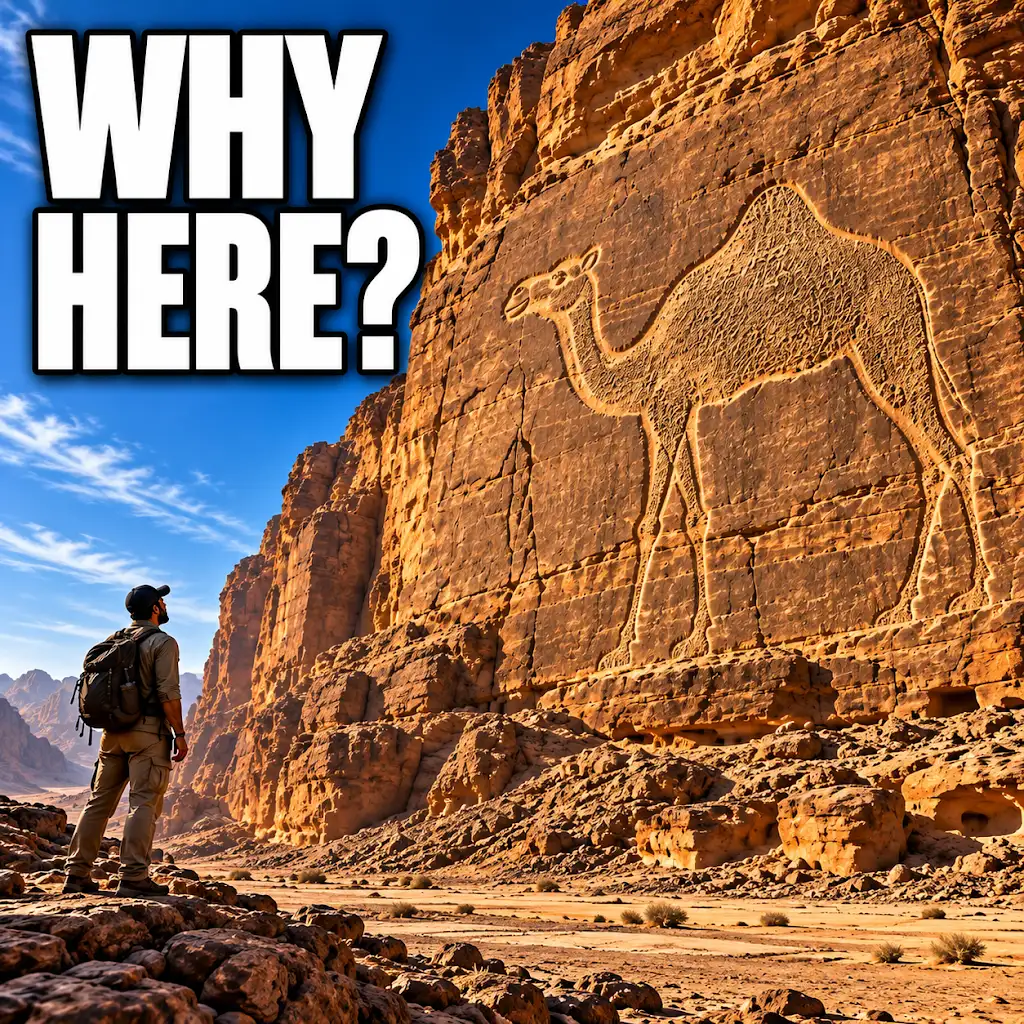
Why Were Giant Camels Carved Above the Desert?
FAQs
1. Who carved the camel petroglyphs?
The camel petroglyphs were carved by ancient civilizations, most likely by the Nabateans who inhabited the region around 2,000 years ago.
2. Where are the camel petroglyphs located?
The camel petroglyphs can be found in the deserts of Saudi Arabia, particularly in the Al Jawf region near the town of Sakaka.
3. What is the significance of the camel petroglyphs?
The camel petroglyphs are significant as they provide insights into the cultural and artistic practices of ancient civilizations, as well as their relationship with animals like camels.
4. How were the camel petroglyphs created?
The camel petroglyphs were created by carving images of camels into the rock surface using sharp tools, likely made of stone or metal, to etch the outlines and details of the figures.
5. Are the camel petroglyphs well-preserved?
Yes, the camel petroglyphs are relatively well-preserved due to the dry desert climate of the region, which has helped protect them from erosion and other environmental factors over the centuries.