
The End of an Outlaw’s Reign
The legend of Jesse James is as enduring as the Wild West itself. A name whispered in hushed tones, a symbol of rebellion and defiance against perceived injustice, Jesse James captivated the American imagination. His exploits as a bank and train robber, leading the James-Younger Gang, cemented his place in folklore. Yet, the very myth that elevated him to outlaw demigod also shrouded his final days in a veil of controversy and enduring mystery. The tale of his death, like so much of his life, is a complex tapestry woven with fact, fiction, and a persistent desire to believe the impossible. For decades, the question of whether the man killed in St. Joseph, Missouri, in 1882 was truly the legendary Jesse James, or if he managed to escape and live out his days in anonymity, has fueled debate and captivated historians, amateur sleuths, and enthusiasts alike. This article delves into the evidence, the prevailing theories, and the enduring questions surrounding the dramatic conclusion of one of America’s most infamous outlaws.
The official narrative, the one that has been passed down through generations, paints a grim picture of betrayal and a swift, ignominious end. It is a story that involves a disillusioned gang member, a cunning lawman, and a fateful decision made in a dusty Missouri bedroom. However, the very circumstances of this purported demise have always been fertile ground for suspicion. The speed with which the news spread, the reluctance of some to accept the identification, and the emergence of later claimants all contributed to the persistent “Jesse James is not dead” theories. Unraveling this mystery requires a deep dive into historical records, forensic analysis, and an understanding of the desperate circumstances faced by both the outlaw and those who sought to capture him. It is a journey into the heart of legend, where the line between truth and myth is often blurred, and where the desire for a heroic escape can overshadow stark historical reality.
The death of Jesse James remains one of the most intriguing mysteries in American history, with various theories surrounding his demise and the identity of his killer. For those interested in exploring another captivating topic related to historical mysteries, you might find the article on autonomous space defense particularly fascinating. It delves into the role of artificial intelligence in modern defense strategies, which can be seen as a contemporary parallel to the enigmatic figures of the past. To read more about this intriguing subject, visit this article.
The Shadow of Betrayal: The Official Account
The most widely accepted account of Jesse James’s death places the blame squarely on the shoulders of one of his own. Robert Ford, often referred to as “the dirty little coward” by those who sided with the outlaws, was the man who pulled the trigger. Driven by a combination of greed and a desire for notoriety, Ford, along with his brother Charley, conspired with Missouri Governor Thomas Crittenden to bring an end to Jesse James’s reign of terror. The promise of a $10,000 reward, a substantial sum in the late 19th century, was a powerful incentive.
The fateful day, April 3, 1882, found Jesse James, along with Robert and Charley Ford, residing in a rented house in St. Joseph, Missouri. Jesse, known for his meticulous planning and paranoia regarding his safety, was reportedly growing uneasy about his situation. He had recently been forced to abandon his family home and was living under an assumed name, seemingly for his own protection. It was during this period of unease that the Fords, under immense pressure and likely influenced by the substantial reward offered by the governor, decided to act.
The Morning of April 3rd
The morning began like any other, with the three men having breakfast. Jesse, reportedly overheated and uncomfortable, removed his coat and, in a moment of apparent carelessness that has long been scrutinized by historians, turned to clean a picture on the wall. This action placed him with his back to Robert Ford. It was at this precise moment that Robert Ford raised his pistol and fired a single shot, striking Jesse James in the back of the head. The legend, so often associated with daring shootouts and bold confrontations, met its end not in a hail of gunfire, but in a moment of unexpected vulnerability and calculated treachery.
The immediate aftermath was chaotic. Charley Ford reportedly helped Robert restrain the dying Jesse. The local authorities were summoned, and the body was quickly identified as Jesse James by neighbors and associates who had known him. The speed of the identification and the subsequent public display of the body were intended to quell any doubts and solidify the narrative of justice served. However, as we shall see, the very efficiency of this official conclusion sowed the seeds for future controversy. The story, as presented by the authorities and widely disseminated, was designed to be unambiguous: Jesse James was dead, killed by one of his own, and the era of his outlawry had definitively ended. Yet, for many, this clean-cut resolution felt too neat, too convenient, and too easily accepted for a figure as larger-than-life as Jesse James.
The Reward and the Doubt
The substantial reward offered for Jesse James’s capture, dead or alive, was a significant factor in the events of April 3, 1882. Governor Crittenden’s administration had been under immense pressure to put an end to the notorious outlaw’s activities. The Fords, already in a precarious position and facing potential repercussions for their past associations with Jesse, saw the reward as a way to secure their own future and gain favor with the authorities. The arrangement was clandestine, with the Fords essentially acting as informants and assassins.
However, the very nature of this arrangement bred suspicion. The Fords, having been close associates of Jesse, were now the primary witnesses to his death. Their testimony, while crucial to the official account, was also inherently compromised by their self-interest. Furthermore, the immediate and widespread acceptance of the body’s identification, despite the opportunities for doubt and the inherent difficulties in positively identifying a person under such circumstances, began to raise eyebrows. Critics argued that the authorities were too eager to declare victory, perhaps even willing to overlook inconsistencies to close a high-profile case. This rush to judgment, coupled with the Fords’ questionable motives, created the fertile ground for the enduring “Jesse James is not dead” theories that would emerge in the years that followed. The legend of Jesse James was so potent that many found it difficult to believe that such a figure could be brought down by such seemingly ignoble means, and by men they once considered comrades.
The Rise of the “Living Legend” Theories
The official narrative, while presented as fact, was never universally accepted. Almost immediately after Jesse James’s supposed death, whispers began to circulate that the man buried in St. Joseph was not the infamous outlaw. These whispers coalesced into full-blown theories, fueled by a potent blend of wishful thinking, a distrust of authority, and the sheer audacity of Jesse James’s legendary persona. The idea that Jesse James, a master of evasion and a symbol of defiance, could have orchestrated his own escape and lived to tell the tale was far more appealing to many than the grim reality of his alleged assassination.
The emergence of multiple men claiming to be Jesse James in the decades following 1882 is a testament to the enduring power of this “living legend” phenomenon. These claimants, often elderly and living in relative obscurity, invariably offered stories that, while varying in detail, shared a common thread: they had either been mistaken for Jesse or had successfully faked their own death to escape the clutches of the law and the dangers of their former life. These claims, whether genuine attempts to reclaim a lost identity or elaborate hoaxes, further muddied the waters and provided ammunition for those who refused to accept the official story.
The “Other Jesse” Phenomenon
The most prominent of these claimants was a man named J. Frank Dalton, who emerged in the early 20th century. Dalton asserted that he was, in fact, Jesse James, and that the man killed in 1882 was a look-alike or a hired double. His story, detailed in various accounts and interviews, suggested that Jesse had been aware of the Fords’ betrayal plot and had pre-emptively arranged for a substitute to take his place. Dalton’s narrative was compelling to many, especially given his advanced age and his ability to recount numerous details of Jesse’s life, which he claimed as his own.
Another notable claimant was a man named John Wilkes Booth, who, in a bizarre twist, claimed to be both John Wilkes Booth, the assassin of Abraham Lincoln, and Jesse James. This theory, while highly improbable, highlights the public’s fascination with these figures and the blurring of lines between different historical narratives. The sheer number of individuals who came forward, each with their own version of how Jesse James escaped his fate, created a confusing but captivating tapestry of folklore. These “other Jesses” became part of the legend, providing an alternative to the stark finality of the St. Joseph death.
The Appeal of the Escape
The enduring appeal of the “Jesse James is alive” theories lies in several psychological and cultural factors. Firstly, Jesse James was a romanticized figure. He was often portrayed in dime novels and early films not just as a criminal, but as a Robin Hood-like character who robbed from the rich and, in some interpretations, gave to the poor. This heroic image made his violent and seemingly ignoble death at the hands of a trusted associate feel incongruous with his legend. The idea of him outsmarting his enemies one last time, disappearing into the anonymity of a long life, was a far more satisfying conclusion for his admirers.
Secondly, there was a deep-seated distrust of authority and official narratives in the American West. The outlaw was often seen as a rebel against corrupt systems, and the idea that he could have been betrayed by the very law he defied resonated with a segment of the population. The Fords, acting in concert with the governor, were seen by some as hypocrites, their actions a testament to the corruption that Jesse supposedly fought against. This distrust made the official account suspect and opened the door for alternative explanations. The possibility of Jesse James successfully faking his death and living a quiet life was a potent symbol of triumph over the forces that sought to control him, a final act of defiance that cemented his legend rather than ending it.
Forensic Fates and Historical Footprints
In the quest to definitively resolve the Jesse James death mystery, modern science and diligent historical research have played crucial roles. While the historical record is fraught with conflicting accounts and biased perspectives, forensic analysis offers a more objective lens through which to examine the evidence. The remains purported to be Jesse James, exhumed and analyzed over the years, have provided critical insights into the veracity of the St. Joseph death.
The debate often centers on the identification of the body, the method of death, and the possibility of substitution. While the immediate identification in 1882 relied on eyewitness accounts and the word of the Fords, later examinations have sought to corroborate or refute these claims through scientific means. The very act of exhumation and analysis, undertaken at different points in history, reflects the enduring public and scholarly interest in settling this long-standing debate.
The Challenge of Identification
The primary challenge in definitively proving or disproving the identity of the body buried in St. Joseph lies in the limitations of historical forensic techniques. In 1882, positively identifying a deceased individual was largely based on physical characteristics observable by those who knew the person. While neighbors and acquaintances claimed to recognize the body as Jesse James, their perceptions could have been influenced by the intense public attention and the desire to see the notorious outlaw brought to justice.
The passage of time also presented difficulties. The body was displayed and, by some accounts, not perfectly preserved. This made definitive visual identification challenging even for those who knew Jesse well. The fact that Jesse James was known to use aliases and had taken steps to conceal his identity further complicated matters. The Fords’ narrative, while crucial to the official account, was the only direct testimony from those present at the moment of death, and their motives for providing that testimony were undeniably tainted by the reward offered.
Modern Scientific Scrutiny
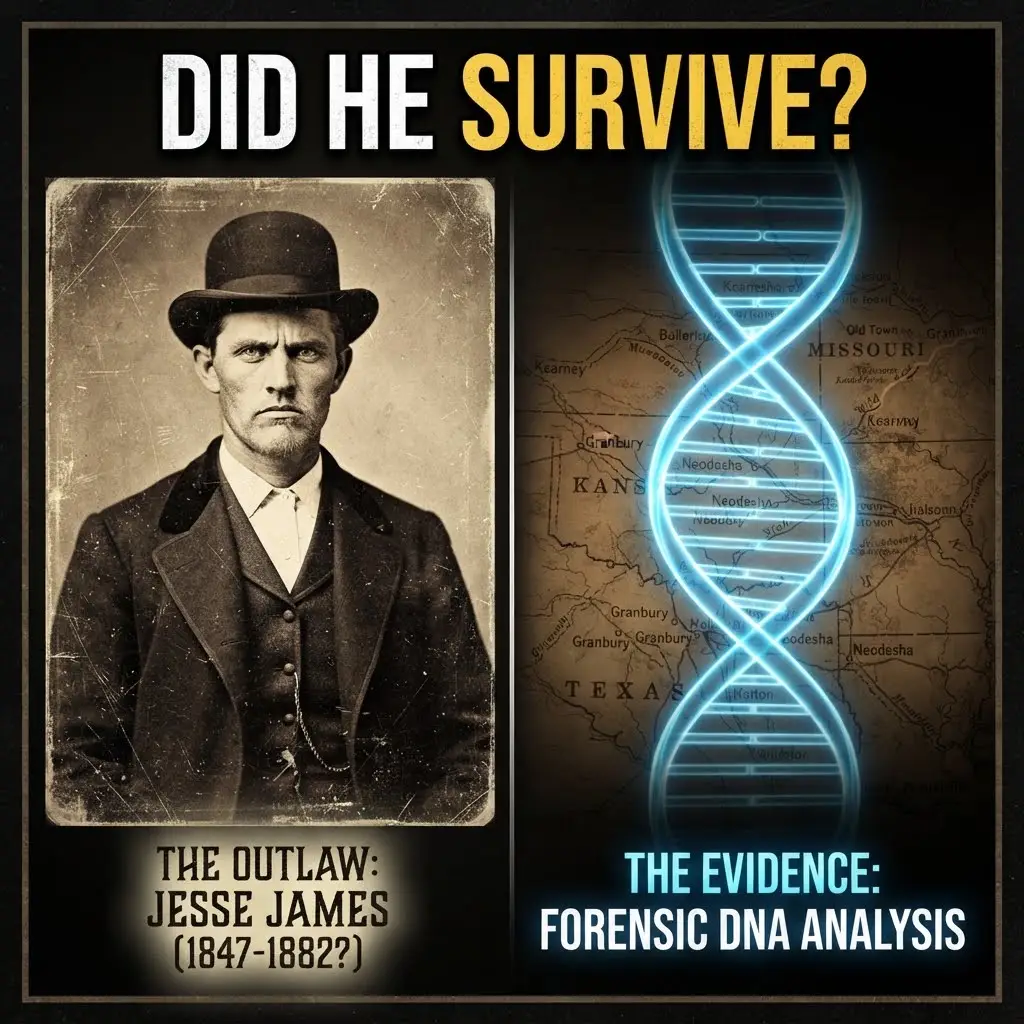
In the late 20th century, advancements in forensic science offered new possibilities for examining the remains. In 1995, the skeletal remains believed to be Jesse James were exhumed from their grave in Holt County, Missouri, for DNA testing. This groundbreaking event aimed to provide definitive answers by comparing the DNA profile of the remains with that of known descendants of Jesse James.
The DNA analysis, conducted by researchers from the University of Indianapolis, compared mitochondrial DNA from the exhumed remains with samples from descendants of Jesse James’s sister, Susie. The results of this testing indicated that the skeletal remains were indeed consistent with those of Jesse James’s maternal lineage. This provided significant scientific support for the claim that the man buried in Holt County was the legendary outlaw. However, some critics argued that mitochondrial DNA only traces maternal lineage and that further analysis, perhaps using nuclear DNA if suitable samples were available, would be needed for absolute certainty. Despite these reservations, the DNA evidence was a major blow to the “Jesse James is alive” theories and strengthened the case for the official account.
The death of Jesse James remains one of the most intriguing mysteries in American history, with various theories surrounding the circumstances of his demise. Many enthusiasts and historians continue to explore the life and legacy of this infamous outlaw, often drawing parallels to the economic uncertainties of today. For instance, an interesting article discusses how assets like gold, real estate, and cryptocurrency can serve as safe havens during times of financial instability, much like the turbulent times Jesse James navigated. You can read more about this topic in the article on top assets for dollar devaluation.
The Lingering Shadows and Unanswered Questions
| Aspect | Details |
|---|---|
| Date of Death | April 3, 1882 |
| Location | St. Joseph, Missouri |
| Cause of Death | Gunshot wound to the back of the head |
| Person Responsible | Robert Ford (gang member) |
| Controversy | Some theories suggest Jesse James faked his death and lived under an alias |
| Evidence Supporting Death | Coroner’s report, eyewitness accounts, and burial records |
| Evidence Against Death | Alleged sightings post-1882, disputed photographs, and family claims |
| Historical Impact | Marked the end of the James-Younger Gang’s criminal activities |
Despite the scientific evidence and the weight of historical consensus, the mystery surrounding Jesse James’s final days refuses to entirely dissipate. The allure of the outlaw, the romanticism of the West, and the enduring human fascination with the impossible conspire to keep the legend alive, even in the face of compelling evidence. The circumstances of his death, marked by betrayal and a rapid official pronouncement, leave room for the imagination to wander and for doubts to persist.
The very nature of historical interpretation means that even strong evidence can be subject to re-examination and alternative readings. While modern science has provided significant clarity, the human element of storytelling and the power of myth continue to exert their influence, ensuring that the legend of Jesse James, and the unanswered questions surrounding his end, will likely endure for generations to come.
The Case for Continued Skepticism
While the DNA evidence is compelling, some historians and enthusiasts continue to harbor skepticism. One of the primary arguments against the definitive conclusion of the 1995 exhumation rests on the fact that the remains were moved multiple times over the years. The original burial site was in St. Joseph, but the body was later reburied in Holt County by Jesse’s mother. The possibility of misidentification or substitution during these transfers, though unlikely, cannot be entirely discounted.
Furthermore, the history of the Fords and their involvement in the death of Jesse James is complex. While Robert Ford was later killed by a saloon keeper in Colorado, Charley Ford died of tuberculosis, reportedly in despair over his role in Jesse’s death. The lingering questions about their true motivations and the possibility of a more elaborate cover-up continue to fuel some of the persistent doubts. The argument is often made that the official narrative, while convenient, may have overlooked crucial details or intentionally obscured aspects of the truth to achieve a desired outcome.
The Legacy of the Legend
Ultimately, whether Jesse James died in a St. Joseph bedroom or lived out his days in hiding, his legend remains indelible. He has been immortalized in countless books, films, songs, and even video games, solidifying his place in American popular culture. The mystery surrounding his death, far from diminishing his fame, has only served to enhance it, adding another layer of intrigue to an already captivating figure.
The enduring appeal of Jesse James lies not just in his criminal exploits but in what he represents: a symbol of defiance, a romanticized rebel, and a figure who operated outside the boundaries of conventional society. The very debate over his death speaks to the power of this legend, the difficulty of separating fact from fiction when dealing with such an iconic figure. The “Jesse James Death Mystery” is not merely an historical puzzle; it is a reflection of America’s complex relationship with its outlaws, its heroes, and the enduring power of a good story. The legend of Jesse James, like the myth of the Wild West itself, continues to capture the imagination, forever leaving us to ponder the shadows of his final days.
The Jesse James DNA Myth: Why Are There 3 Graves?
FAQs
1. Was Jesse James really killed by Robert Ford?
Yes, Jesse James was shot and killed by Robert Ford on April 3, 1882, in St. Joseph, Missouri. Ford was a member of James’ gang and killed him in hopes of collecting a reward.
2. Why did Robert Ford kill Jesse James?
Robert Ford killed Jesse James in an attempt to collect a reward that was being offered for James’ capture or death. Ford conspired with Missouri Governor Thomas T. Crittenden to bring down James.
3. What was the aftermath of Jesse James’ death?
After Jesse James’ death, Robert Ford was charged with murder but was later pardoned by Governor Crittenden. Ford’s actions were met with mixed reactions, with some viewing him as a coward and others as a hero for taking down a notorious outlaw.
4. Were there any conspiracy theories surrounding Jesse James’ death?
Yes, there have been conspiracy theories suggesting that Jesse James faked his own death and lived under an assumed identity for years after the reported killing. However, most historians and experts believe that James did indeed die at the hands of Robert Ford.
5. How did Jesse James’ death impact the legend of the Wild West outlaw?
Jesse James’ death solidified his status as a legendary figure in the Wild West. His life and exploits became the stuff of folklore, and his death only added to the mystique surrounding his persona. The story of Jesse James continues to captivate people to this day.