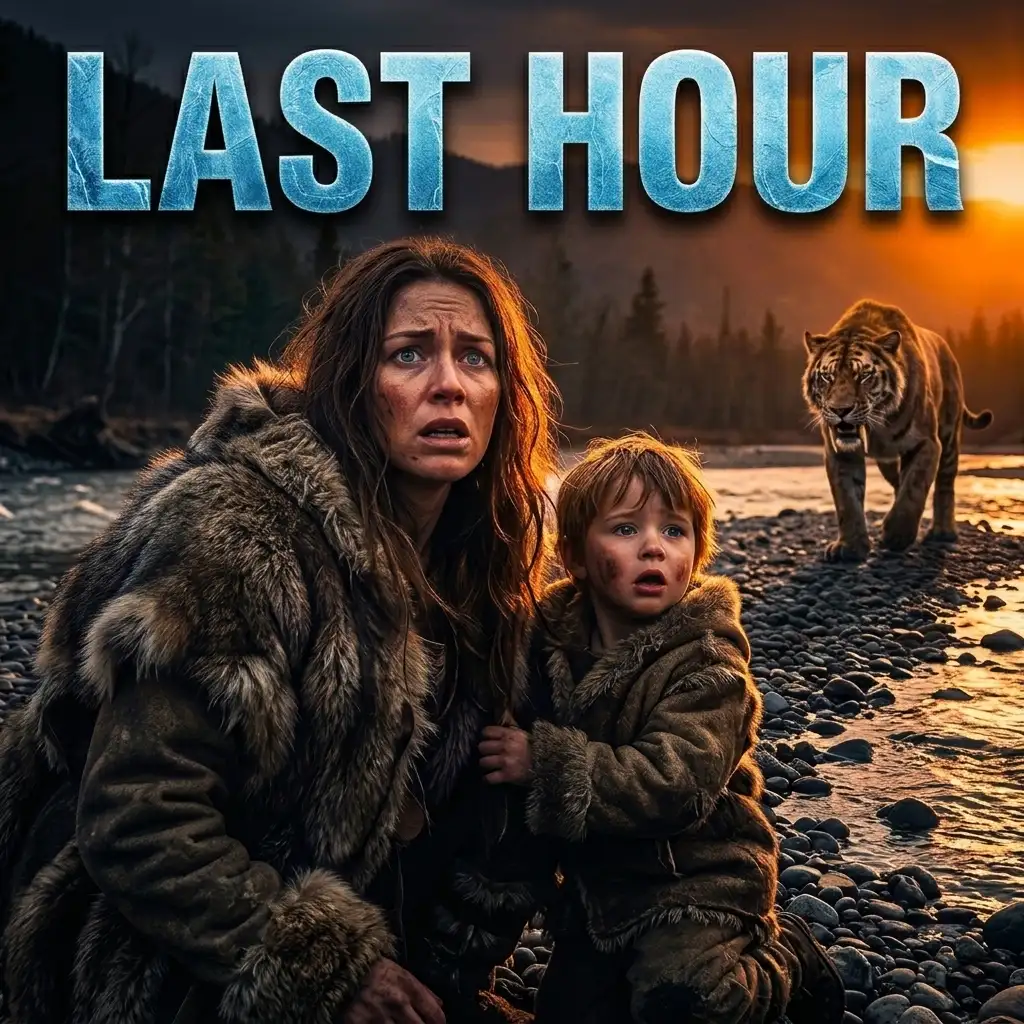
The child, no more than eight summers, felt the familiar weight of his father’s flint knife in his palm. It was a poor imitation of the tools the grown men wielded, but it was his. He clutched it tight, a tiny anchor in the vast, churning sea of his apprehension. The morning mist, heavy with the scent of damp earth and pine, clung to his rough animal-hide tunic, chilling him to the bone. He was not supposed to be here, alone. The Great Hunt was on, the seasoned hunters of the clan already miles away, pursuing the elusive herds that sustained them through the lean moons. His duty, like that of the other younglings, was to remain by the smoldering embers of the camp, learning the ways of the elders, tending to the smaller tasks, waiting.
But waiting had become an unbearable torment. A flicker of insatiable curiosity, a primal urge to explore beyond the well-trodden paths, had ignited within him. It was a dangerous spark, one his mother had warned him against countless times, her voice laced with the fear that haunted all mothers in this untamed world. Yet, it persisted, a tiny, insistent whisper against the clamor of obedience. Today, the whisper had become a roar. The scent of something new, something tantalizing and unknown, had wafted on the breeze from the shadowed depths of the Whispering Woods. He had followed it, one hesitant step after another, until the familiar outline of his village had shrunk to a distant memory, swallowed by the encroaching green.
The Lure of the Unknown
The child’s small world had always been defined by the boundaries of the known. The rolling hills where the berry bushes grew thickest, the river where the fishing was good, the rocky outcrops that served as lookout points, and the sheltered clearing that housed the communal huts. These were the safe havens, the territories imprinted on his young mind by his elders’ teachings and his own limited excursions. But beyond these familiar landmarks lay the vast expanse of the untamed wilderness, a realm of mystery and potential peril. The whispers of the wind through the ancient trees spoke of secrets he could only begin to imagine. Tales of strange creatures, of hidden springs with waters that healed, and of places where the spirits of the ancestors dwelled, all fueled his nascent yearning for discovery.
A Hunger for Experience
It was not merely a fleeting whim that drove the child. There was a deeper, more intrinsic motivation at play. He had observed the elders, their weathered faces etched with the wisdom of a thousand seasons, their hands skilled in tasks that seemed almost magical. He had seen the pride in their eyes when they returned from successful hunts, the respect accorded to those who braved the dangers and brought sustenance to the clan. He yearned to be like them, to possess their knowledge, their courage, and their ability to navigate the complexities of their world. The lessons learned around the fire, while valuable, felt abstract and distant. He craved tangible experiences, the visceral understanding that only direct engagement with the environment could provide. The lure of the unknown was not just a curiosity; it was a potent catalyst for growth, a silent challenge to his own perceived limitations.
The Whispering Woods Beckon
The scent that had drawn him was unlike anything he had encountered before. It was a complex aroma, a mingling of sweet floral notes, the earthy decay of fallen leaves, and a subtle, musky undertone that hinted at something alive and potent. He imagined it might be a new type of berry, or perhaps a rare root that the healers sought. His father, on rare occasions, would speak of finding such treasures, his voice hushed with reverence. This scent, however, was stronger, more pervasive, and seemed to emanate from a particular direction, deeper into the woods than he had ever dared to venture. The trees here were older, their branches intertwined like gnarled fingers reaching towards the sky, casting deep, dappled shadows on the forest floor. Sunlight struggled to penetrate the dense canopy, creating an atmosphere of perpetual twilight, both enchanting and slightly unnerving. The silence was profound, broken only by the rustle of unseen creatures in the undergrowth and the distant sigh of the wind.
In exploring the themes of independence and survival in the wild, one can draw parallels to the article titled “Is the Moon a Sovereign Territory?” found at this link. Just as a prehistoric child ventures into the wilderness alone, facing the challenges of nature and discovering their own capabilities, the article delves into the complexities of sovereignty and territorial claims beyond our planet. Both narratives highlight the human spirit’s quest for exploration and understanding, whether on Earth or in the vastness of space.
Navigating the Unfamiliar Terrain
The child pressed on, his small legs pumping with a mixture of excitement and growing unease. The ground beneath his feet transitioned from the soft, yielding earth of the forest edge to a more uneven terrain, littered with fallen branches, moss-covered rocks, and the tangled roots of ancient trees. He stumbled more than once, his worn hide boots struggling to gain purchase on the slippery surfaces. His breath came in short, ragged gasps, the coolness of the air now tinged with the exertion of his journey. The initial thrill of exploration was slowly being tempered by the growing realization of his isolation. The comforting familiarity of his clan’s presence, the low murmur of voices, the warmth of shared fire, all seemed a universe away.
The Language of Footprints
His eyes, sharp and accustomed to observing the subtle details of his environment, scanned the ground for any sign of life. He recognized the delicate tracks of a rabbit, the broad imprint of a deer’s hoof, and the frantic scurry marks of smaller rodents. These were familiar stories etched in the mud and leaves, tales of the forest’s daily drama. But he also noted something else, something larger, a series of deep gouges in the earth that spoke of immense weight and power. He stopped, his heart thrumming against his ribs like a trapped bird. He had seen depictions of such tracks in cave paintings, rendered by the elders to teach the young ones about the dangers that lurked in the wild. The great bears, formidable beasts whose strength could fell a man with a single swipe. A shiver ran down his spine, but it was not entirely one of fear. There was a grudging respect for the power that created such marks, and a flicker of awe at being in its presence, even if unseen.
The Sensory Assault of the Forest
The wilderness was a symphony of sensations, a constant barrage on his young senses. The air was alive with the chirping of insects, the calls of unseen birds, and the rustling of leaves that could be anything from a gentle breeze to the stealthy movement of a predator. The visual landscape was a kaleidoscope of greens and browns, punctuated by the occasional flash of a bright feather or the vibrant hue of a wild flower. The smells were even more overwhelming, a complex tapestry woven from the decay of fallen vegetation, the dampness of the earth, the resinous scent of pine needles, and the intriguing aroma that had first drawn him. He learned to differentiate between the rustle of a harmless shrew and the heavier tread of a larger animal. He began to understand that every sound, every scent, every subtle shift in the environment, held a meaning, a story waiting to be deciphered. His senses, once dulled by the predictable routines of the village, were now sharpened to an acute awareness, his survival dependent on his ability to interpret this intricate language.
Encounters with the Wild
As the child delved deeper into the Whispering Woods, the encounters with the untamed world became more pronounced, more immediate. The forest was not an empty expanse; it was a vibrant ecosystem teeming with life, each creature playing its part in the grand cycle. He was a trespasser, an interloper in a realm where he was not the dominant force, and this understanding began to dawn on him with a sobering clarity. He had to tread carefully, to observe, and to learn, not just from the absence of danger, but from its very presence.
A Glimpse of the Shadowed Hunter
He was crouched behind a thicket of ferns, his eyes fixed on a patch of sunlight where a plump rabbit was nibbling contentedly on clover. His small hand tightened on the flint knife, a childish instinct to hunt and provide. Suddenly, a flicker of movement at the edge of his vision froze him. A lynx, its tawny coat blending almost perfectly with the dappled shadows, emerged from the undergrowth. Its movements were liquid grace, silent and deliberate. The child held his breath, mesmerized by the predator’s intense focus. The lynx’s gaze was fixed on the rabbit, its body coiled like a spring. In that moment, the child understood the raw, unvarnished reality of the wild. It was not just about finding food; it was about the intricate dance of predator and prey, a perpetual struggle for survival. He watched as the lynx launched itself, a blur of fur and lethal intent. The rabbit, startled, bolted, its speed a desperate gamble. The chase was brief, a fleeting spectacle of natural selection unfolding before his eyes. He did not feel revulsion, only a profound sense of awe and a dawning comprehension of the natural order.
The Silent Watchers
He began to notice that he was not entirely alone, even when no immediate threat was apparent. Small eyes would gleam from the darkness of hollow logs, and the rustle of leaves often signaled the presence of unseen creatures. Squirrels chattered indignantly from the branches above, their alarm calls serving as an early warning system. He saw a family of deer, their ears pricked, pause to observe him with a mixture of curiosity and wariness before melting back into the trees. He learned to interpret their stillness, their subtle shifts in posture, as indicators of their comfort or unease. He was a moving anomaly in their world, and they, in turn, were constant reminders of his intrusion. He realized that the wilderness was not a silent, passive place, but a landscape alive with constant observation, a network of awareness that encompassed every living thing. He was being watched, assessed, and, to some extent, tolerated.
A Lesson from the River
He came upon a small, gurgling brook, its waters clear and cold. He had been thirsty for some time, his throat dry and parched. He knelt to cup his hands, but as he reached for the water, he saw it. A large, vibrant blue dragonfly, its wings shimmering like stained glass, was hovering just above the surface. It dipped down, its slender body touching the water for a fleeting moment before rising again. He remembered his grandmother’s warnings about drinking directly from streams, of the unseen dangers that could lurk within the water. But he also remembered seeing the elders purify water by boiling it. He looked at the dragonfly, so effortlessly accessing this vital resource. He then noticed a small patch of water where the sunlight had warmed it, creating a small, still pool away from the main current. He carefully scooped some water from this warmer pool, a safer option. It was a small victory, a lesson learned not through instruction, but through observation and deduction, a testament to the resourcefulness of nature itself.
The Unfolding of Instinct
As the hours wore on, the child’s innate instincts, honed by generations of ancestors who had lived and thrived in the wild, began to surface with a remarkable clarity. The structured learning of the clan, while important, was augmented by a more primal understanding, a direct connection to the rhythms of the natural world. He was no longer simply a lost child; he was a creature adapting, learning, and surviving.
A Shelter from the Coming Dark
The sun, once a bright beacon in the sky, began its slow descent, painting the western horizon in hues of orange and purple. The shadows lengthened, transforming familiar shapes into looming, indistinct forms. A chill, deeper than the morning mist, began to permeate the air. The child, though exhilarated by his day’s adventure, felt a primal unease as the day began to wane. He knew that the night in the wilderness held its own set of dangers, unseen predators that roamed in the darkness. His father had taught him the importance of a secure shelter, a place of refuge from the elements and the nocturnal hunters. He scanned his surroundings, his eyes searching for a suitable location. He found a small overhang, a natural alcove formed by a cluster of large rocks, partially obscured by thick bushes. It was not a grand cave, but it offered protection from the wind and a degree of concealment. He began to gather dry leaves and soft moss, piling them into a makeshift bed, the instinct to create a safe haven overriding any lingering fear.
The Art of Listening to the Wind
The wind, which had been a gentle murmur throughout the day, began to pick up, rustling the leaves with a more insistent voice. The child found himself listening intently, not just to the sounds, but to the subtle changes in the wind’s direction and intensity. He recognized the way it carried scents, the way it could signal approaching weather. He noticed how the animals reacted to its shifts, the birds becoming more agitated, the deer seeking denser cover. He remembered his father’s lessons about reading the signs, about using the wind as an ally. He used its direction to guide him, to understand where the scent that had lured him was coming from, and more importantly, to gauge the potential direction from which danger might approach. The wind became an invisible map, a constant stream of information that his sharpened senses were now capable of interpreting.
A Hunger Beyond Berries
As his stomach rumbled, a pang of hunger, more acute than he had ever experienced, began to gnaw at him. The berries he had found earlier were long gone, their sweetness a distant memory. He looked at the flint knife in his hand, a tool for carving and cutting, not for hunting the larger prey he had witnessed. He observed the ants, diligently carrying their crumbs, the small birds flitting through the branches. He understood the intricate food chains, the constant struggle for sustenance. He noticed a patch of edible roots, their leaves familiar from his grandmother’s teachings. He carefully dug them up, their earthy taste a welcome, if unglamorous, addition to his meager provisions. He also found a cluster of grubs under a decaying log, a delicacy that, while unappealing to his village sensibilities, was a valuable source of protein. He ate them with a grim determination, his body crying out for nourishment. It was a harsh lesson in survival, a stark reminder that hunger was a powerful motivator, capable of overriding ingrained preferences.
In exploring the theme of resilience in challenging environments, one might find it intriguing to read about the experiences of a prehistoric child who ventures alone into the wilderness. This narrative not only highlights the instinctual survival skills developed over generations but also mirrors the struggles faced in modern times. For instance, the article on financial preparedness during uncertain times offers valuable insights that can be applied to both ancient and contemporary survival scenarios. You can read more about it in this related article, which discusses strategies for navigating difficult situations.
The Journey Home and the Weight of Knowledge
| Metric | Value | Notes |
|---|---|---|
| Estimated Age of Child | 8-12 years | Typical age range for early independence in prehistoric times |
| Distance Traveled Alone | 5-10 kilometers | Based on survival and navigation skills of prehistoric children |
| Survival Skills | Basic hunting, foraging, shelter building | Essential skills taught from a young age |
| Risk Factors | Predators, weather, injury | Common dangers faced in wilderness |
| Duration Alone | Several hours to 1 day | Timeframe before reuniting with group or returning home |
| Tools Carried | Stone knife, fire starter, small spear | Basic tools for protection and survival |
| Environmental Setting | Forest, grassland, or mixed terrain | Typical prehistoric wilderness habitats |
As the first rays of dawn began to paint the eastern sky, a new emotion began to stir within the child: a yearning for the familiar, for the safety and warmth of his clan. His adventure, though filled with wonder and discovery, had also been a stark confrontation with the raw realities of the wild. He had ventured out seeking the unknown, but in doing so, he had discovered something profound about himself and his place in the world.
Following the Fading Scent
The scent that had lured him into the woods had long since dissipated, a phantom carried away by the night air. Now, the child relied on a different kind of navigation. He looked for the subtle clues that marked his passage: a broken twig, a disturbed patch of moss, a faint impression in the earth. He also used the sun, now a rising orb, to orient himself, remembering the general direction from which he had come. He moved with a newfound caution, his senses still on high alert, but now tinged with the urgency of returning. He imagined the worried faces of his mother and father, the collective concern of his clan. The weight of his unauthorized departure settled upon him, a heavy burden of responsibility. He knew he had a great deal to account for, but he also carried with him a wealth of experiences that no amount of storytelling could replicate.
The Unspoken Language of Return
As he neared the edge of the Whispering Woods, the familiar sounds of the forest began to give way to the distant, comforting murmur of human activity. He heard the bleating of goats, the rhythmic chipping of stone, the low hum of voices. His heart quickened with a mixture of relief and trepidation. He saw the smoke from the campfires, a beacon of civilization against the wild backdrop. He hesitated for a moment, gathering his resolve. He was no longer the same child who had slipped away at dawn. He had faced the wilderness, observed its inhabitants, and learned to rely on his own nascent instincts. He had gained a knowledge that was both exhilarating and humbling. He knew the journey home would involve more than just physical steps; it would be a journey of reintegration, of explaining his actions, and of carrying the unspoken language of the wild within him.
A Child Transformed
He emerged from the trees, a small, solitary figure against the vastness of the landscape. The first person to see him was an elder, who had been tending to the traps at the forest’s edge. Her eyes widened in disbelief, followed by a flood of relief. Word spread quickly through the camp. His parents rushed to him, their faces a mixture of anger and overwhelming joy. He was embraced, examined, and then gently questioned. He spoke little of the lynx or the deer, of the dragonfly or the hidden grubs. Instead, he described the rustling leaves, the scent of pine, the feel of the cool stream water. He spoke of the quiet, of the constant presence of unseen life. He did not boast of his bravery, but he carried himself with a subtle shift in his posture, a newfound stillness in his gaze. The child who had ventured alone into the untamed wilderness had returned, not as a hero of grand tales, but as a boy who had glimpsed the raw power and delicate balance of nature, and in doing so, had begun to understand the wild within himself. The experience had etched itself into his being, a silent testament to the transformative power of venturing beyond the known.