
Dark matter is a theoretical form of matter that comprises approximately 27% of the universe’s total mass-energy content. This substance cannot be directly observed using conventional detection methods because it does not interact with electromagnetic radiation—it neither emits, absorbs, nor reflects light or other forms of electromagnetic energy. Scientists can only infer its presence through its gravitational effects on visible matter and the large-scale structure of the universe.
The designation “dark” refers to its inability to interact with light, making it effectively invisible to traditional astronomical observation techniques. Dark matter differs fundamentally from ordinary matter, which consists of atoms and can be detected through electromagnetic radiation across various wavelengths. Dark matter plays a critical role in cosmic structure formation and galactic dynamics.
Observational evidence indicates that it influences galaxy rotation curves, where stars in the outer regions of galaxies rotate faster than predicted by the gravitational effects of visible matter alone. Dark matter also contributes to the formation of the cosmic web, the large-scale structure that organizes galaxies and galaxy clusters throughout the universe. Current research efforts focus on identifying the nature and properties of dark matter particles.
Various theoretical candidates have been proposed, including weakly interacting massive particles (WIMPs) and axions. Understanding dark matter is essential for advancing cosmological models and may require modifications to existing theories of particle physics and gravity.
Key Takeaways
- Dark matter is a mysterious substance that makes up a significant portion of the universe’s mass but does not emit light.
- Scientists use various observational methods and experiments to detect and understand dark matter.
- Theoretical models propose different particles and forces to explain dark matter’s nature and behavior.
- Dark matter plays a crucial role in galaxy formation, cosmic structure, and the overall dynamics of the universe.
- Despite challenges, ongoing research and future technologies aim to uncover the true properties of dark matter.
The Search for Dark Matter
The search for dark matter has been a journey marked by innovation and perseverance.
One of the primary avenues of investigation involves studying the motion of galaxies and galaxy clusters.
By observing how these celestial bodies move, researchers can infer the presence of dark matter based on the gravitational forces at play. This indirect approach has provided compelling evidence for dark matter’s existence, even if it remains unseen. In addition to astronomical observations, you will find that experiments are being conducted deep underground and in particle accelerators to detect dark matter particles directly.
These experiments aim to identify weakly interacting massive particles (WIMPs), which are among the leading candidates for dark matter. By creating conditions that mimic those just after the Big Bang, scientists hope to catch a glimpse of these elusive particles. The search is not without its challenges, as the interactions between dark matter and ordinary matter are expected to be incredibly rare.
Nevertheless, the determination to uncover dark matter continues to drive research across multiple disciplines.
Theoretical Explanations for Dark Matter

As you explore the theoretical landscape surrounding dark matter, you will encounter a variety of hypotheses that attempt to explain its nature. One of the most widely accepted theories posits that dark matter consists of WIMPs, which are predicted by supersymmetry—a theoretical framework that extends the Standard Model of particle physics. According to this theory, WIMPs would have mass and interact through gravity and possibly weak nuclear forces, making them difficult to detect but crucial for understanding cosmic structure.
Another intriguing possibility is that dark matter could be composed of axions, hypothetical particles that arise from quantum field theories. Axions are predicted to be extremely light and could account for dark matter’s gravitational effects without being directly observable. As you delve deeper into these theories, you will find that they often intersect with broader questions about the fundamental nature of reality, challenging our understanding of physics and prompting new lines of inquiry.
Observational Evidence for Dark Matter
The evidence for dark matter is compelling and multifaceted, emerging from various astronomical observations that reveal its influence on cosmic structures. One of the most striking pieces of evidence comes from the rotation curves of galaxies. When you examine how stars orbit around the center of galaxies, you might expect their speeds to decrease with distance from the galactic center, much like planets in our solar system.
However, observations show that stars at the outer edges of galaxies rotate at unexpectedly high speeds, suggesting that there is more mass present than what can be accounted for by visible matter alone. Additionally, gravitational lensing provides another layer of evidence for dark matter’s existence. When light from distant galaxies passes near massive objects like galaxy clusters, it bends due to gravity—a phenomenon known as gravitational lensing.
By studying how light is distorted, astronomers can map out the distribution of mass within these clusters, revealing significant amounts of unseen mass consistent with dark matter. These observations collectively paint a picture of a universe where dark matter plays an essential role in shaping cosmic structures.
The Role of Dark Matter in the Universe
| Metric | Value/Description | Notes |
|---|---|---|
| Estimated Percentage of Universe Composition | 27% | Dark matter constitutes about 27% of the total mass-energy content of the universe. |
| Ordinary (Baryonic) Matter Percentage | 5% | Visible matter makes up only about 5% of the universe. |
| Dark Energy Percentage | 68% | Dark energy is the dominant component driving the accelerated expansion of the universe. |
| Primary Evidence for Dark Matter | Galaxy Rotation Curves | Stars in galaxies rotate faster than can be explained by visible matter alone. |
| Other Evidence | Gravitational Lensing, Cosmic Microwave Background, Large Scale Structure | Multiple independent observations support the existence of dark matter. |
| Leading Dark Matter Candidates | WIMPs, Axions, MACHOs | Weakly Interacting Massive Particles (WIMPs) and axions are popular theoretical candidates. |
| Detection Status | No direct detection yet | Experiments continue to search for dark matter particles without confirmed results. |
| Role in Structure Formation | Seed for galaxy formation | Dark matter’s gravitational pull helped form galaxies and clusters. |
Dark matter serves as a fundamental building block in our understanding of the universe’s architecture. It acts as a gravitational glue that holds galaxies together and influences their formation over cosmic time scales. As you consider the vastness of space, you will realize that without dark matter, galaxies would not have formed as we know them today.
The clumping of dark matter in the early universe provided the necessary gravitational wells for ordinary matter to coalesce into stars and galaxies. Moreover, dark matter plays a pivotal role in the evolution of large-scale structures in the universe. It contributes to the formation of galaxy clusters and superclusters, creating a cosmic web that connects vast regions of space.
As you explore this web, you will find that dark matter’s influence extends beyond individual galaxies; it shapes entire cosmic structures and governs their interactions over billions of years.
Dark Matter and the Standard Model of Cosmology
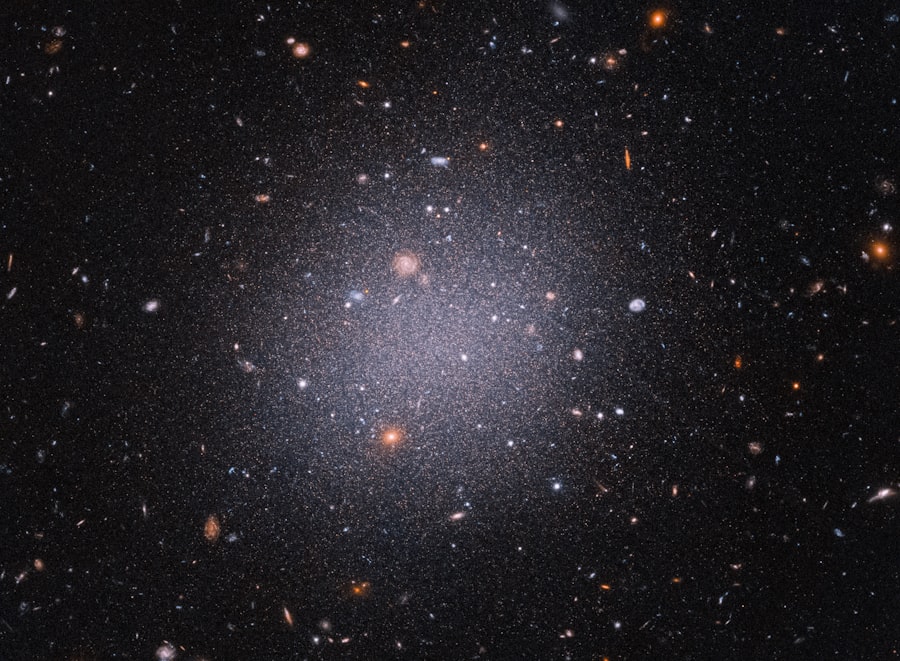
The existence of dark matter has profound implications for the Standard Model of cosmology, which describes the universe’s evolution from the Big Bang to its current state. You will discover that dark matter is a key component in models explaining cosmic inflation and structure formation. Without it, many observed phenomena—such as the uniformity of the cosmic microwave background radiation—would be difficult to reconcile with our current understanding.
Incorporating dark matter into cosmological models has led to significant advancements in our comprehension of cosmic history. It helps explain why galaxies are distributed in a seemingly clumpy manner rather than uniformly throughout space. As you engage with these models, you will appreciate how they provide a framework for understanding not only dark matter but also other critical aspects of cosmology, such as dark energy and the overall fate of the universe.
The Hunt for Dark Matter Particles
The hunt for dark matter particles is an ongoing endeavor that combines theoretical predictions with experimental efforts. As you follow this quest, you will encounter various experiments designed to detect WIMPs or other potential candidates for dark matter. These experiments often take place in highly controlled environments—such as deep underground laboratories—to shield them from cosmic rays and other background noise that could interfere with detection efforts.
Additionally, direct detection experiments like LUX-ZEPLIN aim to observe rare interactions between dark matter particles and ordinary matter using sensitive detectors located deep underground. As you explore these initiatives, you will see how they represent humanity’s relentless pursuit of knowledge about one of the universe’s greatest mysteries.
The Challenges of Detecting Dark Matter
Detecting dark matter presents numerous challenges that have stymied researchers for decades. One primary obstacle is its weak interaction with ordinary matter; if dark matter particles exist as theorized, they would rarely collide with atoms in detectors designed to capture their presence. This rarity means that experiments must be incredibly sensitive and capable of distinguishing between potential signals from dark matter and background noise.
Moreover, there is still much uncertainty regarding what form dark matter takes—whether it consists of WIMPs, axions, or something entirely different. This ambiguity complicates detection efforts since different candidates would require distinct experimental approaches. As you consider these challenges, it becomes clear that while progress has been made in understanding dark matter, significant hurdles remain before its true nature can be unveiled.
Alternative Theories to Explain Galactic Rotation Curves
While dark matter remains the leading explanation for observed phenomena like galactic rotation curves, alternative theories have emerged that challenge this paradigm. One such theory is Modified Newtonian Dynamics (MOND), which posits that Newton’s laws may need adjustment at low accelerations typical in galactic outskirts. According to MOND proponents, this modification could explain why stars at the edges of galaxies rotate faster than expected without invoking unseen mass.
Another alternative is the concept of emergent gravity proposed by some physicists, suggesting that gravity itself may arise from more fundamental interactions rather than being a fundamental force. These alternative theories have sparked considerable debate within the scientific community as researchers weigh their merits against traditional dark matter models. As you explore these ideas, you will find that they reflect humanity’s ongoing quest to understand the universe’s complexities and challenge established notions.
The Implications of Dark Matter for Astrophysics
The implications of dark matter extend far beyond its mere existence; they reshape our understanding of astrophysics as a whole. As you engage with this topic, you will discover how dark matter influences galaxy formation, structure evolution, and even cosmic microwave background radiation patterns. Its presence alters our interpretations of observational data and necessitates revisions to existing models.
Furthermore, understanding dark matter could unlock new insights into fundamental physics questions related to gravity and particle interactions. As researchers continue to investigate its properties and behavior, they may uncover new physics beyond the Standard Model—potentially leading to groundbreaking discoveries that redefine our understanding of reality itself.
Future Prospects for Understanding Dark Matter
Looking ahead, the future prospects for understanding dark matter are both exciting and uncertain. As technology advances and new observational techniques emerge, researchers are poised to make significant strides in unraveling this cosmic mystery. Upcoming experiments like those planned at next-generation particle colliders or advanced astronomical surveys promise to shed light on dark matter’s properties and interactions.
Moreover, interdisciplinary collaboration between astrophysicists, particle physicists, and cosmologists will be crucial in piecing together this puzzle. By combining insights from various fields, scientists can develop more comprehensive models that account for both visible and invisible components of the universe. As you contemplate these future endeavors, it becomes evident that while many questions remain unanswered, humanity’s quest for knowledge about dark matter will undoubtedly continue to inspire generations to come.
In conclusion, your journey through the realm of dark matter reveals a complex tapestry woven into the fabric of our universe. From its elusive nature to its profound implications for cosmology and astrophysics, dark matter remains one of science’s most captivating enigmas—a testament to humanity’s enduring curiosity about the cosmos we inhabit.
Dark matter remains one of the most intriguing mysteries in astrophysics, and understanding its properties is crucial for unraveling the universe’s composition. For a deeper dive into the complexities surrounding dark matter, you can explore the article available at this link, which provides a comprehensive overview of current theories and research in the field.
FAQs
What is dark matter?
Dark matter is a form of matter that does not emit, absorb, or reflect light, making it invisible to current telescopes. It is believed to make up about 27% of the universe’s total mass and energy.
How do scientists know dark matter exists if it cannot be seen?
Scientists infer the existence of dark matter through its gravitational effects on visible matter, such as the rotation curves of galaxies, gravitational lensing, and the large-scale structure of the universe.
What is dark matter made of?
The exact composition of dark matter is unknown. It is hypothesized to consist of non-baryonic particles, such as Weakly Interacting Massive Particles (WIMPs) or axions, which do not interact with electromagnetic forces.
How does dark matter affect the universe?
Dark matter plays a crucial role in the formation and evolution of galaxies and galaxy clusters by providing the necessary gravitational pull to hold them together and influence their motion.
Can dark matter be detected directly?
Direct detection of dark matter particles is an ongoing area of research. Experiments use highly sensitive detectors deep underground to try to observe rare interactions between dark matter particles and ordinary matter.
Is dark matter the same as dark energy?
No, dark matter and dark energy are different. Dark matter exerts gravitational attraction, while dark energy is a mysterious force causing the accelerated expansion of the universe.
What are some methods used to study dark matter?
Methods include observing galaxy rotation curves, gravitational lensing effects, cosmic microwave background measurements, and conducting particle physics experiments to detect dark matter particles.
Why is understanding dark matter important?
Understanding dark matter is essential for a complete picture of the universe’s composition, structure, and evolution, and it could provide insights into fundamental physics beyond the Standard Model.