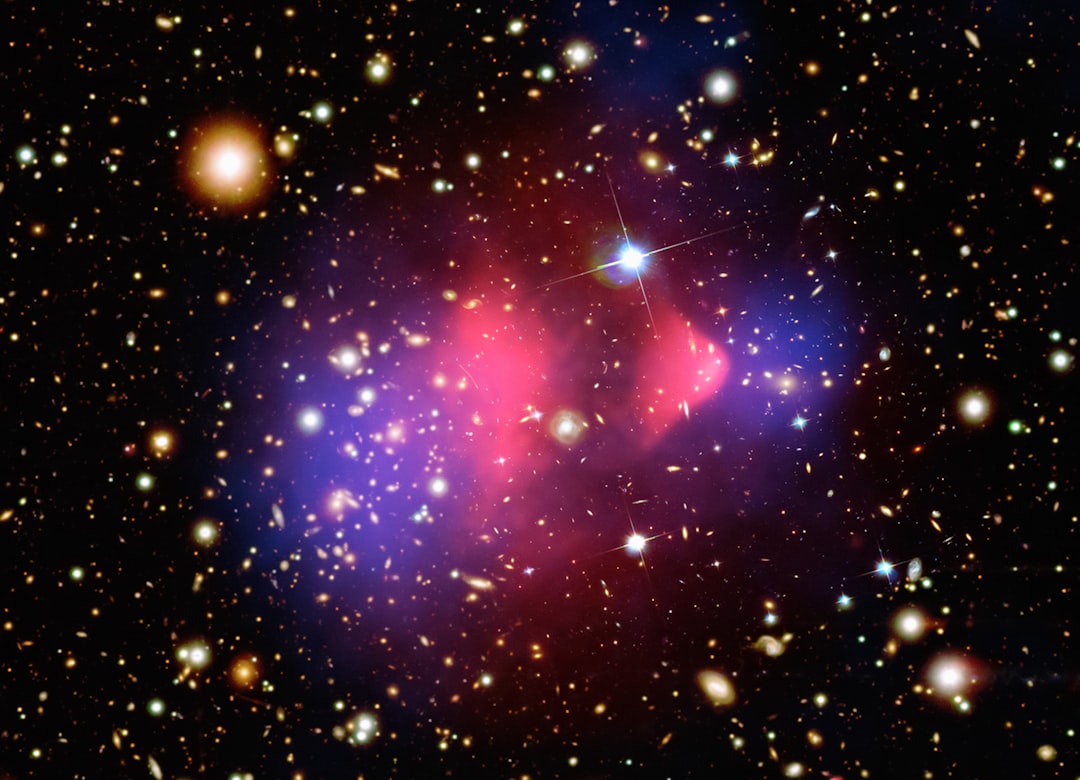
Axion dark matter is a theoretical particle considered a promising candidate for dark matter. Unlike ordinary matter that constitutes stars, planets, and organisms, dark matter neither emits, absorbs, nor reflects light, rendering it invisible and only detectable through gravitational effects. The axion was initially proposed in the 1970s as a solution to a specific problem in particle physics concerning the strong force, but its characteristics have led scientists to investigate it as a potential dark matter component.
Axions are predicted to be extremely lightweight particles with weak interaction properties. This characteristic suggests they could exist abundantly throughout the universe while remaining difficult to detect. The presence of axions could potentially explain the observed galactic rotation speeds that cannot be accounted for by visible matter alone.
Research into axion dark matter continues to advance our understanding of universal composition and structure.
Key Takeaways
- Axion dark matter is a theoretical particle proposed to explain dark matter in the universe.
- It originates from solutions to the strong CP problem in quantum chromodynamics.
- Detecting axions involves specialized experiments using resonant cavities and magnetic fields.
- Axion research complements the search for WIMPs, offering alternative dark matter candidates.
- Understanding axion dark matter has significant implications for cosmology, particle physics, and astrophysics.
Theoretical Origins of Axion Dark Matter
The theoretical origins of axion dark matter can be traced back to the Peccei-Quinn theory, which was proposed to address the strong CP (Charge Parity) problem in quantum chromodynamics (QCD). This theory posits that there exists a new symmetry in nature that, when spontaneously broken, gives rise to the axion. The axion is not just a solution to a theoretical conundrum; it also possesses properties that make it a prime candidate for dark matter.
As you explore the implications of this theory, you will find that the axion’s predicted mass and interactions align well with the characteristics needed for dark matter.
Researchers have been working tirelessly to understand how these particles could have formed in the early universe and how they might still be influencing cosmic structures today.
Detecting Axion Dark Matter

Detecting axion dark matter presents a unique challenge due to its weak interactions with ordinary matter. Various experimental approaches have been proposed to identify these elusive particles. One promising method involves using strong magnetic fields to convert axions into detectable photons.
This process relies on the axion’s predicted coupling to electromagnetic fields, allowing researchers to search for the faint signals that might indicate their presence. You may find it interesting that several experiments are currently underway or in development, such as the Axion Dark Matter Experiment (ADMX) and the Light Shining Through a Wall (LSW) experiment. These initiatives aim to create conditions where axions can be converted into light or other detectable particles.
As technology advances, the hope is that these experiments will yield results that could confirm or refute the existence of axions as a component of dark matter.
Axion Dark Matter and the Search for WIMPs
In the quest to understand dark matter, researchers have primarily focused on Weakly Interacting Massive Particles (WIMPs) as another leading candidate. While WIMPs are still considered viable, axions offer an alternative perspective that could complement or even replace WIMP theories. The search for WIMPs has dominated dark matter research for decades, but as you explore the landscape of particle physics, you will see how axions provide a different approach to understanding this enigmatic substance.
The comparison between axions and WIMPs highlights the diversity of potential dark matter candidates. While WIMPs are expected to have masses on the order of hundreds of GeV (giga-electronvolts), axions are theorized to be much lighter, possibly in the micro-eV (electronvolt) range.
As you consider these two candidates, you will appreciate how they represent different facets of the ongoing search for answers about dark matter.
Axion Dark Matter and the Quest for Dark Matter Particle
| Property | Value / Range | Unit | Description |
|---|---|---|---|
| Mass | 1e-6 to 1e-3 | eV/c² | Estimated mass range of axion dark matter particles |
| Coupling Constant (Photon) | 1e-16 to 1e-10 | GeV⁻¹ | Axion-photon coupling strength |
| Local Density | 0.3 | GeV/cm³ | Estimated local dark matter density in the Milky Way |
| Decay Constant (f_a) | 1e9 to 1e12 | GeV | Axion decay constant related to symmetry breaking scale |
| Velocity Dispersion | ~220 | km/s | Typical velocity of axion dark matter particles in the galaxy |
| Detection Methods | Haloscopes, Helioscopes, Light Shining Through Walls | N/A | Experimental techniques to detect axion dark matter |
The quest for a definitive dark matter particle has been one of the most significant challenges in modern physics. Axions have emerged as a leading candidate due to their unique properties and theoretical underpinnings. As you delve into this quest, you will encounter various models and frameworks that attempt to explain how axions could fit into our understanding of particle physics and cosmology.
The search for a dark matter particle is not just about identifying a single entity; it involves understanding how such particles interact with one another and with ordinary matter. Axions could potentially provide insights into fundamental questions about the universe’s composition and evolution. As researchers continue to explore this avenue, they are also investigating how axions might connect with other areas of physics, such as quantum mechanics and field theory.
Axion Dark Matter and the Quantum Universe
The relationship between axion dark matter and quantum mechanics is a fascinating area of study. Axions are predicted to exhibit quantum behavior due to their light mass and weak interactions. This means that they could play a role in phenomena such as Bose-Einstein condensation or other quantum states that arise in low-energy environments.
As you explore this intersection between axions and quantum mechanics, you will uncover new insights into how these particles might behave under various conditions. Moreover, the implications of axion dark matter extend beyond particle physics into cosmology and astrophysics. The quantum nature of axions could influence large-scale structures in the universe, potentially affecting galaxy formation and evolution.
As you consider these connections, you will begin to appreciate how axions could bridge gaps between different fields of study, offering a more unified understanding of the universe.
The Role of Axion Dark Matter in Cosmology
In cosmology, axion dark matter plays a crucial role in shaping our understanding of the universe’s structure and evolution. The presence of dark matter is essential for explaining various cosmic phenomena, from galaxy rotation curves to gravitational lensing effects. Axions, with their unique properties, could provide a framework for understanding how dark matter influences these processes.
As you delve deeper into cosmological models that incorporate axion dark matter, you will find that they offer explanations for observations that remain puzzling under conventional theories. For instance, simulations incorporating axions can produce results that align more closely with observed galaxy distributions than those based solely on baryonic (ordinary) matter. This connection between axions and cosmology highlights their potential significance in unraveling the mysteries of our universe.
Experimental Evidence for Axion Dark Matter
While direct experimental evidence for axion dark matter remains elusive, several indirect observations support its existence. For instance, astrophysical phenomena such as the cosmic microwave background radiation and large-scale structure formation can be explained more effectively when axions are included in cosmological models. These observations provide tantalizing hints that axions may indeed be part of the dark matter puzzle.
You may also find it intriguing that ongoing experiments are designed specifically to detect axions or their effects on other particles. The results from these experiments could either confirm or challenge existing theories about dark matter. As researchers continue to refine their techniques and technologies, the hope is that definitive evidence for axion dark matter will emerge in the coming years.
Challenges in Studying Axion Dark Matter
Studying axion dark matter presents numerous challenges due to its elusive nature and weak interactions with ordinary matter. One significant hurdle is designing experiments sensitive enough to detect such faint signals amidst background noise from other sources. Researchers must develop innovative techniques and technologies to isolate potential axion interactions from other phenomena.
Additionally, theoretical uncertainties surrounding axion properties complicate efforts to pinpoint their characteristics accurately. The wide range of possible masses and coupling strengths makes it difficult to design experiments tailored specifically for axion detection. As you consider these challenges, you will gain insight into the complexities involved in advancing our understanding of this enigmatic particle.
Axion Dark Matter and the Future of Particle Physics
The future of particle physics may be significantly influenced by discoveries related to axion dark matter. If experimental evidence confirms the existence of axions, it could lead to a paradigm shift in our understanding of fundamental particles and forces. This would not only reshape theories about dark matter but also open new avenues for research in particle physics.
As you contemplate the implications of potential discoveries related to axions, consider how they might impact other areas of science as well. The interplay between particle physics, cosmology, and astrophysics could yield groundbreaking insights into the nature of reality itself. The pursuit of knowledge about axion dark matter represents an exciting frontier in scientific exploration.
Implications of Axion Dark Matter for Astrophysics
The implications of axion dark matter extend far beyond particle physics; they also hold significant relevance for astrophysics. If axions are indeed a component of dark matter, their properties could influence various astrophysical processes, including star formation and galaxy dynamics. Understanding how these particles interact with ordinary matter could provide valuable insights into the evolution of cosmic structures.
As you explore these implications further, consider how they might inform our understanding of phenomena such as gravitational lensing or cosmic inflation. The presence of axions could alter predictions about how galaxies form and evolve over time, leading to new models that better align with observational data. In this way, studying axion dark matter not only enhances our knowledge of fundamental particles but also enriches our understanding of the universe as a whole.
In conclusion, your journey through the world of axion dark matter reveals a complex interplay between theoretical physics, experimental research, and cosmological implications. As scientists continue to investigate this intriguing candidate for dark matter, you will witness how it challenges existing paradigms and opens new avenues for exploration in both particle physics and astrophysics alike.
Recent research into axion dark matter particles has opened new avenues in our understanding of the universe’s composition. For a deeper dive into the implications of axion theory and its potential to solve longstanding mysteries in astrophysics, you can read more in this related article on our site: