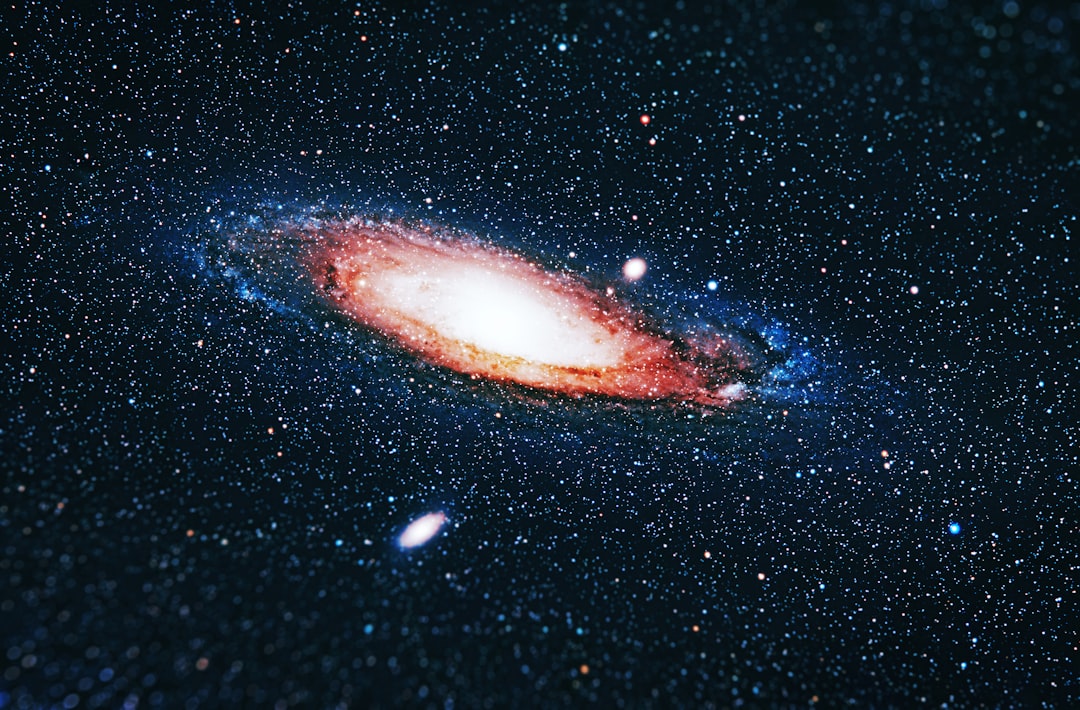
The cosmological constant problem represents a fundamental challenge in theoretical physics and cosmology. This issue centers on the significant discrepancy between the observed energy density of the universe and quantum field theory predictions. The universe’s accelerating expansion contrasts sharply with theoretical calculations of vacuum energy density, creating a substantial numerical mismatch that challenges our understanding of fundamental physical principles.
This problem extends beyond basic cosmological questions, challenging our comprehension of gravity and spacetime structure while carrying significant implications for the universe’s ultimate fate. The cosmological constant (Λ), first introduced by Einstein in his general relativity equations, has evolved in scientific importance over time. This parameter has become central to cosmological research, connecting quantum mechanics, general relativity, and observational astronomy.
The resolution of this discrepancy remains essential for developing a comprehensive understanding of universal structure, origins, and eventual destiny.
Key Takeaways
- The cosmological constant problem highlights the discrepancy between theoretical predictions and observed values of vacuum energy density.
- Einstein originally introduced the cosmological constant to achieve a static universe model, later calling it his “biggest blunder.”
- Observational evidence, such as the accelerated expansion of the universe, supports a positive cosmological constant linked to dark energy.
- Modern research explores various theoretical frameworks and quantum effects to resolve the cosmological constant problem.
- Understanding the cosmological constant is crucial for predicting the ultimate fate of the universe and guiding future cosmological studies.
Historical Background of the Cosmological Constant
The roots of the cosmological constant can be traced back to the early 20th century when Einstein formulated his theory of general relativity. Initially, he introduced the cosmological constant as a means to achieve a static universe, which was the prevailing belief at that time. You might find it intriguing that Einstein’s original equations suggested that gravity would cause the universe to collapse unless a counteracting force was introduced.
However, this notion was dramatically altered in 1929 when Edwin Hubble discovered that the universe is not static but rather expanding. This revelation led Einstein to famously dismiss his cosmological constant as his “greatest blunder.” Yet, as you explore further into the latter half of the 20th century, you will see a resurgence of interest in Λ.
The discovery of cosmic acceleration in the late 1990s reignited discussions about dark energy and its relationship with the cosmological constant, prompting scientists to reconsider its role in our understanding of the universe.
Einstein’s Contribution to the Cosmological Constant
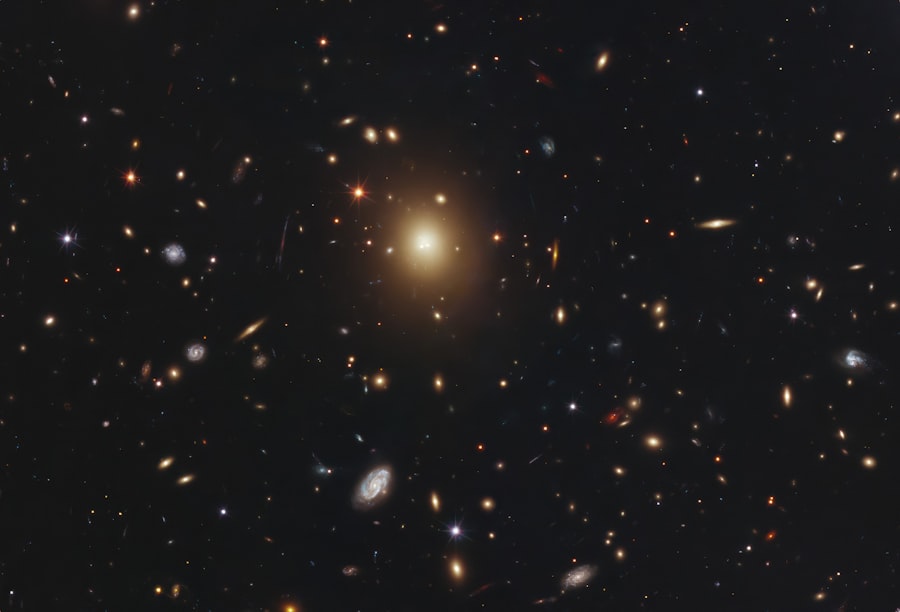
Einstein’s introduction of the cosmological constant was a pivotal moment in theoretical physics. You may appreciate how his desire for a static universe led him to modify his equations, reflecting both his scientific intuition and the cultural context of his time. By incorporating Λ into his field equations, he provided a mathematical framework that allowed for a balance between gravitational attraction and cosmic expansion.
This move was not merely a mathematical convenience; it represented a profound shift in how we perceive the universe. As you examine Einstein’s work more closely, you will notice that his cosmological constant was not just an arbitrary addition but rather a reflection of his deep understanding of gravity and spacetime. It demonstrated his willingness to adapt his theories in light of new evidence, a hallmark of scientific progress.
Theoretical Implications of the Cosmological Constant
The theoretical implications of the cosmological constant are vast and complex. You might find it intriguing that Λ is often associated with dark energy, which is thought to make up about 68% of the universe’s total energy density. This association raises questions about the nature of dark energy itself: Is it truly a constant force acting uniformly throughout space, or does it vary over time?
The answers to these questions could reshape our understanding of fundamental physics. Moreover, as you explore these implications further, you will encounter discussions about how the cosmological constant interacts with other forces in the universe. For instance, its presence influences cosmic structures and their formation, affecting everything from galaxy clusters to cosmic microwave background radiation.
The challenge lies in reconciling these theoretical predictions with observational data, as discrepancies continue to emerge. This ongoing dialogue between theory and observation is essential for advancing our understanding of both Λ and dark energy.
Observational Evidence for the Cosmological Constant
| Metric | Value / Estimate | Unit | Description |
|---|---|---|---|
| Observed Vacuum Energy Density | ~6 x 10^-10 | J/m³ | Energy density associated with the cosmological constant inferred from observations of dark energy |
| Planck Energy Density | ~10^113 | J/m³ | Energy density scale derived from Planck units, representing theoretical vacuum energy from quantum field theory |
| Discrepancy Factor | ~10^123 | Dimensionless | Ratio between theoretical vacuum energy density and observed vacuum energy density |
| Cosmological Constant (Lambda) | ~1.1 x 10^-52 | m^-2 | Value of the cosmological constant derived from cosmological observations |
| Dark Energy Density Parameter (Omega Lambda) | ~0.7 | Dimensionless | Fraction of the total energy density of the universe attributed to dark energy |
| Hubble Constant (H0) | 67.4 – 74 | km/s/Mpc | Current rate of expansion of the universe, relevant for cosmological constant calculations |
Observational evidence supporting the existence of a cosmological constant has emerged from various sources over recent decades. One of the most compelling pieces of evidence comes from Type Ia supernovae observations, which revealed that distant galaxies are receding from us at an accelerating rate. You may find it fascinating that these observations suggest that some form of energy—often attributed to dark energy—is driving this acceleration, leading many scientists to conclude that a cosmological constant is indeed at play.
Additionally, measurements from cosmic microwave background radiation provide further support for Λ. The fluctuations in this radiation offer insights into the early universe’s conditions and its subsequent evolution. As you analyze these findings, you will see how they converge on a consistent picture: a universe dominated by dark energy with a significant contribution from the cosmological constant.
However, while these observations lend credence to Λ’s existence, they also highlight ongoing debates about its precise nature and implications.
Attempts to Solve the Cosmological Constant Problem
The cosmological constant problem has spurred numerous attempts to reconcile theoretical predictions with observational data. You may find it interesting that one approach involves modifying general relativity itself or exploring alternative theories of gravity. These modifications aim to account for cosmic acceleration without relying solely on a constant value for dark energy.
Such theories often introduce dynamic fields or additional dimensions, challenging our conventional understanding of spacetime. Another avenue researchers have pursued is investigating potential cancellations between quantum field theory predictions and gravitational effects. This idea suggests that while vacuum energy should contribute significantly to cosmic energy density, some unknown mechanism might counteract this effect, leading to an observed value close to zero.
As you delve into these various approaches, you will appreciate how they reflect both creativity and rigor in addressing one of cosmology’s most pressing challenges.
Modern Research and Developments in the Cosmological Constant Problem
In recent years, modern research has made significant strides in addressing the cosmological constant problem. You might be intrigued by how advancements in observational technology have allowed scientists to gather more precise data about cosmic expansion and structure formation. Projects like the European Space Agency’s Euclid mission aim to map dark energy’s influence on large-scale structures across vast distances, providing valuable insights into its nature.
Moreover, theoretical physicists are increasingly collaborating across disciplines to explore new frameworks that could shed light on Λ. You may find it exciting that ideas from string theory and quantum gravity are being integrated into discussions about dark energy and its implications for cosmology. These interdisciplinary efforts reflect a growing recognition that solving the cosmological constant problem requires innovative thinking and collaboration among diverse fields.
The Role of Dark Energy in the Cosmological Constant Problem
Dark energy plays a central role in understanding the cosmological constant problem. As you explore this concept further, you will discover that dark energy is often equated with Λ due to its observed effects on cosmic expansion. However, distinguishing between these two concepts is crucial; while Λ represents a specific value in Einstein’s equations, dark energy encompasses a broader range of phenomena that could include dynamic fields or other exotic forms of energy.
The challenge lies in characterizing dark energy’s properties and behavior over time. You may find it fascinating that researchers are investigating whether dark energy remains constant or evolves as the universe expands. This inquiry has profound implications for our understanding of cosmic history and future evolution.
As you engage with these ideas, consider how unraveling dark energy’s mysteries could lead to breakthroughs not only in cosmology but also in fundamental physics.
Implications for the Fate of the Universe
The cosmological constant problem has significant implications for predicting the fate of the universe. You might ponder how different scenarios could unfold based on varying values of Λ and dark energy dynamics. If Λ remains constant, current models suggest an ever-accelerating expansion leading to a “Big Freeze,” where galaxies drift apart until stars burn out and galaxies become dark voids in an increasingly cold universe.
Conversely, if dark energy evolves or diminishes over time, alternative outcomes could emerge. For instance, some theories propose scenarios where gravitational forces eventually dominate again, leading to a “Big Crunch.” As you contemplate these possibilities, consider how they reflect not only on our understanding of cosmic evolution but also on humanity’s place within this vast expanse.
Unsolved Questions and Future Directions in Cosmology
Despite significant progress in understanding the cosmological constant problem, many questions remain unanswered. You may find it compelling that researchers continue to grapple with fundamental issues such as why vacuum energy density is so small compared to theoretical predictions or what mechanisms might underlie dark energy’s behavior. These unresolved questions highlight gaps in our knowledge and signal opportunities for future exploration.
As you look ahead, consider how emerging technologies and interdisciplinary collaborations could pave new paths in cosmology. Projects like gravitational wave observatories and advanced telescopes promise to provide fresh insights into cosmic phenomena related to dark energy and Λ. By remaining open to new ideas and approaches, you can appreciate how scientific inquiry evolves over time and how each discovery builds upon previous knowledge.
Conclusion and Implications for Cosmological Studies
In conclusion, the cosmological constant problem encapsulates some of the most profound questions facing modern science today. As you reflect on this issue, consider how it intertwines with our understanding of fundamental physics, cosmic evolution, and even philosophical inquiries about existence itself. The journey toward unraveling this mystery is ongoing, fueled by curiosity and innovation across disciplines.
The implications extend beyond theoretical considerations; they touch upon humanity’s quest for knowledge about our place in the universe. By engaging with these ideas and remaining attuned to new developments in cosmology, you contribute to a broader dialogue about our understanding of reality itself—a dialogue that continues to evolve as we seek answers to some of life’s most profound questions.
The cosmological constant problem remains one of the most perplexing issues in modern physics, as it highlights the discrepancy between the observed value of dark energy and the theoretical predictions from quantum field theory. For a deeper understanding of related concepts and discussions surrounding this topic, you can explore the article on Real Lore and Order, which delves into various aspects of cosmology and the implications of the cosmological constant.
FAQs
What is the cosmological constant?
The cosmological constant, often denoted by the Greek letter Lambda (Λ), is a term introduced by Albert Einstein in his equations of General Relativity. It represents a constant energy density filling space homogeneously, which can cause the expansion of the universe to accelerate.
What is the cosmological constant problem?
The cosmological constant problem refers to the large discrepancy between the observed value of the cosmological constant, which is very small but positive, and theoretical predictions from quantum field theory, which suggest it should be enormously larger. This mismatch is one of the biggest unsolved problems in theoretical physics.
Why is the cosmological constant important in cosmology?
The cosmological constant is important because it affects the rate of expansion of the universe. Observations of distant supernovae and the cosmic microwave background indicate that the universe’s expansion is accelerating, which can be explained by a positive cosmological constant or dark energy.
How does quantum field theory relate to the cosmological constant problem?
Quantum field theory predicts that vacuum fluctuations contribute a large energy density to empty space. When this vacuum energy is interpreted as a cosmological constant, the predicted value is many orders of magnitude larger than what is observed, leading to the cosmological constant problem.
What are some proposed solutions to the cosmological constant problem?
Proposed solutions include ideas such as supersymmetry, which could cancel out vacuum energy contributions; modifications to gravity; anthropic reasoning within the multiverse framework; and dynamic dark energy models like quintessence. However, no consensus solution currently exists.
Is the cosmological constant the same as dark energy?
The cosmological constant is the simplest form of dark energy, characterized by a constant energy density and pressure. Dark energy more generally refers to any form of energy causing the accelerated expansion of the universe, which may vary over time.
How was the cosmological constant originally introduced?
Einstein introduced the cosmological constant in 1917 to allow for a static universe solution in his field equations of General Relativity. After the discovery of the expanding universe, he reportedly called it his “biggest blunder,” though the term has regained importance in modern cosmology.
What observational evidence supports a nonzero cosmological constant?
Key evidence includes observations of distant Type Ia supernovae showing accelerated expansion, measurements of the cosmic microwave background radiation, and large-scale structure surveys. These collectively support a small positive cosmological constant or dark energy component in the universe.
Does the cosmological constant affect the fate of the universe?
Yes, a positive cosmological constant implies that the universe will continue to expand at an accelerating rate, potentially leading to a “cold death” scenario where galaxies move beyond each other’s observable horizons and star formation ceases.
Is the cosmological constant problem purely theoretical, or does it have practical implications?
While primarily a theoretical issue in fundamental physics and cosmology, resolving the cosmological constant problem could lead to deeper understanding of quantum gravity, the nature of spacetime, and the fundamental forces, potentially impacting future physics theories.