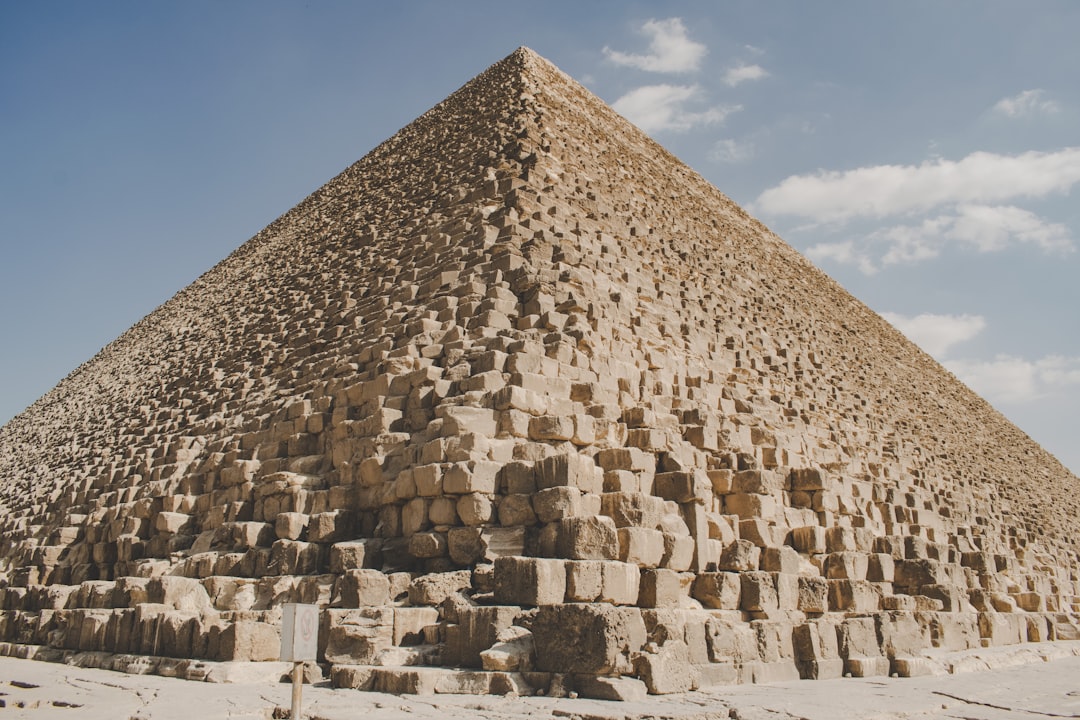
The Great Pyramid of Giza was constructed during Egypt’s Fourth Dynasty of the Old Kingdom period, approximately 4,500 years ago, as a burial monument for Pharaoh Khufu (known in Greek as Cheops). The structure originally measured 146.
Located on the Giza plateau, this pyramid is the largest of three pyramids at the site.
The monument required extensive resources and demonstrates advanced engineering capabilities and organizational systems for managing large-scale construction projects. Archaeological evidence indicates the pyramid’s construction involved sophisticated mathematical calculations, precise stone cutting techniques, and complex logistical coordination. The Great Pyramid reflects the religious practices and social structure of ancient Egyptian society, particularly beliefs surrounding pharaonic burial customs and the afterlife.
Modern archaeological and engineering studies continue to examine the construction methods, internal chamber systems, and the monument’s role within ancient Egyptian funerary traditions and royal ideology.
Key Takeaways
- The Great Pyramid’s construction involved advanced mathematics, geometry, and precise alignment techniques.
- Various theories exist about its purpose, ranging from tomb to astronomical observatory.
- Ingenious interior design showcases sophisticated engineering and structural stability.
- Construction likely utilized advanced tools and innovative building methods for its time.
- The pyramid’s legacy continues to influence modern engineering and architectural practices.
Theories and Speculations about its Construction
The construction of the Great Pyramid has long been shrouded in mystery, leading to a plethora of theories and speculations regarding how it was built. One prevailing theory suggests that a large workforce, possibly numbering in the tens of thousands, was organized to transport and assemble the massive limestone blocks that constitute the pyramid. These workers were likely skilled laborers rather than slaves, as previously thought, and they may have been motivated by a sense of national pride and religious duty.
Evidence from workers’ cemeteries near Giza supports this notion, indicating that those who built the pyramid were well cared for and respected. Another theory posits that ramps were used to move the heavy stones into place. Various ramp designs have been proposed, including straight ramps, zigzagging ramps, and circular ramps that spiraled around the pyramid as it rose.
Each design presents its own set of challenges and advantages, but all underscore the remarkable engineering skills possessed by the ancient Egyptians. Despite extensive research, no single theory has been universally accepted, leaving room for ongoing debate and exploration into how such an extraordinary feat was accomplished. Discover the secrets behind the pyramid mystery ancient egypt in this fascinating video.
Unraveling the Mysteries of the Pyramid’s Alignment
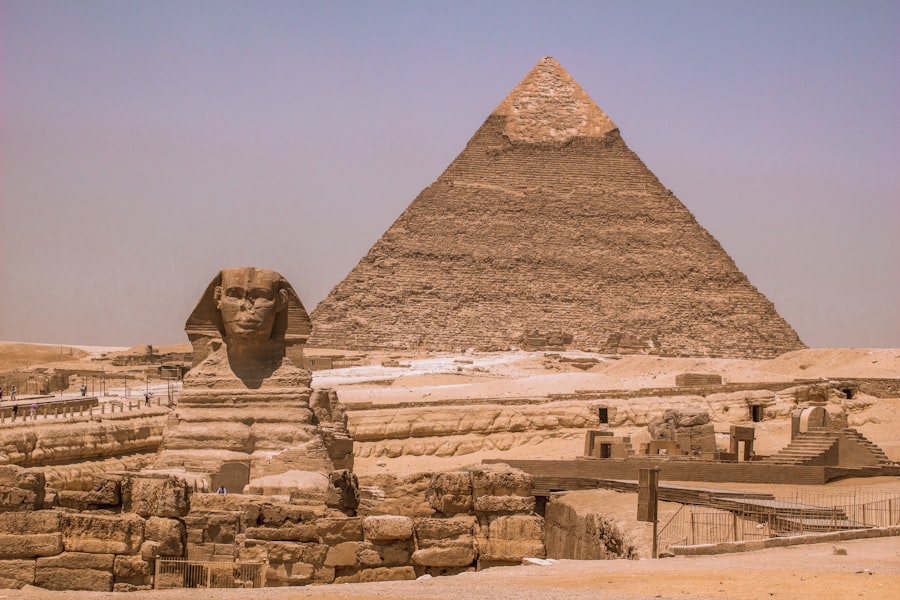
One of the most intriguing aspects of the Great Pyramid is its precise alignment with cardinal points—north, south, east, and west. The pyramid’s sides are oriented with astonishing accuracy to these directions, with an error margin of only a fraction of a degree. This precision has led scholars to speculate about the methods employed by ancient Egyptians to achieve such alignment without modern tools or technology.
Some researchers suggest that they may have used astronomical observations, tracking the stars or the sun’s position at specific times of the year to establish true north. The alignment of the Great Pyramid is not merely a matter of aesthetics; it holds significant religious and cultural implications. The ancient Egyptians believed that their pharaohs would ascend to the heavens after death, and aligning their tombs with celestial bodies may have been intended to facilitate this journey.
The pyramid’s orientation towards the constellation Orion, which was associated with Osiris—the god of the afterlife—further emphasizes this connection between architecture and spirituality. As researchers continue to investigate these alignments, they uncover deeper layers of meaning embedded within this ancient structure.
The Ingenious Design of the Pyramid’s Interior
The interior design of the Great Pyramid is as remarkable as its exterior. Comprising a series of chambers and passageways, the pyramid was meticulously crafted to serve both practical and symbolic purposes. The King’s Chamber, located at the heart of the pyramid, is constructed entirely from granite and features a flat ceiling supported by massive granite beams.
This chamber housed the sarcophagus of Pharaoh Khufu and was designed to reflect his divine status. The Grand Gallery, an impressive ascending corridor leading to the King’s Chamber, showcases the architectural prowess of its builders with its corbelled ceiling and intricate design. In addition to its functional aspects, the interior layout also reflects profound religious beliefs.
The presence of various chambers—such as the Queen’s Chamber and several smaller shafts—suggests that they may have held ritual significance or served as symbolic pathways for the pharaoh’s journey into the afterlife. The careful arrangement of these spaces indicates a deep understanding of both architecture and spirituality among ancient Egyptian builders. As researchers delve into these intricate designs, they continue to uncover insights into how these elements contributed to the overall purpose of the pyramid.
The Role of Mathematics and Geometry in the Pyramid’s Construction
| Engineering Aspect | Details | Metric / Data | Significance |
|---|---|---|---|
| Base Dimensions | Square base with near-perfect alignment to cardinal points | 230.4 meters per side; deviation less than 0.05° | Ensures structural stability and astronomical alignment |
| Height | Original height of the pyramid | 146.6 meters (481 feet) | Determines volume and internal chamber placement |
| Number of Blocks | Estimated total limestone and granite blocks used | Approximately 2.3 million blocks | Reflects scale and labor organization |
| Block Weight | Average weight of limestone blocks | 2.5 tons (2,500 kg) per block | Challenges in transportation and placement |
| Internal Chambers | Number of main internal chambers | 3 (King’s Chamber, Queen’s Chamber, Grand Gallery) | Complex internal design for burial and ventilation |
| Ventilation Shafts | Purpose and number of shafts | 4 shafts designed for air flow and symbolic purposes | Maintains air quality and spiritual symbolism |
| Construction Time | Estimated duration to build the pyramid | Approximately 20 years | Indicates workforce size and project management |
| Precision Engineering | Accuracy in stone cutting and placement | Less than 0.1 mm gap between stones | Ensures durability and longevity |
Mathematics and geometry played a crucial role in the construction of the Great Pyramid, showcasing the advanced knowledge possessed by ancient Egyptian architects. The pyramid’s proportions are based on precise mathematical ratios that reflect an understanding of geometry far ahead of its time. For instance, the ratio of the pyramid’s height to its base perimeter approximates pi (π), suggesting that builders had a sophisticated grasp of circular geometry.
Moreover, the use of specific measurements in constructing the pyramid demonstrates an intentional design philosophy rooted in mathematical principles. The dimensions were likely derived from sacred numbers significant in Egyptian culture, such as those associated with creation myths or cosmological beliefs. This integration of mathematics into architectural design not only facilitated construction but also imbued the structure with deeper symbolic meaning.
As scholars continue to analyze these mathematical relationships, they reveal how ancient Egyptians harmonized their architectural endeavors with their spiritual worldview.
Understanding the Construction Techniques Used in Building the Great Pyramid
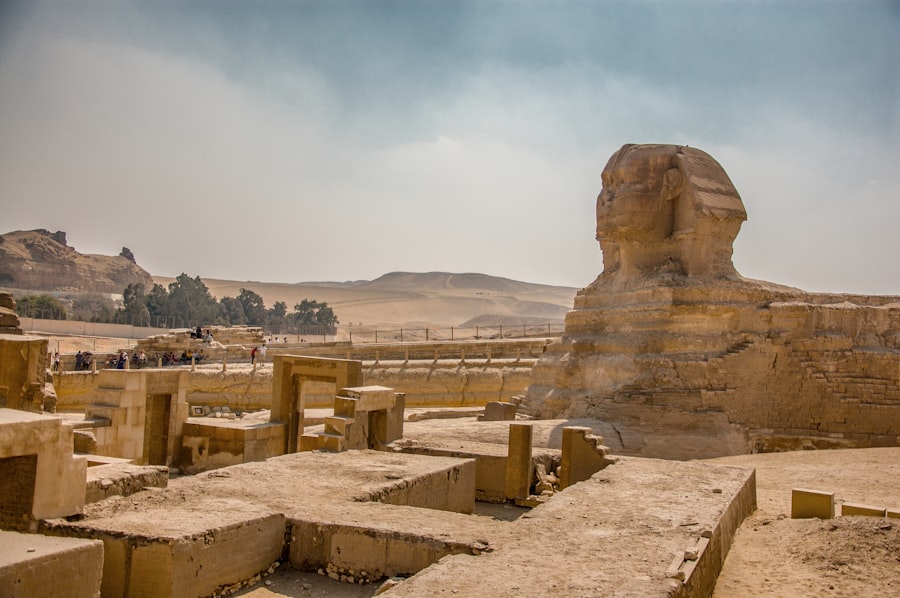
The construction techniques employed in building the Great Pyramid remain a subject of fascination and inquiry among historians and archaeologists. While many aspects are still debated, evidence suggests that a combination of skilled labor, innovative tools, and effective organization were key components in bringing this monumental project to fruition. Workers likely utilized levers and sledges to transport massive stone blocks from nearby quarries to the construction site.
Recent discoveries indicate that they may have even used lubricated surfaces or water to reduce friction during transport. Additionally, evidence points to a highly organized workforce capable of executing complex tasks efficiently. The presence of workers’ villages near Giza suggests that laborers were not only well-fed but also housed close to their worksite, allowing for better coordination and productivity.
This organization extended beyond mere labor management; it involved meticulous planning regarding resource allocation and scheduling to ensure that construction progressed smoothly over decades. As researchers continue to uncover more about these techniques, they gain insights into how ancient Egyptians overcame challenges associated with such an ambitious undertaking.
The Use of Advanced Tools and Technology in Building the Pyramid
While it is often assumed that ancient Egyptians relied solely on rudimentary tools for construction, recent studies reveal that they possessed advanced technology for their time. Tools made from copper—such as chisels and saws—were used to shape stone blocks with remarkable precision. Additionally, evidence suggests that wooden sledges equipped with runners were employed to transport heavy stones across sandy terrain effectively.
The ingenuity displayed in tool-making extended beyond mere functionality; it reflected a deep understanding of materials and their properties. For instance, while limestone was readily available for construction, granite—used for critical structural elements—required specialized tools due to its hardness. This adaptability highlights not only technological advancement but also resourcefulness in utilizing available materials effectively.
As researchers continue to explore these tools’ roles in construction processes, they uncover how ancient Egyptians harnessed technology to achieve their architectural ambitions.
Theories about the Purpose of the Great Pyramid
The purpose of the Great Pyramid has been a topic of speculation since its inception. Traditionally viewed as a royal tomb for Pharaoh Khufu, some scholars argue that its significance extends beyond mere burial practices. The pyramid may have served as a symbol of Khufu’s divine authority and connection to the gods—a physical manifestation of his power meant to ensure his immortality in both life and death.
Moreover, some theories propose that the pyramid functioned as an astronomical observatory or a center for religious rituals tied to solar worship. Its alignment with celestial bodies suggests that it may have played a role in ancient Egyptian cosmology, serving as a bridge between earth and heaven. This multifaceted interpretation underscores how deeply intertwined religion, politics, and architecture were in ancient Egyptian society.
As new evidence emerges through archaeological discoveries, scholars continue to refine their understanding of what this monumental structure represented within its historical context.
The Significance of the Pyramid’s Positioning and Orientation
The positioning and orientation of the Great Pyramid are not merely coincidental; they hold profound significance within both practical and symbolic realms. Strategically located on the Giza plateau near Cairo, its placement allowed for easy access to resources while also serving as a prominent landmark visible from afar. This visibility reinforced Khufu’s status as a powerful ruler whose legacy would endure through time.
Furthermore, its orientation towards cardinal points reflects an intentional design choice rooted in religious beliefs about life after death. By aligning with celestial bodies such as Orion’s Belt—associated with Osiris—the pyramid may have been intended as a conduit for Khufu’s soul to ascend into eternity. This connection between architecture and spirituality illustrates how deeply ingrained these concepts were within ancient Egyptian culture; every aspect—from location to alignment—was carefully considered in creating this monumental structure.
Examining the Structural Stability and Durability of the Great Pyramid
The structural stability and durability of the Great Pyramid are remarkable achievements that have allowed it to withstand millennia of natural elements and human activity. Built using limestone blocks weighing several tons each, its design incorporates features such as a broad base tapering towards its apex—a principle known as “load distribution.” This design minimizes stress on individual stones while maximizing stability over time. Additionally, recent studies suggest that seismic activity has had little impact on its integrity due to its robust construction techniques combined with careful attention paid during assembly processes.
The use of interlocking stones further enhances stability by preventing movement during earthquakes or other disturbances. As researchers continue examining these structural elements through modern technology like 3D modeling and simulations, they gain insights into how ancient builders achieved such enduring strength in their architectural endeavors.
The Legacy of the Great Pyramid and its Influence on Modern Engineering
The legacy left by the Great Pyramid extends far beyond its physical presence; it has profoundly influenced modern engineering practices across various disciplines. Its innovative design principles continue to inspire architects today who seek to create structures that harmonize aesthetics with functionality while ensuring longevity against environmental challenges. Moreover, lessons learned from studying this ancient wonder have informed contemporary approaches toward project management—particularly regarding resource allocation and workforce organization during large-scale constructions projects worldwide.
As engineers strive for efficiency without compromising quality or safety standards today—much like their ancient counterparts—they draw upon centuries-old wisdom embedded within structures like those found at Giza. In conclusion, while many questions surrounding its construction remain unanswered—the Great Pyramid stands testament not only to human ingenuity but also serves as an enduring symbol connecting past civilizations with present-day aspirations toward excellence in engineering practices worldwide.
The engineering secrets behind the Great Pyramid of Giza have fascinated historians and archaeologists for centuries. Recent studies have shed light on the advanced techniques used by the ancient Egyptians, revealing insights into their construction methods and the tools they employed. For a deeper exploration of these engineering marvels, you can read more in this related article: Great Pyramid Engineering Secrets.
WATCH THIS! 🔺 THEY LIED ABOUT THE PYRAMIDS — Here’s The Real Truth 🤯
FAQs
What is the Great Pyramid of Giza?
The Great Pyramid of Giza is an ancient pyramid located in Egypt, built as a tomb for the Pharaoh Khufu around 2580–2560 BC. It is the largest of the three pyramids on the Giza Plateau and one of the Seven Wonders of the Ancient World.
How was the Great Pyramid constructed?
The Great Pyramid was constructed using millions of limestone and granite blocks, some weighing several tons. The exact methods remain debated, but it is believed that a combination of skilled labor, ramps, levers, and precise planning were used to transport and position the stones.
What engineering techniques were used in the Great Pyramid?
The pyramid features precise alignment with the cardinal points, advanced knowledge of geometry, and sophisticated internal chambers and passageways. The builders used a corbelled roof design in the King’s Chamber to distribute weight and prevent collapse.
How accurate is the alignment of the Great Pyramid?
The Great Pyramid is aligned almost perfectly with the four cardinal directions (north, south, east, and west), with an error of only about 3/60th of a degree, demonstrating remarkable astronomical and engineering knowledge.
What materials were used in the construction of the Great Pyramid?
Primarily, the pyramid was built from locally quarried limestone blocks. The inner chambers and some structural elements used granite, transported from quarries located hundreds of kilometers away.
What are some of the internal features of the Great Pyramid?
The pyramid contains several chambers, including the King’s Chamber, Queen’s Chamber, and the Grand Gallery. It also has narrow shafts and passageways, some of which may have had astronomical or ritual significance.
How long did it take to build the Great Pyramid?
Estimates suggest that the Great Pyramid took approximately 20 years to complete, involving thousands of workers and a highly organized labor force.
Are there any modern technologies used to study the Great Pyramid?
Yes, modern technologies such as 3D scanning, ground-penetrating radar, muon radiography, and computer modeling have been used to study the pyramid’s structure and uncover hidden chambers or voids.
What mysteries or secrets about the Great Pyramid remain unsolved?
Despite extensive research, questions remain about the exact construction methods, the purpose of certain internal shafts, and whether undiscovered chambers exist within the pyramid.
Why is the Great Pyramid considered an engineering marvel?
The Great Pyramid is considered an engineering marvel due to its massive scale, precise construction, alignment, and durability, all achieved with ancient technology and without modern machinery.