Piri Reis was a prominent Ottoman admiral, navigator, and cartographer who lived during the 16th century. Born in 1465 in the city of Gallipoli, he was a member of the Turkish naval forces and is best known for his remarkable contributions to the field of cartography. His most famous work, the Piri Reis map, created in 1513, is a testament to his skills and knowledge.
This map not only depicted parts of Europe and Africa but also included a portion of the Americas, showcasing the extent of exploration during that era. Piri Reis’s background as a sailor and his experiences in maritime navigation greatly influenced his cartographic endeavors. Piri Reis’s life was marked by his dedication to the sea and exploration.
He served under various Ottoman sultans and was involved in numerous naval expeditions. His writings, including the “Kitab-ı Bahriye” (Book of Navigation), provided valuable insights into navigation techniques and maritime geography. This work, along with his maps, reflects the synthesis of knowledge from various cultures, including Greek, Arab, and Indian influences.
Piri Reis’s legacy endures not only through his maps but also through his role in advancing the understanding of navigation and cartography in the early modern world.
Key Takeaways
- Piri Reis was an Ottoman admiral, geographer, and cartographer who created a famous world map in 1513.
- The significance of Piri Reis’s map lies in its accurate representation of the coastlines of the Americas, challenging the belief that Columbus was the first to discover the continent.
- Piri Reis made significant contributions to cartography through his meticulous mapping of coastlines and his use of mathematical principles in mapmaking.
- Understanding ice sheet mass balance is crucial for predicting sea level rise and assessing the impact of climate change on polar regions.
- The impact of climate change on ice sheet mass balance is leading to accelerated melting and increased ice loss, contributing to rising sea levels.
The significance of Piri Reis’s map
The Piri Reis map holds immense significance in the history of cartography due to its unique blend of accuracy and artistic representation. Created in 1513, it is one of the oldest surviving maps that depict the New World, specifically parts of South America and the Caribbean.
This amalgamation of knowledge illustrates the interconnectedness of different cultures and their contributions to geographical understanding during the Age of Discovery. Moreover, the Piri Reis map is notable for its depiction of the coastlines with remarkable precision, especially considering the limited navigational tools available at the time. The map’s portrayal of South America, particularly Brazil, is strikingly accurate, suggesting that Piri Reis had access to advanced navigational techniques or possibly even earlier maps that have since been lost to history.
The significance of this map extends beyond its artistic merit; it serves as a historical document that provides insights into the early European perceptions of the Americas and their geographical understanding during a time of exploration and expansion.
Piri Reis’s contribution to cartography
Piri Reis’s contributions to cartography are multifaceted and reflect a deep understanding of both geography and navigation. His maps were not merely tools for navigation; they were also works of art that combined scientific knowledge with aesthetic appeal. The Piri Reis map exemplifies this duality, showcasing intricate illustrations alongside detailed geographical information.
This approach to cartography was innovative for its time and set a precedent for future mapmakers who sought to blend artistry with accuracy. In addition to his famous map, Piri Reis authored the “Kitab-ı Bahriye,” which served as a comprehensive guide to navigation in the Mediterranean Sea. This work included detailed descriptions of coastal regions, harbors, and navigational hazards, making it an invaluable resource for sailors and navigators.
Piri Reis’s emphasis on practical navigation techniques and his ability to synthesize knowledge from various cultures contributed significantly to the advancement of cartography. His work laid the groundwork for future explorers and cartographers, influencing how maps were created and utilized in subsequent centuries.
Understanding ice sheet mass balance
| Year | Ice Sheet Mass Balance (Gt/year) | Uncertainty (Gt/year) |
|---|---|---|
| 2002-2016 | -269 ± 38 | Unknown |
| 2007-2016 | -286 ± 20 | Unknown |
| 2012-2016 | -335 ± 69 | Unknown |
Ice sheet mass balance refers to the difference between the accumulation of snow and ice on an ice sheet and the loss of ice through melting and calving. This concept is crucial for understanding how ice sheets respond to climate change and their contributions to global sea level rise. The mass balance of an ice sheet can be influenced by various factors, including temperature fluctuations, precipitation patterns, and oceanic conditions.
A positive mass balance occurs when accumulation exceeds loss, while a negative mass balance indicates that more ice is being lost than gained. To comprehend ice sheet mass balance fully, it is essential to consider both spatial and temporal scales. Ice sheets are vast expanses of ice that can take thousands of years to respond to climatic changes.
Therefore, long-term monitoring is necessary to assess trends in mass balance accurately. Researchers utilize various methods to measure changes in ice thickness, surface elevation, and ice flow dynamics to gain insights into how these massive structures are evolving over time.
The impact of climate change on ice sheet mass balance
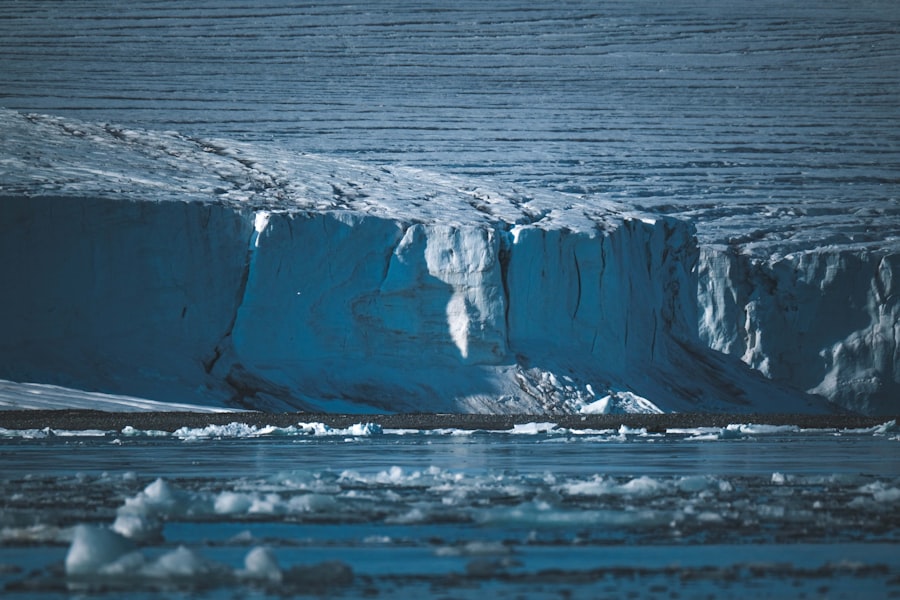
Climate change has profound implications for ice sheet mass balance, primarily driven by rising global temperatures. As temperatures increase, the rate of ice melt accelerates, leading to a negative mass balance for many ice sheets around the world. This phenomenon is particularly evident in Greenland and Antarctica, where warmer air temperatures contribute to surface melting and increased calving events from ice shelves.
The consequences of these changes extend beyond local ecosystems; they pose significant risks for global sea levels. The impact of climate change on ice sheet mass balance is further exacerbated by feedback mechanisms within the climate system. For instance, as ice melts, darker ocean or land surfaces are exposed, which absorb more sunlight and lead to further warming—a process known as albedo feedback.
Additionally, changes in ocean currents can influence the stability of ice shelves, which act as barriers to prevent further inland ice from flowing into the ocean. Understanding these complex interactions is crucial for predicting future changes in ice sheet dynamics and their contributions to sea level rise.
Piri Reis’s influence on modern understanding of ice sheet mass balance
While Piri Reis lived centuries before contemporary discussions on climate change and ice sheet dynamics emerged, his contributions to cartography laid foundational principles that resonate with modern scientific inquiry. His meticulous approach to mapping geographical features reflects an early understanding of how different elements interact within a larger system—an idea that parallels current research on ice sheet mass balance. Just as Piri Reis synthesized knowledge from various cultures to create accurate maps, modern scientists integrate data from diverse sources to understand complex environmental phenomena.
Moreover, Piri Reis’s work serves as a reminder of humanity’s long-standing relationship with exploration and discovery. His maps not only charted physical landscapes but also represented a quest for knowledge about the world—a pursuit that continues today as researchers strive to unravel the complexities of climate change and its effects on ice sheets. By examining historical perspectives on geography and navigation, contemporary scientists can gain insights into how societies have understood their environments over time, informing current approaches to studying ice sheet mass balance.
Techniques used to measure ice sheet mass balance
Measuring ice sheet mass balance involves a combination of remote sensing technologies and ground-based observations. Satellite altimetry is one prominent technique used to assess changes in ice thickness over time. By measuring variations in surface elevation from space, scientists can estimate how much ice is being gained or lost across vast areas.
Additionally, gravimetry—using satellites like GRACE (Gravity Recovery and Climate Experiment)—allows researchers to detect changes in gravitational pull caused by variations in mass distribution within an ice sheet. Ground-based measurements also play a crucial role in understanding ice sheet dynamics. Researchers deploy GPS stations on glaciers to monitor their movement and flow rates accurately.
These observations help scientists understand how changes in temperature and precipitation affect ice dynamics at a local scale. Furthermore, field studies involving snow pits and core samples provide valuable data on accumulation rates and historical climate conditions, contributing to a comprehensive understanding of ice sheet mass balance.
The importance of monitoring ice sheet mass balance
Monitoring ice sheet mass balance is essential for several reasons, primarily due to its implications for global sea level rise. As climate change accelerates melting processes in polar regions, understanding how much ice is being lost becomes critical for predicting future sea level scenarios. Accurate assessments of mass balance help policymakers make informed decisions regarding coastal planning and climate adaptation strategies.
Additionally, monitoring ice sheets provides insights into broader climate patterns and feedback mechanisms within the Earth’s system. Changes in ice mass can influence ocean circulation patterns, weather systems, and even global temperature trends. By studying these interactions, scientists can develop more robust climate models that account for the complexities of Earth’s interconnected systems.
Ultimately, ongoing monitoring efforts are vital for enhancing our understanding of climate change impacts on polar regions and their far-reaching consequences.
Piri Reis’s legacy in the study of ice sheet mass balance
Piri Reis’s legacy extends beyond his contributions to early cartography; it also serves as an inspiration for contemporary scientific inquiry into complex environmental issues such as ice sheet mass balance. His ability to synthesize diverse sources of knowledge reflects a fundamental principle that remains relevant today: interdisciplinary collaboration is essential for advancing our understanding of complex systems. Just as Piri Reis drew upon various cultural influences to create accurate maps, modern scientists must integrate insights from multiple disciplines—such as geology, climatology, and oceanography—to address pressing challenges related to climate change.
Furthermore, Piri Reis’s work exemplifies the importance of documentation and record-keeping in scientific endeavors. His meticulous maps provide historical context that informs current research on ice sheets and their responses to climate change. By studying past cartographic practices, contemporary researchers can gain valuable insights into how societies have perceived their environments over time—a perspective that enriches our understanding of current challenges related to ice sheet dynamics.
Current research and developments in understanding ice sheet mass balance
Current research on ice sheet mass balance is characterized by rapid advancements in technology and methodology. Scientists are increasingly utilizing satellite data combined with ground-based observations to create comprehensive models that predict future changes in ice dynamics. For instance, recent studies have employed machine learning algorithms to analyze vast datasets from satellite imagery, enabling researchers to identify patterns in ice melt more efficiently than ever before.
Moreover, international collaborations have emerged as crucial components of contemporary research efforts. Initiatives like the International Partnership for Ice Core Science (IPICS) bring together scientists from around the world to share data and expertise related to polar research. These collaborative efforts enhance our collective understanding of how climate change impacts ice sheets globally while fostering innovative approaches to studying complex environmental systems.
The future of ice sheet mass balance research
The future of ice sheet mass balance research holds great promise as scientists continue to refine their methodologies and expand their understanding of these critical systems. As climate change accelerates, ongoing research will be essential for predicting how polar regions will respond over time. Advances in remote sensing technology will likely play a pivotal role in this endeavor, allowing researchers to monitor changes with unprecedented precision.
Furthermore, interdisciplinary approaches will become increasingly important as scientists seek to understand the interconnectedness between ice sheets, ocean currents, atmospheric conditions, and global climate patterns. By fostering collaboration across disciplines—such as geology, climatology, oceanography, and engineering—researchers can develop more comprehensive models that account for the complexities inherent in studying ice sheet dynamics.
His legacy serves as both an inspiration for modern researchers striving to understand complex environmental issues like ice sheet mass balance while highlighting the importance of interdisciplinary collaboration in addressing pressing global challenges.
The study of ice sheet mass balance is crucial for understanding global sea level changes and climate dynamics. A related article that delves into the historical context of cartography and its implications on modern scientific studies, such as those concerning ice sheets, can be found on the Real Lore and Order website. This article explores the fascinating intersection of ancient maps and contemporary climate science, providing insights into how historical data can inform current research. For more information, you can read the full article by visiting this link.
WATCH THIS 🧊The US Military Confirmed It: What’s REALLY Under the Antarctic Ice?
FAQs
What is the Piri Reis map?
The Piri Reis map is a world map created by the Ottoman admiral and cartographer Piri Reis in 1513. It is notable for its inclusion of the coastline of Antarctica, which was not officially discovered until the early 19th century.
What is ice sheet mass balance?
Ice sheet mass balance refers to the overall change in mass of an ice sheet, taking into account factors such as snow accumulation, ice melt, and iceberg calving. It is an important measure for understanding the impact of climate change on polar ice sheets.
How does the Piri Reis map relate to ice sheet mass balance?
The Piri Reis map has been the subject of speculation and debate due to its depiction of the coastline of Antarctica, which some have interpreted as evidence of advanced knowledge of the continent’s geography. This has led to discussions about the potential implications for understanding historical ice sheet mass balance in Antarctica.
What is the current understanding of ice sheet mass balance in Antarctica?
Scientists use a variety of methods, including satellite observations and field measurements, to monitor and assess the mass balance of the Antarctic ice sheet. Overall, research indicates that the Antarctic ice sheet is experiencing a net loss of ice, primarily due to increased melting and calving of ice from the continent’s glaciers and ice shelves.
How does ice sheet mass balance in Antarctica impact global sea level rise?
The mass balance of the Antarctic ice sheet is a significant factor in global sea level rise. As the ice sheet loses mass, it contributes to the overall increase in sea levels, which has implications for coastal communities and ecosystems around the world. Understanding and monitoring ice sheet mass balance is therefore crucial for predicting and adapting to future sea level rise.