The Cantino Map, a remarkable artifact from the early 16th century, has long captivated historians, cartographers, and enthusiasts alike. This map, which is believed to have been created around 1502, is one of the earliest known representations of the New World, showcasing the lands discovered by European explorers during the Age of Discovery. Its origins are shrouded in intrigue, as it was commissioned by an anonymous patron who sought to gain an advantage in the burgeoning competition for overseas territories.
The map’s intricate details and geographical accuracy have sparked debates about its creation and purpose, leading to a deeper exploration of its historical context. The allure of the Cantino Map lies not only in its artistic craftsmanship but also in the secrets it holds about the early European understanding of the Americas. The map features a wealth of information, including coastlines, rivers, and even indigenous territories, which were largely unknown to Europeans at the time.
As scholars delve into its mysteries, they uncover layers of meaning that reflect the ambitions and aspirations of a world on the brink of transformation. The Cantino Map serves as a window into a pivotal moment in history, where exploration and discovery were reshaping global dynamics.
Key Takeaways
- The Cantino Map is a historically significant early 16th-century map revealing early Portuguese explorations.
- Its creation involved a skilled cartographer whose identity remains partly mysterious.
- The map’s accuracy and details influenced navigation and exploration during the Age of Discovery.
- Modern technology has enhanced the study, preservation, and restoration of the Cantino Map.
- The map continues to contribute valuable insights into ancient civilizations and cartographic legacy today.
Historical Significance of the Cantino Map
The historical significance of the Cantino Map cannot be overstated. It represents a critical juncture in the evolution of cartography and European exploration. Created during a time when knowledge of the New World was still in its infancy, the map provides invaluable insights into how early explorers perceived and documented their discoveries.
It is one of the first maps to depict Brazil and parts of the Caribbean with such detail, marking a shift in European awareness of these regions. The map’s existence underscores the competitive nature of European powers as they vied for dominance in trade and colonization. Moreover, the Cantino Map is a testament to the technological advancements in navigation and cartography during the Renaissance.
The precision with which it portrays coastlines and geographical features reflects a growing understanding of geography and navigation techniques. This map not only served as a practical tool for explorers but also as a symbol of national pride for Portugal, which was at the forefront of maritime exploration during this era. Its historical significance extends beyond mere geography; it encapsulates the spirit of discovery that defined an age and laid the groundwork for future explorations.
Uncovering the Secrets of the Cantino Map
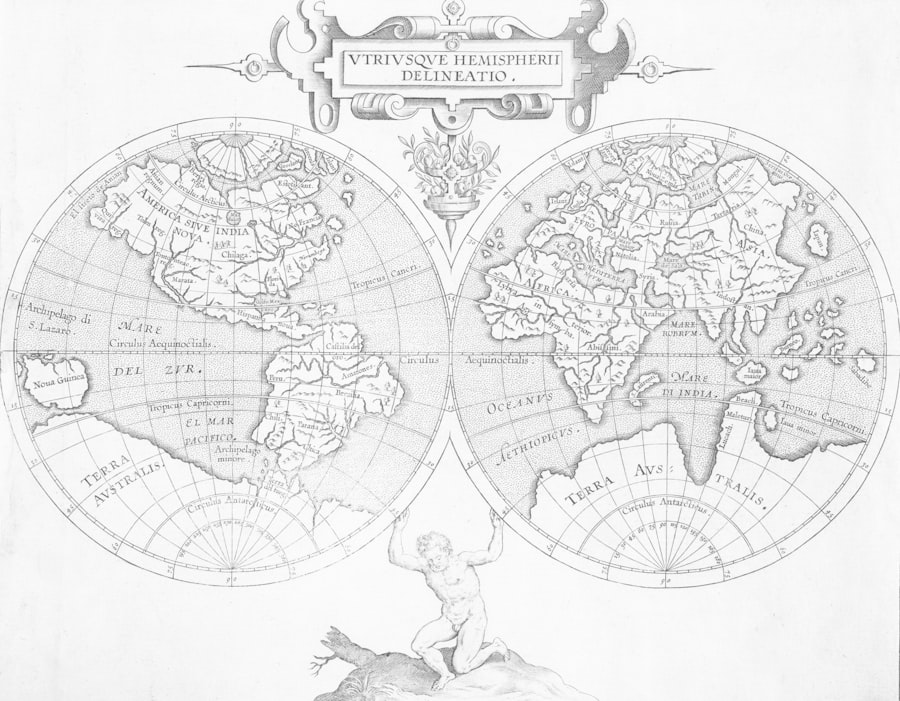
Uncovering the secrets of the Cantino Map has been a fascinating journey for historians and researchers. The map’s intricate details invite scrutiny, revealing clues about its origins and purpose. Scholars have employed various methods to analyze its content, including comparative studies with other contemporary maps and historical documents.
These investigations have led to intriguing discoveries about the motivations behind its creation and the information it conveys about early encounters between Europeans and indigenous peoples. One of the most compelling aspects of the Cantino Map is its depiction of indigenous territories and cultures. The map includes annotations that suggest an awareness of local populations and their customs, indicating that early explorers were not merely focused on claiming land but were also beginning to understand the complexities of the societies they encountered.
This nuanced portrayal challenges traditional narratives that often depict early European exploration as solely exploitative. Instead, it highlights a more intricate relationship between explorers and indigenous peoples, suggesting that mutual curiosity and exchange were also at play.
The Cartographer Behind the Cantino Map
The identity of the cartographer behind the Cantino Map remains a subject of speculation and intrigue. While some scholars attribute its creation to an anonymous Portuguese cartographer, others suggest that it may have been produced by an Italian artist or navigator who was working in collaboration with Portuguese explorers. This ambiguity adds to the map’s mystique, as it reflects the interconnectedness of European cultures during a time when knowledge was shared across borders.
Regardless of its creator’s identity, the craftsmanship displayed in the Cantino Map is undeniable. The map features elaborate illustrations, vibrant colors, and meticulous attention to detail that showcase the artistic skills of its maker. The cartographer’s ability to blend artistic expression with scientific observation speaks to a broader trend in Renaissance cartography, where maps were not only functional tools but also works of art that conveyed cultural values and aspirations.
The Cantino Map stands as a testament to this tradition, embodying both the spirit of exploration and the artistic achievements of its time.
Analyzing the Accuracy of the Cantino Map
| Metric | Description | Value | Source/Date |
|---|---|---|---|
| Map Creation Date | The year the Cantino map was created | 1502 | Historical Records |
| Geographical Coverage | Regions depicted on the map | Europe, Africa, Asia, and the newly discovered Americas | Map Analysis |
| Accuracy Level | Relative accuracy compared to modern maps | Moderate for coastal outlines, low for interior regions | Cartographic Studies |
| Intelligence Source | Origin of the geographic information | Portuguese navigators and explorers | Historical Documentation |
| Significance | Importance in cartographic history | First known map to show Portuguese discoveries in the East and West | Historical Analysis |
| Map Dimensions | Physical size of the original map | Approximately 55 cm x 120 cm | Museum Records |
| Material | Material used for the map | Vellum (calfskin parchment) | Conservation Reports |
The accuracy of the Cantino Map has been a focal point for scholars seeking to understand its significance within the context of early cartography. While it is celebrated for its detailed representation of newly discovered lands, some inaccuracies are evident when compared to modern geographical knowledge. For instance, certain coastlines are depicted with a degree of distortion, reflecting the limitations of navigational techniques available at the time.
However, these inaccuracies do not diminish its value; rather, they provide insight into the challenges faced by early cartographers as they attempted to map uncharted territories. In analyzing its accuracy, researchers have noted that the Cantino Map successfully captures key geographical features that were essential for navigation and exploration. Its depiction of Brazil’s coastline is particularly noteworthy, as it aligns closely with later maps produced after further exploration.
This suggests that while some elements may be flawed, the map’s overall representation was informed by firsthand accounts from explorers who ventured into these regions. The Cantino Map thus serves as both a historical document and a reflection of evolving cartographic practices during a transformative period in history.
The Cantino Map’s Influence on Exploration and Navigation
The influence of the Cantino Map on exploration and navigation cannot be overstated. As one of the earliest maps to provide detailed information about newly discovered territories, it served as a crucial reference for subsequent explorers embarking on voyages to the New World. The map’s dissemination among navigators and maritime authorities contributed to a growing body of knowledge about geography and navigation techniques, ultimately shaping future expeditions.
Its detailed representation of Brazil and other regions fueled interest among explorers seeking to claim new lands for their respective nations. The map became a symbol of national pride for Portugal, reinforcing its status as a leader in maritime exploration.
As other countries sought to rival Portugal’s dominance, they too began producing their own maps based on similar principles, leading to an explosion of cartographic innovation that would define subsequent centuries.
Comparing the Cantino Map to Other Ancient Maps
When comparing the Cantino Map to other ancient maps from its era, several distinctive features emerge that highlight its uniqueness. Unlike many contemporary maps that focused primarily on Europe or Asia, the Cantino Map boldly ventures into uncharted territories, offering one of the first glimpses into South America and parts of North America. This willingness to explore beyond familiar boundaries sets it apart from other maps that adhered more closely to established geographical conventions.
Additionally, while many ancient maps were often steeped in mythological representations or religious symbolism, the Cantino Map adopts a more pragmatic approach by emphasizing geographical accuracy and detail. Its annotations provide insights into indigenous cultures and natural resources, reflecting a growing interest in empirical observation rather than reliance on hearsay or legend. This shift towards more realistic representations marks a significant evolution in cartography and underscores the importance of the Cantino Map within this broader context.
Preservation and Restoration of the Cantino Map
The preservation and restoration of the Cantino Map have been paramount in ensuring its survival for future generations. As an invaluable historical artifact, efforts have been made to protect it from deterioration caused by environmental factors such as light exposure and humidity. Conservators have employed specialized techniques to stabilize its condition while maintaining its original integrity.
Restoration efforts have also focused on enhancing visibility without compromising authenticity. This delicate balance requires expertise in both art conservation and historical preservation techniques. By carefully addressing issues such as fading ink or damaged parchment, conservators aim to ensure that viewers can appreciate not only the map’s aesthetic qualities but also its historical significance.
These preservation efforts underscore society’s commitment to safeguarding cultural heritage while allowing contemporary audiences to engage with this remarkable piece of history.
Modern Technology and the Study of the Cantino Map
Modern technology has revolutionized the study of historical artifacts like the Cantino Map, providing researchers with tools that enhance their understanding and analysis. Digital imaging techniques allow for high-resolution scans that reveal intricate details previously obscured by wear or damage. These advanced imaging methods enable scholars to examine layers of ink and pigment composition, offering insights into the materials used by the cartographer.
Furthermore, geographic information systems (GIS) have facilitated comparative analyses between ancient maps like the Cantino Map and contemporary geographical data. By overlaying historical maps onto modern satellite imagery, researchers can assess changes in coastlines and landforms over time. This intersection of technology and historical research not only enriches our understanding of cartography but also fosters interdisciplinary collaboration among historians, geographers, and scientists.
The Cantino Map’s Contribution to Understanding Ancient Civilizations
The Cantino Map contributes significantly to understanding ancient civilizations by providing insights into their interactions with European explorers during a transformative period in history. Its depiction of indigenous territories suggests an awareness of diverse cultures existing long before European contact. By documenting these regions with such detail, the map challenges simplistic narratives that often portray indigenous peoples as passive subjects in colonial encounters.
Moreover, studying the Cantino Map allows historians to explore themes such as trade networks, resource distribution, and cultural exchange between indigenous populations and European explorers. The annotations on the map hint at complex social structures and economic systems that existed prior to colonization. This nuanced portrayal encourages a reevaluation of historical narratives surrounding exploration and colonization, emphasizing agency among indigenous peoples rather than viewing them solely through a colonial lens.
The Legacy of the Cantino Map in the 21st Century
In the 21st century, the legacy of the Cantino Map endures as scholars continue to explore its significance within both historical and contemporary contexts. Its role as an early representation of global exploration resonates with ongoing discussions about cultural exchange, colonialism, and indigenous rights today. As societies grapple with their histories, artifacts like the Cantino Map serve as reminders of complex interactions between cultures that shaped our world.
Furthermore, advancements in technology have made it possible for wider audiences to engage with historical artifacts through digital platforms. Online exhibitions and interactive mapping tools allow individuals from diverse backgrounds to explore maps like the Cantino Map without geographical limitations. This democratization of access fosters greater appreciation for historical artifacts while encouraging critical dialogue about their implications in contemporary society.
In conclusion, while rooted in history, the Cantino Map continues to inspire curiosity and scholarship in various fields today. Its intricate details offer glimpses into an era defined by exploration and discovery while prompting reflections on how these narratives shape our understanding of cultural heritage in an increasingly interconnected world.
The Cantino map, a significant artifact in the history of cartography, showcases the early European understanding of the New World. For those interested in exploring more about the historical context and implications of such maps, a related article can be found at Real Lore and Order, which delves into the intricate relationship between exploration and the mapping of newly discovered territories.
WATCH THIS! 🗺️ The Map That Proves Humans Explored Earth 5,000 Years Too Early
FAQs
What is the Cantino map?
The Cantino map is a world map created in 1502, known for being one of the earliest surviving maps to show Portuguese geographic discoveries in the East and West. It is named after Alberto Cantino, an Italian diplomat who acquired the map.
Why is the Cantino map significant in the history of cartography?
The Cantino map is significant because it provides a detailed depiction of the known world at the beginning of the 16th century, including parts of the Americas, Africa, Europe, and Asia. It reflects the Portuguese maritime explorations and is one of the first maps to show the coastlines of Brazil and parts of the Indian Ocean.
What intelligence does the Cantino map reveal?
The Cantino map reveals intelligence about Portuguese navigational routes, territorial claims, and newly discovered lands. It shows strategic information about trade routes, colonial possessions, and maritime knowledge that was closely guarded by Portugal at the time.
How was the Cantino map used for intelligence purposes?
The Cantino map was used as a form of intelligence by providing detailed geographic information that could influence political and economic decisions. It was a valuable asset for understanding Portuguese exploration achievements and for planning further expeditions or territorial negotiations.
Where is the Cantino map currently located?
The Cantino map is currently housed in the Biblioteca Estense in Modena, Italy, where it is preserved as a significant historical artifact.
What materials and techniques were used to create the Cantino map?
The Cantino map was drawn on parchment using ink and colors typical of early 16th-century cartography. It combines nautical charting techniques with artistic elements to depict coastlines, islands, and important landmarks.
How does the Cantino map compare to other maps of its time?
Compared to other maps of the early 1500s, the Cantino map is notable for its accuracy in depicting Portuguese discoveries and for being one of the first to show the Brazilian coastline. It is more detailed than many contemporary maps and reflects the advanced maritime knowledge of Portugal.
Who was Alberto Cantino?
Alberto Cantino was an Italian diplomat and agent who is believed to have obtained the map from Portugal and brought it to Italy. His role was crucial in making the map accessible outside Portugal, contributing to the spread of geographic knowledge.
What impact did the Cantino map have on European exploration?
The Cantino map influenced European exploration by disseminating knowledge of new lands and sea routes. It helped other European powers understand Portuguese discoveries and spurred further exploration and competition in the Age of Discovery.