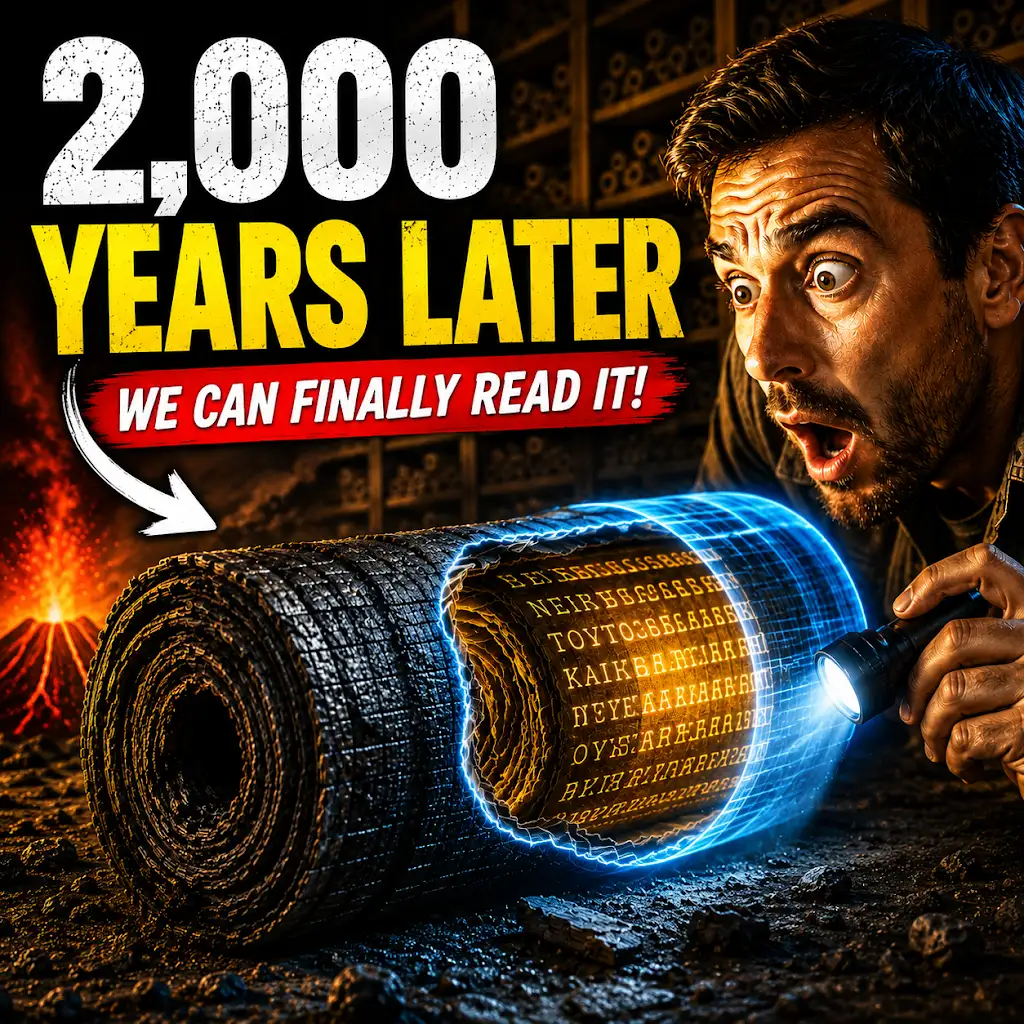
The faint scent of papyrus, a ghost of ancient libraries, hangs in the air, not in a physical space, but in the digital realm. It is here, within the intricate algorithms and immense processing power of artificial intelligence, that the secrets of Herculaneum’s scorched scrolls are finally beginning to yield. For centuries, these carbonized remnants, victims of Mount Vesuvius’s catastrophic eruption in 79 AD, have presented an insurmountable physical barrier to human understanding. Now, a confluence of advanced imaging techniques and sophisticated AI is rewriting the narrative of discovery, allowing scholars to read what was once thought irrevocably lost to time and fire.
The eruption of Mount Vesuvius was a cataclysm of unimaginable scale, a pyroclastic flow of unparalleled destructive power that buried entire cities under meters of volcanic ash and pumice. Herculaneum, a vibrant Roman town nestled at the foot of the volcano, suffered a particularly brutal fate. Unlike Pompeii, which was famously preserved under a layer of ash, Herculaneum was engulfed by superheated volcanic gases and debris, which then solidified into a hard, rock-like mass. This intense heat and pressure had a devastating effect on the organic materials within the city, most notably the vast collection of papyrus scrolls found within the Villa of the Papyri, a sprawling estate believed to have belonged to the wealthy philosopher and politician Lucius Calpurnius Piso Caesoninus, father-in-law to Julius Caesar.
The Villa of the Papyri: A Library Lost to Fire
The discovery of the Villa of the Papyri in the 18th century was a monumental event. Buried deep beneath volcanic debris, it revealed an unprecedented collection of papyrus scrolls, estimated to number in the thousands. The sheer volume of material suggested a significant intellectual and cultural center. However, the fire that consumed the villa also fused the papyri into brittle, carbonized lumps, many no thicker than a cigarette paper and often appearing as solid black cylinders. The delicate nature of these scrolls meant that any attempt to unroll them traditionally resulted in disintegration, leaving the text within inaccessible. For generations, these “carbonized scrolls” remained tantalizing but ultimately unreadable, a silent testament to a lost literary heritage.
The Challenges of Traditional Restoration
The physical challenges posed by the Herculaneum scrolls are profound. Imagine holding a piece of burnt toast so brittle that the slightest touch would turn it to dust. This is the reality faced by conservators attempting to handle these ancient documents. Traditional methods of unrolling, such as painstakingly separating layers with scalpels or using humidification techniques, proved largely unsuccessful, often leading to the complete destruction of the delicate papyrus. The carbonization process had not only fused the layers together but had also rendered the ink indistinguishable from the charred papyrus itself, making visual decipherment even more difficult. This inherent fragility and the complex fusion of layers created a seemingly insurmountable obstacle to accessing the knowledge contained within.
The Dawn of a New Era: Advanced Imaging and AI
The limitations of traditional methods spurred a search for innovative solutions. The 21st century has witnessed a technological revolution, and it is this technological leap that has breathed new life into the quest to read the Herculaneum scrolls. The combination of cutting-edge imaging techniques and the burgeoning power of artificial intelligence has opened up unprecedented possibilities, allowing for non-invasive analysis and the potential for reconstruction of the text. This marks a paradigm shift from destructive attempts at physical unrolling to a sophisticated digital decipherment.
Non-Invasive Imaging Techniques: Seeing Through the Carbon
The breakthrough in reading the scrolls has been driven by the development and application of advanced imaging technologies. These methods aim to penetrate the carbonized layers without causing any further damage to the delicate papyrus. The goal is to detect subtle differences in the density, composition, and texture of the papyrus and the ink, even when they appear visually indistinguishable to the naked eye.
X-ray Computed Tomography (CT) Scanning: Peering into the Layers
One of the pioneering imaging techniques employed is X-ray Computed Tomography (CT) scanning. This technology, commonly used in medical diagnostics, works by passing X-rays through the object from multiple angles. A computer then processes these X-ray images to create cross-sectional slices of the scroll. By analyzing variations in how the X-rays are absorbed by different materials, CT scans can reveal the internal structure of the carbonized rolls. Researchers are able to identify the layers of papyrus and, crucially, detect the presence of ink, which often has a slightly different density or chemical composition compared to the papyrus. This allows for the visualization of the ink strokes buried within the layers.
Synchrotron X-ray Imaging: Unveiling Subtle Signatures
For even greater detail and sensitivity, synchrotron X-ray imaging has been employed. Synchrotrons are powerful particle accelerators that produce extremely bright and focused X-ray beams. This allows for imaging at a much higher resolution and with greater sensitivity to subtle variations in elemental composition. By using techniques like X-ray fluorescence (XRF) or phase-contrast imaging, researchers can identify the presence of specific elements within the ink, such as iron in iron gall ink, which was commonly used in Roman times. This elemental mapping can highlight the faint traces of ink against the background of the carbonized papyrus, providing crucial information for subsequent decipherment.
Visible Light and Infrared Imaging: Exploiting Spectral Differences
Beyond X-rays, other forms of light have also been utilized. Visible light imaging, under specific wavelengths and illumination conditions, can sometimes reveal subtle variations in the surface texture or color that might be invisible under normal lighting. Infrared (IR) imaging, on the other hand, exploits the fact that different materials absorb and reflect infrared light differently. This can be particularly useful in distinguishing between the papyrus and the ink, as they may have distinct spectral signatures in the infrared range. These complementary imaging techniques provide a multi-faceted view of the scrolls, offering different types of data for analysis.
The Artificial Intelligence Revolution: Deciphering the Invisible
The vast amount of data generated by these sophisticated imaging techniques would be overwhelming for human analysis alone. This is where artificial intelligence, particularly machine learning, steps in. AI algorithms are trained to recognize patterns, identify anomalies, and make predictions, capabilities that are perfectly suited to the monumental task of deciphering the Herculaneum scrolls.
Machine Learning Models: Learning from the Past to Read the Future
The core of the AI approach lies in training machine learning models on existing knowledge of ancient texts and the properties of papyrus and ink. This involves feeding the AI with datasets that include examples of legible ancient texts, as well as data from the imaging of partially deciphered Herculaneum fragments. The models learn to associate specific visual or spectral signatures with ink strokes, papyrus fibers, and even potential ink residues.
Pattern Recognition: Identifying the Ghostly Traces of Ink
One of the primary functions of AI in this context is pattern recognition. The algorithms are designed to scan the imaging data and identify any subtle deviations from the expected texture of carbonized papyrus that could indicate the presence of ink. This involves looking for variations in density, color, or chemical composition that, when considered collectively, suggest the formation of letters or words. The AI learns to differentiate between the natural variations in the papyrus and the deliberate marks made by an ancient scribe.
Segmentation and Delineation: Isolating the Textual Elements
Once potential ink traces are identified, the AI then moves on to segmentation and delineation. This process involves separating the identified ink marks from the surrounding papyrus material. Algorithms can effectively “segment” the image, drawing boundaries around individual letters or characters. This is a crucial step in preparing the data for reconstruction, as it isolates the textual elements that can then be analyzed for their form and meaning.
Optical Character Recognition (OCR) for Ancient Scripts: A Novel Application
The ultimate goal is to read the text, and for this, a specialized form of Optical Character Recognition (OCR) is being developed. Traditional OCR is designed for modern printed text, but for ancient, carbonized, and often partially formed characters, entirely new approaches are required. The AI models are trained to recognize the distorted and fragmented forms of ancient Greek or Latin letters as they appear on the scrolls. This involves understanding the variations in stroke width, the presence of smudges, and the incomplete nature of many characters due to the degradation of the papyrus.
Reconstructing the Lost Words: From Pixels to Prose
The process doesn’t end with identifying individual characters. The true challenge and the ultimate triumph lie in reconstructing coherent sentences, paragraphs, and ultimately, entire works. This requires a sophisticated understanding of ancient languages, grammar, and context, areas where AI is also proving to be a powerful ally.
Linguistic Analysis and Contextual Understanding: Beyond mere character recognition
Once the AI has segmented and identified potential characters, linguistic analysis comes into play. This involves using natural language processing (NLP) techniques to understand the sequence of characters and their potential meaning. The AI can leverage its knowledge of ancient Greek and Latin grammar, vocabulary, and common word formations to infer missing letters, correct misidentified characters, and even propose entire words based on the context of the surrounding text.
Predictive Text for Ancient Languages: Filling in the Gaps
Similar to how modern predictive text suggests the next word in a sentence, AI can be used to predict missing words or letters in the Herculaneum scrolls. By analyzing the statistical probabilities of letter and word sequences in ancient texts, the AI can make educated guesses about what might be missing. This is particularly useful when a significant portion of a letter or word has been lost.
Statistical Language Modeling: Uncovering the Underlying Structure
Statistical language models, trained on vast corpora of ancient literature, help the AI to understand the underlying structure and common patterns of the languages. This allows the AI to identify plausible sequences of words and sentences, even when the individual characters are highly degraded. It can distinguish between random noise and meaningful linguistic data.
From Fragments to Full Texts: The Art of Digital Assembly
The process of reconstructing a full text from fragmented and partially deciphered characters is akin to assembling a complex jigsaw puzzle. The AI plays a crucial role in identifying overlapping fragments, aligning segments that likely belong to the same line or page, and piecing together the narrative.
Collation and Alignment: Connecting the Dots
The AI can be used to compare different imaging results of the same scroll or even different scrolls that might contain related content. By identifying similar patterns or text sequences, the AI can help in the collation and alignment of fragments, effectively stitching together pieces of the lost text.
Probabilistic Reconstruction: Embracing Uncertainty
Given the inherent uncertainties in deciphering damaged texts, AI-driven reconstruction often employs probabilistic methods. This means that the AI provides not just a single reconstruction, but a range of possibilities, each with a calculated probability of being correct. This allows scholars to assess the confidence in the reconstructed text and to focus on the areas that are most likely to be accurate.
Unlocking Ancient Wisdom: The Future of Classical Studies
The implications of AI-powered decipherment of the Herculaneum scrolls are far-reaching, promising to revolutionize our understanding of ancient philosophy, literature, and history. The potential for new discoveries is immense, opening doors to intellectual treasures that have been hidden for millennia.
Philosophical and Literary Discoveries: Recovering Lost Texts
The Villa of the Papyri is believed to have housed a significant collection of philosophical works, particularly those of the Epicurean school. The potential recovery of lost treatises by prominent philosophers like Philodemus, or even previously unknown works by figures like Epicurus himself, could fundamentally alter our understanding of ancient thought. Literary discoveries, from epic poems to comedies, could also shed new light on Roman and Greek literary traditions.
Historical Insights: A Window into the Roman World
Beyond philosophical and literary texts, the scrolls may also contain historical accounts, letters, and administrative documents. These could provide invaluable insights into the daily lives of people in Herculaneum and the wider Roman Empire, offering details about social structures, economic practices, and political events that are currently unknown or poorly understood. The ability to read these personal accounts would offer an unprecedented intimate glimpse into the Roman world.
The Ongoing Mission: A Collaborative Endeavor
The effort to read the Herculaneum scrolls is a testament to human ingenuity and the power of collaboration. It involves a multidisciplinary team of archaeologists, conservators, computer scientists, and philologists working together. The development of AI tools for deciphering these unique artifacts is an ongoing process, constantly being refined and improved as more data becomes available and algorithms become more sophisticated.
The quest to unlock the secrets of the Herculaneum scrolls is no longer a battle against physical decay alone, but a sophisticated digital exploration. As AI continues to evolve, the carbonized whispers of ancient Herculaneum are steadily transforming into legible voices, ready to enrich our understanding of the human past in ways we are only just beginning to comprehend. The faint scent of papyrus, once a symbol of loss, is now a harbinger of profound discovery.