
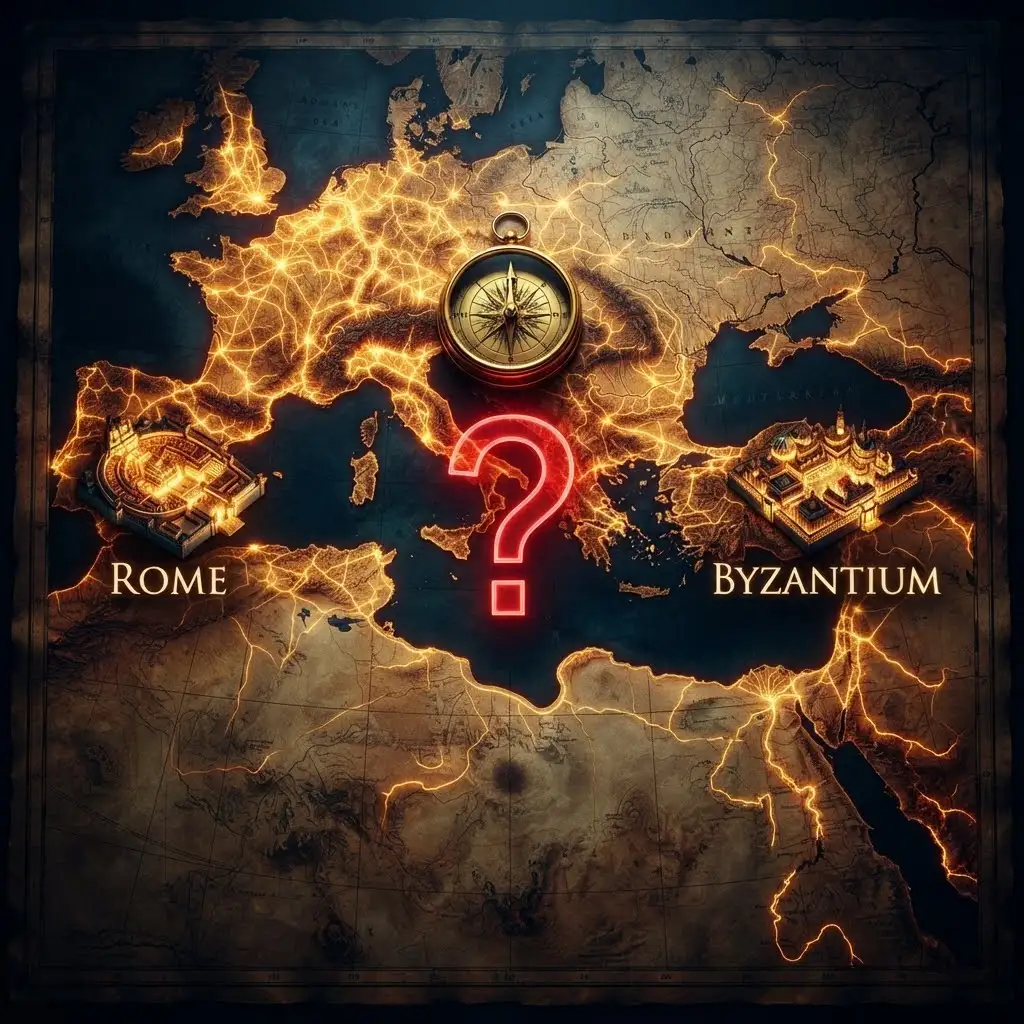
The annals of Western civilization are indelibly marked by two colossal entities: Rome and Byzantium. One, the progenitor, forged an empire of unparalleled might and influence that reshaped the Mediterranean world and beyond. The other, its spiritual and geographical successor, inherited that legacy, adapting and enduring for over a millennium, a bulwark against eastern incursions and a vibrant crucible of culture and faith. The question of which of these two historical titans was more central to the grand sweep of history is not a simple one, demanding a nuanced examination of their respective contributions, their interconnectedness, and the enduring ripples they left on the fabric of the world.
The Shadow of the Eagle: Rome’s Foundational Impact
To assess Rome’s centrality, one must first acknowledge its foundational role in shaping Western thought, governance, and infrastructure. The Roman Republic and later the Empire established precedents that continue to resonate. Their legal systems, codified in the Twelve Tables and later the Corpus Juris Civilis, formed the bedrock of many modern legal traditions, emphasizing concepts of citizenship, property rights, and due process. The very idea of a unified, vast empire, bound by common laws, language (Latin), and a sophisticated administrative apparatus, was a Roman innovation that inspired countless subsequent rulers and political thinkers.
Engineering the World: Roman Infrastructure and Innovation
Beyond abstract concepts, Rome’s tangible achievements were monumental. Their mastery of engineering allowed for the construction of roads, aqueducts, bridges, and public buildings on a scale previously unimagined. These infrastructural marvels not only facilitated trade and communication within the empire but also served as enduring testaments to Roman ingenuity, many of which still stand today. The spread of Roman technology and architectural styles across their vast territories left an indelible mark, influencing subsequent building practices and urban planning for centuries. The sheer scale of their ambition in physically transforming the landscape cannot be overstated in its historical significance.
The Lex Romana: Legal and Administrative Legacies
The Roman legal system, a complex and evolving body of laws and jurisprudence, provided a framework for social order and dispute resolution that was remarkably sophisticated for its time. The development of abstract legal principles, the concept of universal law applicable to all citizens, and the intricate procedures of Roman courts laid the groundwork for legal systems across Europe. Furthermore, the Roman administrative structure, with its legions of bureaucrats, tax collectors, and provincial governors, created a model of centralized governance that subsequent empires and nation-states would seek to emulate. The effective management of such a vast and diverse territory required organizational skills and a bureaucratic capacity that set a new standard.
The debate over whether Byzantium was more central than Rome in shaping the course of history continues to intrigue historians and scholars alike. While some argue that Rome’s influence laid the groundwork for Western civilization, others point to Byzantium’s role in preserving and transmitting knowledge, culture, and trade across continents. For those interested in exploring the intricate craftsmanship that flourished in this era, a related article on the art of crafting Damascus steel can provide fascinating insights into the technological advancements of the time. You can read more about it here: The Art of Crafting Damascus Steel.
The Phoenix Rises: Byzantium’s Millennial Stewardship
While Rome eventually fractured and its western half succumbed to barbarian invasions, its eastern counterpart, Byzantium, rose from the ashes to endure for another thousand years. Constantinople, its magnificent capital, became a beacon of civilization, a sophisticated metropolis that preserved and evolved classical knowledge while developing its own unique cultural and religious identity. Byzantium’s role as a preserver of Greek and Roman learning during the European “Dark Ages” is often cited as its most profound contribution.
The Aegis of Orthodoxy: Byzantium’s Religious and Cultural Influence
The Eastern Roman Empire, or Byzantium as it came to be known, was inextricably linked with Eastern Orthodox Christianity. The intricate relationship between church and state, the development of Byzantine theology and liturgy, and the dissemination of Orthodox faith to Slavic peoples were among its most significant achievements. Through missionary work and the translation of religious texts into vernacular languages, Byzantium profoundly shaped the religious and cultural landscape of Eastern Europe, laying the foundations for the national identities of countries like Russia, Serbia, and Bulgaria. The artistic and architectural styles that emerged from this religious fervor, characterized by magnificent mosaics and iconic imagery, continue to inspire and captivate.
The Bridge Between Worlds: Byzantium as a Cultural and Economic Hub
Constantinople’s strategic location at the crossroads of Europe and Asia made it a vital center of trade and cultural exchange. For centuries, it facilitated the flow of goods, ideas, and technologies between East and West. Byzantine silk production, its exquisite metalwork, and its illuminated manuscripts were highly prized throughout the known world. The city acted as a crucial intermediary, absorbing influences from Persia, the Arab world, and beyond, and re-exporting them to the West, thereby enriching European culture and fostering a more interconnected global economy.
The Enduring Interplay: Rome’s Foundation, Byzantium’s Evolution
It is impossible to discuss Byzantium without acknowledging its Roman origins. Byzantium was not a separate entity that sprung into existence, but rather the continuation and transformation of the Roman Empire. The Emperor Constantine the Great, in moving the capital to Byzantium and renaming it Constantinople, effectively divided the empire but also ensured its survival in the East. This continuity meant that much of Rome’s legal, administrative, and cultural heritage was inherited by Byzantium. However, to argue that Byzantium was merely a pale imitation of Rome would be a disservice to its own distinct achievements.
The Weight of Legacy: Inheriting and Adapting Roman Structures
Byzantium consciously adopted and adapted Roman institutions. The Justinianic Code, a monumental codification of Roman law, became the legal foundation for the empire and significantly influenced legal systems in both the East and West. The Roman administrative hierarchy, the military organization, and even the imperial titles were preserved, though often adapted to reflect the empire’s changing circumstances and its predominantly Greek-speaking populace. This ability to absorb and adapt Roman structures, rather than simply mimic them, was key to Byzantium’s longevity.
Divergent Paths: The Great Schism and Cultural Divergence
The eventual Great Schism of 1054 between the Eastern Orthodox and Roman Catholic Churches marked a significant point of divergence, solidifying distinct cultural and religious spheres. While both branches of Christianity stemmed from a common root, their theological interpretations, liturgical practices, and institutional structures evolved differently. This religious divide, coupled with linguistic differences (Greek in the East, Latin in the West) and distinct political trajectories, contributed to a growing cultural separation between the Latin West and the Byzantine East.
Measuring Influence: The Scope and Duration of Impact
When considering which was “more central” to history, a crucial metric is the scope and duration of their influence. Rome’s initial impact was geographically vast, encompassing much of Europe, North Africa, and the Middle East. Its legal, linguistic, and architectural foundations were laid during its ascendancy, a period of roughly five centuries of imperial rule. Byzantium, conversely, endured for over a millennium, acting as a crucial bulwark against invasions from the East and preserving classical learning during periods when Western Europe was in disarray.
The Long Shadow: Rome’s Influence on Western European Development
Rome’s immediate and direct legacy is most profoundly felt in Western Europe. The Romance languages, the foundations of Western legal systems, and the very concept of European political unity can trace their lineage back to Rome. The fall of the Western Roman Empire did not erase its influence; rather, it led to its reinterpretation and adaptation by the successor kingdoms that emerged. The Church, increasingly centered in Rome, played a vital role in preserving and transmitting Roman culture and administration.
The Thousand-Year Shield: Byzantium’s Enduring Eastern Role
Byzantium’s influence, while perhaps less overtly visible in the immediate formation of Western nation-states, was profoundly significant in shaping Eastern Europe and the wider Eastern Mediterranean. Its role as a bulwark against Sasanian Persia, Arab invasions, and later Turkic expansion protected the developing West from pressures that could have irrevocably altered its trajectory. Furthermore, its cultural and religious dissemination to the Slavic world created a distinct civilizational sphere that continues to be a major force in global affairs. The preservation of classical texts was also critical; without Byzantine scholars, much of ancient Greek philosophy, science, and literature might have been lost to the West.
The debate over whether Byzantium was more central than Rome in shaping the course of history continues to intrigue scholars and enthusiasts alike. A fascinating perspective on this topic can be found in an article that explores the significance of historical maps and their impact on our understanding of navigation and exploration. This article delves into the intricacies of cartography and how it relates to the broader narrative of empires, including the Byzantine Empire. To learn more about the connections between geography and historical events, you can read the article here.
Conclusion: A Symbiotic Relationship, Not a Competition
| Metric | Byzantium (Constantinople) | Rome | Notes |
|---|---|---|---|
| Geographical Centrality | Located at the crossroads of Europe and Asia, controlling key trade routes between the Black Sea and Mediterranean | Located in the Italian Peninsula, central to the Mediterranean but less connected to Eastern trade routes | Byzantium had a more strategic position for East-West trade |
| Political Influence (Peak) | Capital of the Eastern Roman Empire, center of Orthodox Christianity, influential in Eastern Europe and Near East | Capital of the Roman Republic and Empire, center of Western civilization and Catholic Church | Rome was more influential in the West; Byzantium dominated the East |
| Economic Power | Thriving trade hub with access to Silk Road goods, strong economy through commerce and taxation | Economic power declined after the fall of Western Roman Empire; earlier strong economy based on agriculture and trade | Byzantium maintained economic centrality longer than Rome |
| Cultural Centrality | Preserved and transmitted Greek and Roman knowledge, center of Orthodox Christian culture | Origin of Roman law, Latin language, and Western Christian traditions | Both were cultural centers but in different spheres |
| Duration as Capital | Over 1,000 years (330 AD – 1453 AD) | Approximately 1,000 years (753 BC – 330 AD) | Byzantium served as capital longer than Rome |
Ultimately, framing the question as “Byzantium vs. Rome: Which Was More Central to History?” is a somewhat artificial dichotomy. They were not opposing forces, but rather two phases of a continuous, albeit transformative, historical phenomenon. Rome provided the foundational blueprint, the initial spark that ignited a civilization whose echoes would resonate for millennia. Byzantium, in turn, nurtured that spark, adapting it to new contexts, preserving it during turbulent times, and spreading its light in directions that Rome itself could not have fully envisioned.
The Indivisible Legacy: Rome’s Seed, Byzantium’s Bloom
Rome’s centrality lies in its role as the progenitor, the empire that laid the groundwork for much of Western civilization’s political, legal, and infrastructural frameworks. Its influence is so pervasive in the West that it is often taken for granted, the very air that a modern observer breathes. Byzantium’s centrality, on the other hand, lies in its extraordinary longevity and its role as a preserver and evolver of that Roman legacy, especially in the East. It acted as a vital bridge, a cultural and religious nexus, and a formidable defender for over a thousand years. To ask which was “more” central is to overlook the symbiotic relationship that existed. Rome planted the seed; Byzantium cultivated the plant, allowing it to bloom and bear fruit in ways that ultimately enriched the entire historical garden. The question of centrality is not about superiority, but about understanding the distinct and equally vital contributions each made to the grand tapestry of human history.
The 2.7% Statistic That Terrifies Roman Historians
FAQs
1. Was Byzantium geographically more central than Rome?
Yes, Byzantium, later known as Constantinople, was strategically located at the crossroads of Europe and Asia, making it a more central location compared to Rome.
2. Did Byzantium serve as the capital of the Eastern Roman Empire?
Yes, Byzantium became the capital of the Eastern Roman Empire in 330 AD when Emperor Constantine the Great established it as the new imperial capital, renaming it Constantinople.
3. Was Byzantium considered a cultural and economic hub in the Eastern Mediterranean?
Yes, Byzantium was a major cultural and economic center in the Eastern Mediterranean, serving as a bridge between Europe and Asia and playing a crucial role in trade and diplomacy.
4. Did Byzantium outlast the Western Roman Empire?
Yes, Byzantium outlasted the Western Roman Empire by nearly a thousand years, enduring until the fall of Constantinople in 1453 to the Ottoman Empire, while the Western Roman Empire fell in 476 AD.
5. Was Byzantium known for its rich blend of Roman, Greek, and Christian influences?
Yes, Byzantium was renowned for its unique blend of Roman, Greek, and Christian cultures, which shaped its art, architecture, and governance, distinguishing it from its predecessor in Rome.