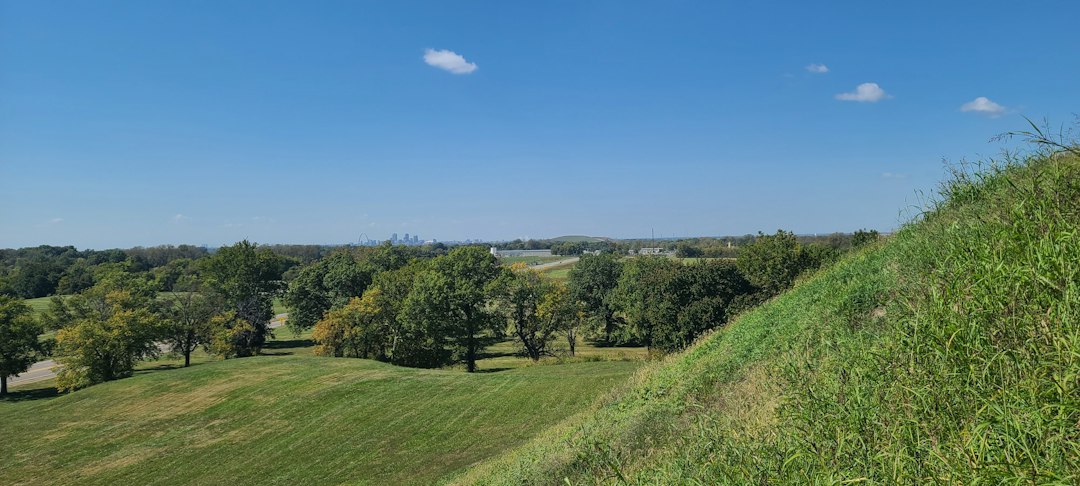
The Mississippi River has long been a conduit of life and commerce, shaping civilizations that rose and fell along its fertile banks. Among the most enigmatic and impressive of these ancient cultures was the Mississippian civilization, and its grandest settlement, Cahokia, stands as a testament to their ingenuity and organizational prowess. Far from being a mere collection of villages, Cahokia was a sprawling metropolis, a hub of political, economic, and religious activity that, at its zenith, dwarfed contemporary European cities, including the burgeoning settlement of London.
The sheer scale of Cahokia is a revelation that continues to captivate archaeologists and historians. Its population estimates, once conservative, have steadily climbed with new discoveries and sophisticated analytical techniques. It is now widely accepted that at its peak, around 1050-1200 CE, Cahokia was home to tens of thousands of people, possibly exceeding 100,000 at its most vibrant. This makes the comparison to London, which likely had a population of around 40,000 to 50,000 during the same period, not merely an interesting historical footnote, but a stark demonstration of the power and complexity of indigenous societies in North America. The narrative of global urban development has often been Eurocentric, focusing on the rise of cities in the Old World. However, Cahokia’s story forces a profound re-evaluation, revealing a sophisticated urban center that rivaled and, in terms of sheer population and architectural ambition, surpassed its European contemporaries.
The Scale of Ancient Cahokia: A City Unearthed
The initial understanding of Cahokia was based on the imposing mounds that dotted the landscape. These earthen structures, some monumental in their size, were the most visible remnants of this ancient civilization. However, decades of meticulous excavation have revealed that these mounds were not isolated features but integral components of a vast and densely populated urban landscape. The city covered an area of approximately six square miles, a footprint that would have been immediately recognizable as a significant urban center to any observer from the pre-industrial world.
Unveiling the Urban Footprint
The boundaries of Cahokia were not defined by stone walls or fortified ramparts, as was common in many European cities. Instead, the city’s extent was marked by a complex network of plazas, residential areas, ceremonial precincts, and, crucially, a remarkable palisade. This impressive defensive structure, rebuilt multiple times throughout the city’s occupation, stretched for over two miles and enclosed the core of the settlement. The sheer labor required to construct and maintain such a fortification speaks volumes about the centralized authority and organized workforce that characterized Cahokian society. The scale of this palisade alone suggests a level of defensive planning and resource management comparable to that of any major European city of the era.
Population Estimates: A Demographic Revolution
The most striking aspect of Cahokia’s size is its population. Early estimates often placed the population in the low thousands, leading to a perception of Cahokia as a large village or a regional center. However, subsequent archaeological research, employing methods such as analyzing shell-tempered pottery distribution, calculating burial densities, and mapping settlement patterns, has dramatically revised these figures upwards. It is now understood that the central urban core alone may have housed between 10,000 and 20,000 people, with the surrounding hinterlands supporting a much larger population that contributed to the city’s sustenance and workforce. This makes Cahokia one of the largest cities in the world during its peak, a demographic phenomenon that challenges traditional narratives of urbanism.
Comparing Urban Centers: Cahokia vs. London
The comparison with London is particularly illustrative. In the 11th and 12th centuries, London was a significant port and administrative center for Norman England, but its urban fabric was far less dense and its population smaller than what we now understand about Cahokia. London’s medieval walls encompassed a relatively compact area, and its buildings, while growing, were not on the scale of Cahokia’s monumental mounds. Cahokia’s sheer population, combined with its extensive physical layout, places it firmly in a league of global urban centers that were few and far between in the medieval world.
Cahokia, an ancient Native American city located near present-day St. Louis, was once larger than London during its peak in the 12th century, showcasing the impressive urban planning and societal organization of its time. For those interested in exploring how historical developments continue to shape modern economies, you might find the article on the potential impact of Chinese electric vehicles on the U.S. market insightful. You can read more about it here: Chinese EVs Threat to U.S. Market.
The Heart of the Metropolis: Monks Mound and the Central Plaza
At the very heart of Cahokia stood Monks Mound, a colossal structure that served as the city’s primary ceremonial and administrative center. Its immense size and strategic location underscore the organizational capacity and hierarchical structure of the society that built it. The mound’s construction was a monumental undertaking, requiring the relocation of an estimated 1.4 million cubic feet of earth, all moved by human labor using baskets and primitive tools. Its scale is such that it remains the largest pre-Columbian earthwork in the Americas.
Monks Mound: An Architectural Marvel
Monks Mound is not merely a large hill; it is a meticulously engineered platform, measuring approximately 100 feet high, 950 feet long, and 700 feet wide. It rises in four terraces, suggesting a deliberate design that facilitated public ceremonies and provided a stage for the ruling elite. Atop its summit, a large wooden structure, likely a temple or a residence for the paramount chief, commanded a view of the entire city and the surrounding countryside. The sheer effort involved in its construction, over centuries, points to a well-organized labor force and a leadership capable of mobilizing and directing vast numbers of people towards a common goal.
The Grand Plaza: The City’s Public Forum
Adjacent to Monks Mound lay the Grand Plaza, an enormous cleared area that served as the city’s public gathering space. This vast open expanse, stretching over 40 acres, was the site of markets, festivals, political assemblies, and public ceremonies. Its deliberate preservation as an open space, rather than being built upon, highlights its crucial role in the social and political life of Cahokia. The Grand Plaza provided a communal space where the inhabitants could interact, conduct trade, and participate in shared cultural practices, fostering a sense of collective identity.
The Ritual and Political Significance
The intimate connection between Monks Mound and the Grand Plaza suggests a profound integration of religious and political power. The ruling elite, residing atop the mound, likely performed rituals that were visible to the assembled populace in the plaza below. This visual and symbolic connection reinforced their authority and the divine sanction they claimed. The scale of these structures and their central placement in the urban layout indicate that Cahokia was not just a collection of people but a highly structured society with a powerful governing body and a complex belief system.
Beyond the Center: Residential Wards and Craft Specialization
While Monks Mound and the Grand Plaza represent the public face of Cahokia, the vast majority of its inhabitants lived in dispersed residential areas, organized into distinct wards or neighborhoods. These areas reveal a society that, while hierarchical, also had a functioning economy with specialized labor and trade networks. The organization of these neighborhoods, often enclosed by smaller palisades, hints at social stratification and perhaps even a degree of self-governance within these districts.
Housing and Daily Life
Archaeological excavations have uncovered the remains of numerous houses, typically rectangular structures made of wattle and daub, with thatched roofs. These houses were clustered together, forming villages within the larger city. The size and quality of these dwellings varied, suggesting differences in wealth and status among the inhabitants. Evidence of hearths, storage pits, and refuse middens provide insights into the daily routines of Cahokian families, their diet, and their domestic activities. The sheer density of housing in certain areas, even outside the immediate vicinity of Monks Mound, points to the significant population that sustained the city.
Specialized Craft Production
Cahokia was a center of sophisticated craft production. Evidence abounds for specialized artisans working in various media. Among the most significant were the producers of shell-tempered pottery, a hallmark of the Mississippian culture. The meticulous craftsmanship of some of these vessels, decorated with intricate designs, indicates a high degree of skill and artistry. Furthermore, evidence of stone tool production, including the quarrying and working of chert, as well as the creation of finely crafted copper ornaments and celts, highlights the presence of skilled craftspeople who dedicated their lives to specific trades. This specialization was crucial for the economic vitality of the city.
Trade and Resource Management
The presence of exotic materials such as mica, obsidian, and copper, found at Cahokia but originating from distant regions, underscores the extensive trade networks that connected the city to a vast hinterland. These materials were likely obtained through exchange with other communities, both near and far. The ability to acquire and distribute such resources further testifies to Cahokia’s economic power and its role as a central node in regional trade. The management of these resources, from raw materials to finished goods, would have required a complex system of organization and distribution.
The Mississippian World System: Cahokia’s Influence
Cahokia was not an isolated entity. It was the heart of a vast cultural and economic network, often referred to as the Mississippian world system. Its influence extended hundreds of miles in all directions, shaping the development of other settlements and leaving an indelible mark on the cultural landscape of eastern North America. The artifacts found at Cahokia, and those found at other Mississippian sites that bear Cahokian influence, paint a picture of a shared cosmology, artistic styles, and political ideologies.
Expansion and Influence
The Mississippian culture, with Cahokia as its most prominent example, spread across a wide geographical area, from the Great Plains to the Atlantic coast, and from the Great Lakes to the Gulf of Mexico. While not a monolithic empire in the traditional sense, Cahokia exerted a significant cultural and economic influence over many of these regions. The adoption of Mississippian architectural styles, pottery traditions, and societal structures in other areas suggests a powerful radiating influence from the central Mississippi Valley.
Trade Networks and Communication
The long-distance trade in exotic goods, as mentioned earlier, is a prime indicator of these extensive networks. However, influence also traveled through more intangible means, such as the spread of ideas, religious practices, and political models. The presence of Cahokian-style artifacts at distant sites, and vice versa, indicates a dynamic exchange that went beyond mere material goods. Communication, likely facilitated by riverine routes and possibly overland trails, allowed for the dissemination of information and the maintenance of these connections.
The Role of Other Mississippian Centers
While Cahokia was the largest and most influential, it was not the only significant Mississippian center. Other large towns and cities, such as Moundville in Alabama and Etowah in Georgia, also played important roles in the Mississippian world system. However, the sheer scale, population, and monumental architecture of Cahokia, particularly Monks Mound, set it apart as the undisputed metropolis of its time in this vast region.
Cahokia, an ancient Native American city located near present-day St. Louis, was once larger than London at its peak, showcasing the impressive urban planning and societal organization of its time. For a deeper understanding of how historical civilizations have shaped modern nations, you can explore this insightful article on Kurdistan’s quest for independence, which highlights the ongoing struggles of communities seeking recognition and autonomy in today’s world.
The Mystery of Cahokia’s Decline
Despite its grandeur and apparent stability, Cahokia experienced a significant decline beginning in the late 13th century. The reasons for this abandonment are still debated among scholars, with a variety of theories proposed, ranging from environmental degradation and resource depletion to social unrest and warfare. The suddenness of its decline, leaving behind its monumental structures, adds another layer of mystery to this fascinating civilization.
Environmental Factors
One prominent theory suggests that environmental factors played a crucial role. Overpopulation and intensive agriculture in the fertile bottomlands of the Mississippi River could have led to soil exhaustion, deforestation, and increased susceptibility to flooding. Evidence of soil erosion and changing agricultural practices at Cahokia lends some support to this hypothesis. The demands of feeding such a large population would have placed immense pressure on the surrounding environment.
Social and Political Upheaval
Other scholars propose that internal social and political factors contributed to Cahokia’s decline. Theories include the possibility of resource scarcity leading to social stratification and conflict, or the rise of internal factions challenging the established elite. The construction of the large palisade, rebuilt multiple times, could indicate a period of increasing insecurity and conflict within or around the city. The cessation of large-scale mound construction and the eventual abandonment of the central urban core suggest a breakdown in the social and political cohesion that had sustained the city for centuries.
The Legacy of a Lost Metropolis
Whatever the precise reasons for its decline, Cahokia left an enduring legacy. It stands as a powerful reminder of the complexity and sophistication of indigenous societies in North America, challenging Eurocentric narratives of history and urban development. The archaeological remains of Cahokia, particularly the imposing Monks Mound, continue to inspire awe and spark curiosity, inviting us to reconsider our understanding of the ancient world and the remarkable achievements of its forgotten peoples. The story of Cahokia is a crucial part of the human story, a testament to human ingenuity, social organization, and the enduring power of human ambition, all played out on the banks of the mighty Mississippi.

A City Bigger Than London Once Stood in America. Then It Vanished.
FAQs

What is Cahokia?
Cahokia was a pre-Columbian Native American city located in present-day Illinois, near St. Louis, Missouri. It was the largest and most influential urban settlement of the Mississippian culture, thriving between the 9th and 15th centuries.
How big was Cahokia compared to London?
At its peak, Cahokia covered nearly six square miles and had a population of 10,000 to 20,000 people, making it larger than London during the same time period.
What were some of the features of Cahokia?
Cahokia was characterized by its large earthen mounds, including Monks Mound, the largest prehistoric earthwork in the Americas. The city also had a sophisticated urban layout, with plazas, residential areas, and ceremonial spaces.
What caused the decline of Cahokia?
The exact reasons for the decline of Cahokia are not fully understood, but factors such as environmental degradation, resource depletion, and social upheaval are believed to have played a role in the city’s eventual abandonment.
What is the significance of Cahokia today?
Cahokia is a UNESCO World Heritage Site and is recognized for its cultural and historical importance. It provides valuable insights into the complex societies of pre-Columbian North America and continues to be a subject of archaeological research and preservation efforts.