
The silent passage of celestial bodies across our cosmic neighborhood, often conceived as mere astronomical curiosities, has within its dusty tails and fiery descent a profound and often potent influence on Earth’s climate. For millennia, humanity has gazed upon the heavens, largely unaware of the direct connections between transient cometary visitors and the planet’s long-term thermal equilibrium. However, a growing body of scientific evidence is reshaping this perception, revealing comets not just as harbingers of wonder, but as significant geological agents capable of triggering abrupt climatic shifts, influencing the very trajectory of civilization, and even offering glimpses into the habitability of worlds beyond our own.
Approximately 12,800 years ago, a dramatic and abrupt cooling event known as the Younger Dryas plunged much of the Northern Hemisphere back into glacial conditions following a period of warming. This period of climatic upheaval, characterized by a sudden drop in temperatures and significant alterations in precipitation patterns, coincided with profound societal and ecological changes. For decades, the exact cause of this rapid climatic reversal remained a subject of intense scientific debate. While various terrestrial and oceanic factors were proposed, a compelling theory emerged, suggesting an extraterrestrial origin: a comet impact.
Unearthing the Evidence: A Cosmic Smoking Gun
Recent research, notably spearheaded by scientists at the University of California, Santa Barbara, has provided robust support for the Younger Dryas Impact Hypothesis. This evidence, meticulously gathered from geological strata across North America, paints a picture of a catastrophic cosmic event. The discovery of significant concentrations of platinum, a rare element on Earth’s surface but more common in comets, within sediment layers dating to the Younger Dryas boundary, serves as a crucial indicator. Accompanying the platinum are various impact proxies, including microspherules – tiny, glassy beads formed from molten rock vaporized and re-solidified – and meltglass, a direct product of intense heat and pressure associated with hypervelocity impacts. Crucially, the presence of shock-fractured quartz, a mineral that displays characteristic deformation patterns when subjected to extraordinary forces like those of an impact, further solidifies the extraterrestrial hypothesis.
A Fragmented Comet’s Fury: Airburst and Atmospheric Cataclysm
The prevailing model suggests that a large, fragmented comet, perhaps around 100 kilometers in diameter, did not strike the Earth directly in a singular colossal impact. Instead, it is hypothesized that the comet broke apart in Earth’s atmosphere, with multiple large fragments detonating in a series of airbursts. These colossal explosions, occurring at high altitudes, would have unleashed energies far exceeding those of any nuclear detonation. The immense heat and shockwaves generated by these airbursts would have had devastating immediate consequences, including widespread wildfires and atmospheric disturbances.
The “Impact Winter”: A Global Cooling Cascade
The fallout from these atmospheric detonations would have been catastrophic for the planet’s climate. The volatilized material from the comet, combined with vast quantities of pulverized terrestrial rock and vegetation ignited by the intense heat, would have been lofted into the upper atmosphere. This debris would have acted as a highly effective shield, blocking incoming solar radiation and triggering a period of prolonged, widespread cooling – an “impact winter.” This sudden and dramatic reduction in global temperatures would have significantly disrupted ecosystems, leading to the collapse of food chains and contributing to the extinction of megafauna, such as mammoths and mastodons, that were prevalent during that era.
Societal Collapse and the Dawn of a New Era
The climatic and ecological devastation wrought by the Younger Dryas impact had profound implications for early human populations. The Clovis culture, characterized by its distinctive stone tools and widespread presence across North America, experienced a dramatic decline and eventual collapse during this period. The loss of large game animals, the disruption of plant life, and the harsh new environmental conditions would have made traditional hunter-gatherer lifestyles unsustainable. Some researchers argue that the societal upheaval and desperate need for a more stable food source may have played a role in pushing human societies towards the development of agriculture and animal domestication, marking a significant turning point in human history.
The intriguing question of whether a comet could trigger climate change has sparked discussions about various environmental factors that can influence our planet’s climate. A related article that delves into the broader implications of technological advancements and their potential impact on society is titled “The Rise of Artificial Intelligence and Societal Collapse.” This article explores how artificial intelligence might contribute to significant societal shifts, paralleling the unpredictable nature of celestial events like comets. For more insights, you can read the article here: The Rise of Artificial Intelligence and Societal Collapse.
The Paleocene-Eocene Thermal Maximum: A Comet’s Carboniferous Overture
Fifty-six million years ago, our planet experienced one of the most rapid and dramatic warming events in geological history: the Paleocene-Eocene Thermal Maximum (PETM). This event saw a global temperature rise of approximately 6°C over a period of thousands of years, accompanied by significant ocean acidification and ecological turnover. While the precise trigger for the PETM has been a subject of investigation, the possibility of a cometary impact gaining traction as a plausible initiator.
Tracing the Impact Signature: Microtektites and Charcoal
Research led by scientists like Dennis Kent and his colleagues has unearthed compelling evidence pointing towards a cometary impact as the catalyst for the PETM. Their investigations of sediment layers in regions like New Jersey have revealed the presence of microtektites and widespread charcoal deposits precisely at the boundary between the Paleocene and Eocene epochs. Microtektites are minute, glassy spheres formed from molten rock ejected during an impact event and subsequently cooled as they re-entered the atmosphere. Their presence in these geological strata, in conjunction with evidence of widespread burning, strongly suggests a cataclysmic event capable of both vaporizing rock and igniting continental-scale fires.
The Carbon Dioxide Inferno: A Galactic Release
The proposed mechanism by which a cometary impact could have triggered the PETM involves the release of vast quantities of carbon dioxide (CO2) into the atmosphere. It is theorized that the impact, or series of impacts, struck or vaporized geological formations rich in carbon, such as carbonate rocks or organic-rich sediments. The immense energy of the impact would have transformed these carbon-bearing materials into atmospheric CO2. Some studies suggest that this impact could have doubled atmospheric CO2 levels in as little as a single year, a rate of increase far exceeding that of current anthropogenic emissions.
A Rapidly Warming World: Ecological Ramifications
The sudden and massive influx of greenhouse gases into the atmosphere would have initiated a powerful and rapid warming trend. The 6°C global temperature rise associated with the PETM had far-reaching ecological consequences. Marine ecosystems experienced significant disruption, with widespread extinction of bottom-dwelling organisms due to ocean acidification caused by the absorption of excess CO2. On land, many species were forced to migrate or face extinction as their habitats changed dramatically. The PETM stands as a stark reminder of the planet’s sensitivity to rapid changes in atmospheric composition and the potential for extraterrestrial events to profoundly alter global climate.
Exoplanetary Climate Disruption: Comets as Architects of Alien Worlds
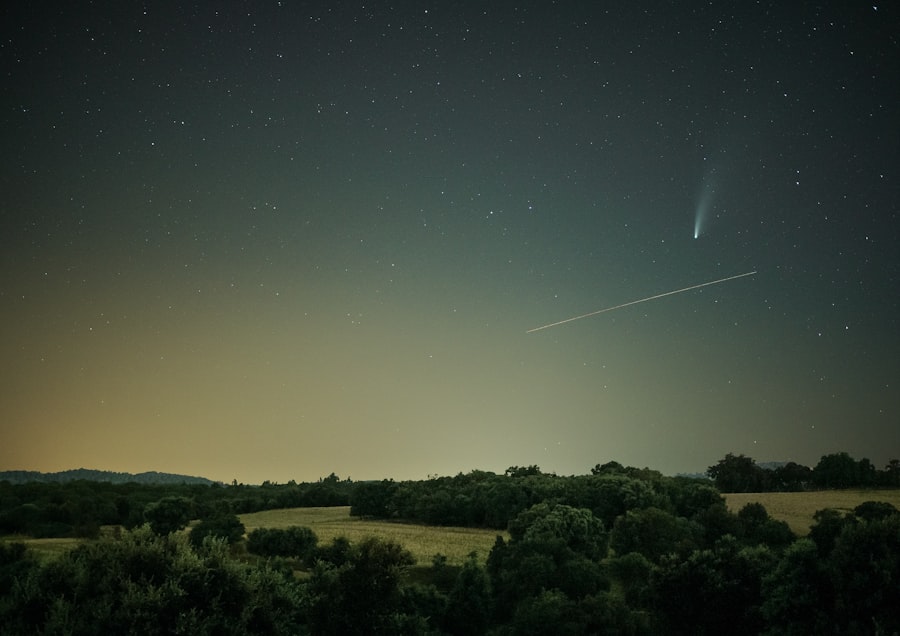
The study of cometary impacts extends beyond our own solar system, offering insights into the potential for life and habitability on exoplanets. Recent astronomical observations and theoretical modeling are revealing that even relatively minor cometary impacts can have significant and observable effects on the atmospheres and potential habitability of planets orbiting other stars.
Terrestrial Exoplanets and Tidally Locked Worlds
While the initial focus of exoplanet research was often on Earth-like planets in habitable zones, the discovery of a wider array of planetary types, including tidally locked worlds, has broadened our understanding. Tidally locked planets, with one side perpetually facing their star and the other in eternal darkness, present unique climatic challenges. However, cometary impacts may play a crucial role in homogenizing temperatures and redistributing vital elements on these alien worlds.
Delivering Oxygen and Forging Oceans
Studies suggest that the impact of even a moderately sized comet can significantly alter the atmospheric composition of a terrestrial exoplanet. The impactor itself, often rich in volatile compounds, can deliver substantial amounts of oxygen and other key elements to the planet’s atmosphere. Furthermore, the immense energy released during an impact can drive chemical reactions that lead to the formation of liquid water. It is theorized that cometary impacts could be a mechanism for creating or replenishing oceans on otherwise arid exoplanets, a crucial step in the development of life as we know it.
Observable Signatures in the Cosmic Canvas
The detection of these cometary-induced climatic changes on exoplanets may be within the capabilities of advanced telescopes like the James Webb Space Telescope. By analyzing the light passing through an exoplanet’s atmosphere, scientists can infer its chemical composition and detect the presence of gases like oxygen or water vapor. The signatures of past or ongoing cometary bombardment, such as the presence of specific isotopes or atmospheric anomalies, could provide astronomers with tangible evidence of extraterrestrial geological and climatic processes.
Ongoing Atmospheric Effects: The Dusty Veil of Cometary Debris

While catastrophic impacts represent the most dramatic manifestations of cometary influence, smaller, more frequent events also contribute to Earth’s atmospheric dynamics. The continuous disintegration of comets as they traverse the inner solar system releases vast quantities of dust and small particles into space. A portion of this debris eventually enters Earth’s atmosphere, leading to subtle yet significant short-term climatic effects.
Meteoric Smoke and the Cooling Canvas
As comets approach the Sun, their icy composition sublimes, releasing volatile gases and leaving behind a trail of dust and rocky particles. These particles, ranging in size from microscopic grains to pebbles, are dispersed along the comet’s orbital path. When Earth passes through these debris streams, typically during annual meteor showers, these particles enter our atmosphere at high speeds. This influx of extraterrestrial material, often referred to as “meteoric smoke,” can accumulate in the upper atmosphere.
A Shield Against Solar Radiation
The microscopic dust particles create a thin, but widespread, layer in the stratosphere. This layer can act as a subtle shield, reflecting a small fraction of incoming solar radiation back into space. While the effect is generally short-lived, on a planetary scale, this influx of meteoric smoke can contribute to a brief period of cooling. This phenomenon, distinct from the prolonged impact winter of larger events, highlights the continuous interaction between Earth and its cosmic environment.
Widespread Wildfires: A Fiery Connection
Beyond cooling effects, the entry of dense meteoric debris streams into the atmosphere has also been linked to an increased incidence of widespread wildfires. The friction and compression of air as these particles descend generate intense heat, capable of igniting dry vegetation. If these debris streams are particularly dense, they could potentially trigger multiple ignition points across vast geographical areas, leading to widespread conflagrations. Scientists theorize that such occurrences, driven by cometary debris, may recur on timescales of a few thousand years, contributing to natural fire cycles throughout Earth’s history.
The intriguing possibility of a comet triggering climate change raises questions about the broader impacts of celestial events on Earth’s environment. A related article explores the mysterious behavior of glaciers and how their changes can reflect significant shifts in climate patterns. This piece delves into the science behind glacial movements and their implications for understanding climate dynamics, making it a fascinating read for those interested in the intersection of space and climate science. For more insights, you can check out the article on glacier mysteries here.
Human History’s Crossroads: Comets as Catalysts for Civilization
| Metrics | Data |
|---|---|
| Comet Size | Varies, typically several kilometers in diameter |
| Impact Velocity | Typically tens of kilometers per second |
| Impact Energy | Equivalent to millions of nuclear bombs |
| Climate Change Trigger | Potentially, through dust and gas released into the atmosphere |
| Historical Impacts | Believed to have caused mass extinctions in the past |
The profound impact of comets on Earth’s climate has, in turn, significantly shaped the course of human history, albeit often in ways that were not recognized by the societies experiencing them. The environmental shifts triggered by cometary events have, at critical junctures, forced humanity to adapt, innovate, and evolve, fundamentally altering the trajectory of our species.
The Abu Hureyra Sediments: A Tale of Climate and Culture
The archaeological site of Abu Hureyra in Syria offers a striking example of this connection. Excavations at Abu Hureyra have revealed a continuous record of human settlement spanning over 13,000 years. Crucially, sediment layers at this site contain evidence of a significant event approximately 13,000 years ago, coinciding with the Younger Dryas cooling period and the aforementioned comet impact hypothesis.
The Great Subsistence Shift
Analysis of the Abu Hureyra record indicates a dramatic environmental shift around this time. The data suggests a period of prolonged drought and environmental instability, which would have made traditional hunter-gatherer lifestyles increasingly precarious. This environmental pressure, potentially exacerbated by the climatic consequences of a cometary impact, appears to have been a significant impetus for humans to transition towards more settled ways of life.
The Dawn of Agriculture and Domestication
The environmental challenges faced at Abu Hureyra, and likely in many other regions, are believed to have accelerated the development of agriculture and animal domestication. Faced with unpredictable wild food sources, early humans began to experiment with cultivating crops and managing livestock. This shift towards a more controlled and predictable food supply allowed for larger, more sedentary populations, the development of permanent settlements, and ultimately, the rise of complex human societies and civilizations. The comet impact, in this context, is not just a geological event, but a potent catalyst that appears to have steered humanity away from nomadic existence and towards the foundational pillars of civilization.
In conclusion, the once-distant and ethereal nature of comets has been increasingly supplanted by the burgeoning realization of their tangible and transformative power on Earth’s climate. From triggering the abrupt cooling of the Younger Dryas and the rapid warming of the PETM, to influencing the habitability of exoplanets and subtly altering our atmosphere, comets have continuously played a significant role in shaping our planet’s environmental history. Furthermore, the evidence from sites like Abu Hureyra underscores how these celestial events, through their climatic ramifications, have acted as profound catalysts for human societal evolution, pushing our ancestors towards the agrarian revolution and setting the stage for the complex world we inhabit today. As our understanding of these cosmic visitors deepens, so too does our appreciation for the interconnectedness of the universe and the profound, often overlooked, influence of celestial bodies on the story of life on Earth.

The Black Layer That Shouldn’t Exist
FAQs
What is a comet?
A comet is a small celestial body that orbits the sun and is made up of ice, rock, and dust. When a comet gets close to the sun, the heat causes the ice to vaporize, creating a glowing coma and sometimes a tail.
How could a comet trigger climate change?
If a comet were to collide with Earth, it could release a large amount of energy and debris into the atmosphere. This could potentially block out sunlight, leading to a temporary cooling effect known as a “nuclear winter.”
Has a comet ever triggered climate change in the past?
There is evidence to suggest that a comet impact may have contributed to the extinction of the dinosaurs around 66 million years ago. The impact would have released massive amounts of debris and caused widespread fires, leading to a significant climate shift.
What are the potential consequences of a comet impact on Earth’s climate?
A comet impact could lead to widespread destruction, including tsunamis, wildfires, and changes in global temperature and weather patterns. The resulting climate change could have long-lasting effects on ecosystems and human civilization.
What measures are in place to monitor and potentially mitigate the impact of a comet on Earth?
Astronomers and space agencies around the world actively monitor the skies for near-Earth objects, including comets, that could pose a threat to our planet. Efforts are also underway to develop technologies that could potentially deflect or mitigate the impact of a comet or asteroid on Earth.