
The legend of Jesse James is as enduring as the American West itself, a tale woven with daring robberies, cunning escapes, and a violent end that has captivated imaginations for over a century. However, the definitive narrative of his death has been challenged by persistent claims that the outlaw didn’t die in 1882 as officially recorded. Chief among these challengers was a man named J. Frank Dalton, who, for decades, asserted his identity as the legendary Jesse James. This article delves into the compelling, yet ultimately unproven, claims of J. Frank Dalton, examining the evidence and arguments he presented to convince the world that he, not Robert Ford, fired the fatal shot that ended the life of Jesse James.
The Shadow of Doubt: Early Claims of Survival
The official account of Jesse James’s demise is that he was shot and killed by Robert Ford, one of his own gang members, on April 3, 1882, in St. Joseph, Missouri. Ford, seeking a reward offered for James’s capture, ambushed the outlaw while he was straightening a picture on the wall. This event, while widely accepted, was not without its skeptics from the outset. The speed with which the body was identified, the alleged hasty burial, and the sheer audacity of Ford’s betrayal fueled whispers of a possible cover-up or a mistaken identity.
The idea that Jesse James might have survived his supposed assassination gained traction in the decades that followed. The romanticized image of the outlaw, a folk hero to some, a dangerous criminal to others, lent itself to the notion that he might have engineered his own death to escape the law and live a quiet life. This fertile ground for speculation was where J. Frank Dalton would eventually cultivate his own remarkable assertion. Dalton began to make his claims in the early 20th century, long after the events of 1882, presenting himself as the genuine article. His story, however, was not a sudden revelation; it was a carefully constructed narrative that evolved over time, gathering support and drawing skepticism in equal measure.
The Seeds of a Legend: Early Whispers and Unsubstantiated Stories
Even before Dalton himself stepped into the spotlight, the legend of Jesse James’s survival was already taking root. Newspapers of the era, often sensationalizing news, played a role in this narrative. Some accounts hinted at a possible escape or a cunning ruse. The sheer difficulty of definitively identifying a body in that era, coupled with the potential for financial gain or personal vendettas, meant that the official narrative was never universally accepted without question.
Furthermore, the lore surrounding Jesse James painted him as an intelligent and resourceful individual, capable of outsmarting even the most determined lawmen. This inherent mystique made it plausible for some to believe that he could have orchestrated his own death, perhaps even hiring someone to impersonate him or using a stand-in for the final act. These early, often fragmented, rumors and suspicions created an environment ripe for someone to step forward and claim to be the surviving outlaw.
The Role of Folk Heroes and Romanticized Outlaws
The 19th century in America was a period that produced a peculiar fascination with outlaws and figures who defied societal norms. Jesse James, alongside contemporaries like Billy the Kid, became archetypes of a rebellious spirit, often portrayed as Robin Hood-like figures fighting against oppressive systems, even if their actions were undeniably criminal. This romanticized image blurred the lines between reality and myth, making it easier for the public to embrace the idea that such a legendary figure might have achieved a triumphant escape from his pursuers.
This romanticism also contributed to a desire for the outlaw’s story to have a more satisfying conclusion than a violent assassination by a former associate. A successful escape, a life lived in anonymity, offered a more fitting end to a character who had become larger than life in the public consciousness. This predisposition towards a more heroic narrative provided a receptive audience for any claims that Jesse James had indeed survived.
The intriguing question of whether J. Frank Dalton truly proved he was Jesse James has captivated historians and enthusiasts alike for decades. For those interested in exploring the broader context of American history, including the evolution of labor and its impact on society, a related article can be found here: The Evolution of the American Factory Worker. This article provides valuable insights into the socio-economic conditions of the time, which may help frame the legendary status of figures like Jesse James within the larger narrative of American history.
J. Frank Dalton Steps Forward: The Man and His Narrative
J. Frank Dalton was born James Frank Dalton in 1850, according to his own accounts. He was a figure of considerable mystery and, at times, charisma. Over the course of his life, he lived in various parts of the United States, often under different aliases. It was in the 20th century, as he aged, that he began to consistently and publicly declare himself to be Jesse James. His story was not just a simple declaration; it was accompanied by a series of anecdotes, alleged memories, and physical characteristics that he believed corroborated his identity.
Dalton’s narrative often centered on his alleged survival of the St. Joseph shooting. He claimed that the man killed by Robert Ford was not him, but rather a look-alike or a decoy. He then proceeded to describe his subsequent life, filled with disguises, constant movement, and the need to remain hidden from those who still sought him. These stories were often detailed and dramatic, painting a picture of a man forever looking over his shoulder, haunted by his past.
The Claims of Mistaken Identity and Orchestrated Death
Central to J. Frank Dalton’s assertion was the claim that he had meticulously planned his escape from his outlaw life. He posited that he had foreseen the betrayal by his gang members, particularly Robert Ford, and had taken steps to ensure his survival. This often involved the idea that he had substituted someone else for himself, either willingly or unknowingly, to be the victim of Ford’s bullet. Some versions of his story suggested he had paid a man to impersonate him, while others hinted at a more elaborate scheme involving family members or close associates.
Dalton would often point to specific details of the 1882 event that he claimed supported his version of events. He might question the accuracy of the initial identification of the body, highlight inconsistencies in eyewitness accounts, or emphasize his own supposed physical differences from the man buried as Jesse James. These selective interpretations of historical records and witness testimonies formed the bedrock of his argument for his own continued existence.
Personal Anecdotes and Alleged Memories
Beyond the broad strokes of an orchestrated death, Dalton would often bolster his claims with personal anecdotes and alleged memories that only the real Jesse James would supposedly know. He would recount specific details of his robberies, his associations with other outlaws, or intimate details about his family life. These stories, when presented with conviction, could be incredibly persuasive to those who were predisposed to believe him.
He might describe the layout of a particular bank, the color of a horse he rode, or the exact words exchanged during a tense standoff. These were not just generic tales of outlaw life; they were presented as firsthand recollections, imbued with the emotional weight of personal experience. While such anecdotes could be fabricated or learned from existing lore, in the hands of a convincing storyteller, they lent an air of authenticity to his assertions.
Examining the Evidence: Corroboration and Contradiction
The claims of J. Frank Dalton were met with a spectrum of reactions. Some individuals and groups actively championed his cause, seeing him as a living legend and a vindication of their doubts about the official record. Others, including historical societies, law enforcement officials, and many journalists, remained deeply skeptical, demanding concrete proof that went beyond personal testimony. The investigation into Dalton’s claims involved examining historical documents, comparing his physical characteristics to known images of Jesse James, and seeking corroborating evidence from those who claimed to know him or Jesse James.
Physical Comparisons and Historical Records
One of the most direct avenues of investigation involved comparing J. Frank Dalton’s physical appearance to known photographs of Jesse James. Proponents of Dalton’s claims would highlight perceived similarities, such as facial features, height, and build, while skeptics would point to discrepancies. The quality of early photographs, the possibility of aging and disfigurement, and the inherent subjectivity of such comparisons made this a contentious area of debate.
Furthermore, historians and researchers meticulously scrutinized historical records related to Jesse James’s life and death. They sought to cross-reference Dalton’s claims with existing documentation, looking for any inconsistencies or confirmations. This involved examining old newspaper articles, official reports, family records, and any surviving letters or diaries that might shed light on either the events of 1882 or Dalton’s own life story. The absence of any definitive, contemporaneous documentation that supported Dalton’s narrative was a significant hurdle for his cause.
Testimonies of Associates and Acquaintances
The credibility of J. Frank Dalton’s claims heavily relied on the testimonies of individuals who claimed to have known him or, more importantly, to have known Jesse James. Over the years, several people came forward, asserting that they recognized Dalton as the legendary outlaw. These testimonies could come from former associates of Jesse James, individuals who had encountered him during his supposed life in hiding, or even family members who claimed to have identified him.
However, the nature of such testimonies often proved problematic. Many of these individuals came forward years, even decades, after the events in question. Their memories could be fallible, influenced by the passage of time, by personal biases, or by the desire for attention or financial gain. In some cases, the alleged associates themselves had questionable reputations, further undermining the reliability of their statements. Skeptics argued that these testimonials were often based on hearsay, conjecture, or a romanticized perception of Jesse James.
The Lingering Doubts: Unanswered Questions and Counter-Arguments
Despite the efforts of J. Frank Dalton and his supporters to prove his identity, significant questions and counter-arguments persistently challenged his narrative. The official record, while not entirely immune to scrutiny, held considerable weight, and the evidence supporting it was more robust and contemporaneous. The lack of definitive, irrefutable proof from Dalton’s side left a considerable gap for skepticism to fill.
The Strength of the Official Record and Robert Ford’s Confession
The official account of Jesse James’s death at the hands of Robert Ford was supported by several key pieces of evidence. Ford himself confessed to the crime, and his confession was corroborated by other members of the James-Younger gang and by law enforcement officials present at the time. The body, though perhaps not as thoroughly examined as a modern forensic case, was identified by numerous individuals who knew Jesse James.
Furthermore, the reward money offered for Jesse James’s capture and the subsequent actions of Robert Ford (including his own eventual assassination) were all consistent with the idea that he had indeed killed the infamous outlaw. While Dalton claimed Ford was part of a deception, the counter-argument was that Ford’s actions and the wider historical context were far more consistent with the official narrative than with a complex conspiracy involving a decoy.
Lack of Scientific Evidence and Definitive Proof
Perhaps the most significant hurdle for J. Frank Dalton was the absence of definitive scientific evidence to support his claims. In an era where DNA analysis and advanced forensic techniques were not available, the proof relied heavily on eyewitness accounts, circumstantial evidence, and personal testimony. Dalton never produced any irrefutable proof, such as a diary entry in Jesse James’s hand that detailed the survival, a verifiable birth certificate from a known alias that could be traced back to a plausible timeline, or genetic material that could definitively link him to Jesse James’s known relatives.
Skeptics argued that without such concrete evidence, Dalton’s claims remained in the realm of speculation and folklore. While he might have been a convincing storyteller and gathered a following, his narrative lacked the scientific validation necessary to overturn a well-established historical event. The burden of proof rested on him, and he ultimately failed to meet that standard.
The intriguing story of J. Frank Dalton claiming to be the infamous outlaw Jesse James has captivated many, leading to various investigations and discussions about his assertions. For those interested in exploring similar historical mysteries, an article that delves into the fascinating history of the Topkapi Palace and its connections to ancient maps can be found here. This piece not only highlights the significance of historical narratives but also emphasizes how legends can shape our understanding of the past.
The Legacy of a Contested Identity: A Tale of Folklore and Fact
| Metric | Details |
|---|---|
| Claimant Name | J. Frank Dalton |
| Claim | He was Jesse James |
| Time of Claim | 1930s |
| Evidence Presented | Personal testimony, some anecdotal stories |
| Official Verification | No official proof or legal recognition |
| Historical Consensus | Claim widely discredited by historians |
| DNA Testing | Not available at the time; later tests on Jesse James’ relatives do not support claim |
| Public Reaction | Mixed curiosity but general skepticism |
| Conclusion | J. Frank Dalton did not prove he was Jesse James |
The story of J. Frank Dalton’s claim to be Jesse James is a fascinating intersection of history, folklore, and the enduring human desire for mystery. While the vast majority of historical consensus, supported by considerable evidence, concludes that Jesse James died in 1882, the persistent claims of men like Dalton demonstrate the power of legend and the human tendency to question even the most accepted narratives.
Dalton’s story, though ultimately unproven, contributed to the mystique surrounding Jesse James, adding another layer to the outlaw’s already complex legacy. It highlights how the line between fact and fiction can become blurred, especially when dealing with figures who have captured the public imagination. Whether Dalton was a genuine survivor, a delusional individual, or a clever charlatan remains a subject of debate for those who are fascinated by the legend, but the historical record, as it stands, points to the conclusion that J. Frank Dalton was not the notorious outlaw Jesse James. His tale serves as a reminder that while the allure of the “what if” can be powerful, solid evidence is the bedrock of historical truth.
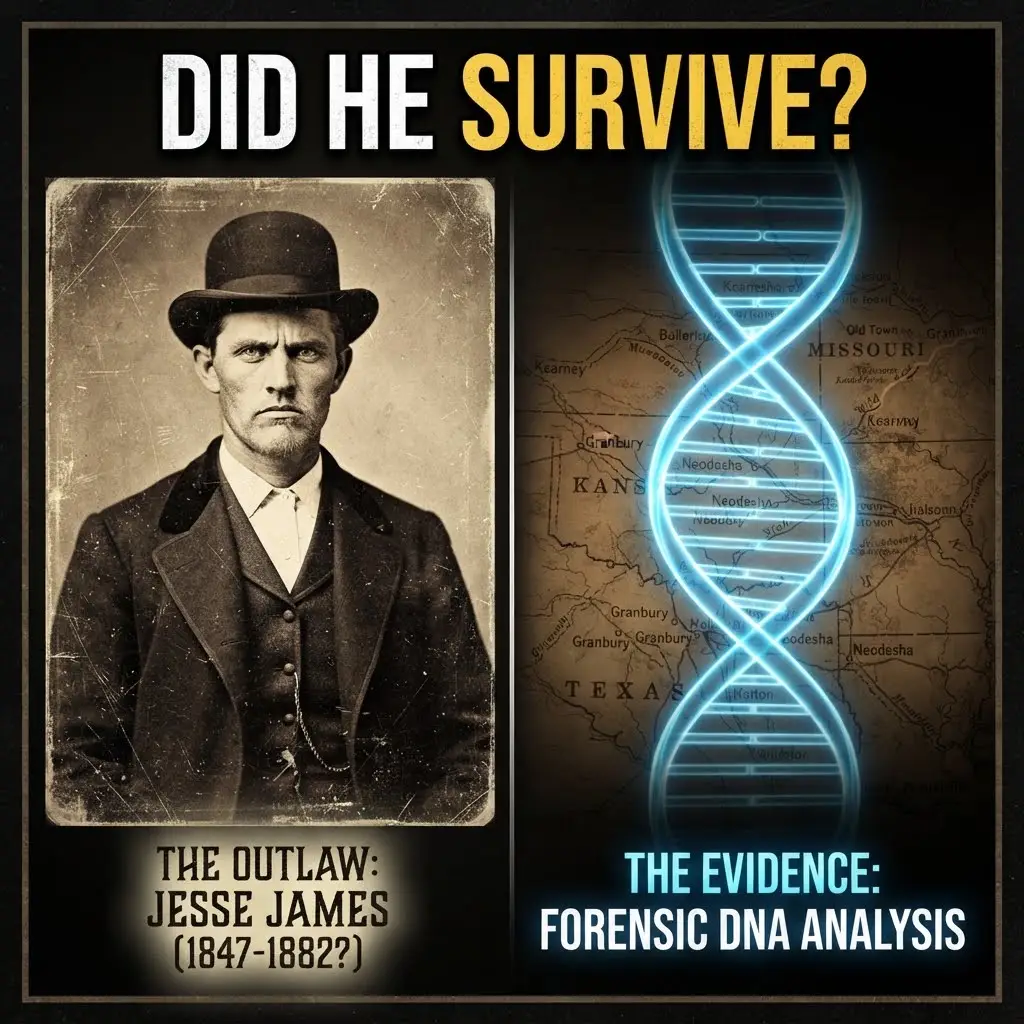
The Jesse James DNA Myth: Why Are There 3 Graves?
FAQs
1. Did J. Frank Dalton provide any evidence to support his claim of being Jesse James?
Yes, J. Frank Dalton claimed to have a scar on his chest that matched a scar Jesse James was known to have. He also stated that he had knowledge of personal details about Jesse James’ life that only the real Jesse James would know.
2. Was J. Frank Dalton’s claim of being Jesse James widely accepted by historians and experts?
No, the majority of historians and experts do not believe J. Frank Dalton’s claim of being Jesse James. There is a lack of concrete evidence to support his assertion, and many inconsistencies in his story have been pointed out.
3. What was the outcome of J. Frank Dalton’s request to have his body exhumed for DNA testing?
J. Frank Dalton’s request to have his body exhumed for DNA testing was denied by the court. Without this scientific testing, his claim of being Jesse James remains unproven.
4. Are there any living descendants of Jesse James who could provide DNA samples for comparison?
Yes, there are living descendants of Jesse James who could provide DNA samples for comparison. However, they have not been willing to participate in testing to confirm or refute J. Frank Dalton’s claim.
5. What are some reasons why J. Frank Dalton’s claim of being Jesse James is considered dubious?
Some reasons why J. Frank Dalton’s claim is considered dubious include inconsistencies in his story, lack of concrete evidence such as DNA testing, and the fact that he came forward with his claim many years after Jesse James was believed to have died.