
The Whispers of the West: Echoes of Jesse James in Texas
The name Jesse James conjures images of dusty plains, daring train robberies, and a life lived on the run. For decades, his legend has been inextricably linked with the American West, a symbol of rebellion and defiance against the encroaching modernity of the late 19th century. Yet, within this captivating narrative, a persistent and tantalizing question has always lingered: did Jesse James truly meet his end in Missouri, or did he, as many tales suggest, escape to the vast, untamed lands of Texas? This article delves into the enduring mystery, examining the evidence, the legends, and the persistent whispers that suggest a life after death for one of America’s most notorious outlaws.
The legend of Jesse James and his supposed escape to Texas has intrigued historians and enthusiasts alike, sparking numerous debates and theories about the infamous outlaw’s fate. For those interested in exploring more about historical figures and their connections to engineering marvels, a fascinating article on ancient hydraulic engineering can be found here: Ancient Hydraulic Engineering Marvels: Masterpieces of Water Management. This article delves into the ingenuity of past civilizations, providing a broader context for understanding the era in which Jesse James lived.
The Official Account: A Bullet in the Back
The widely accepted narrative of Jesse James’s demise places his death in St. Joseph, Missouri, on April 3, 1882. According to historical accounts, James was shot and killed by Robert Ford, a disgruntled member of his own gang, who sought the substantial reward offered by the governor of Missouri for James’s capture, dead or alive. The circumstances surrounding this event are relatively well-documented, painted as a betrayal born of greed and desperation.
The Missouri Graveyard: A Tombstone and a Corpse
The traditional story holds that Jesse James was shot by Robert Ford in his own home, while reaching for his hat. Ford, along with his brother Charley, then allegedly alerted the authorities, and the body was publicly displayed in St. Joseph to confirm the outlaw’s death. The stark reality of a corpse in a coffin, identified by many as Jesse James, seemed to put a definitive end to the bandit’s reign of terror. This event was widely reported, solidifying the Missouri narrative in the public consciousness.
The Aftermath and the Reward
Robert Ford was tried for the murder of Jesse James and, surprisingly, received a pardon from Governor Thomas Crittenden, who had offered the significant reward. This pardon, granted shortly after the conviction, has fueled speculation for years, with some arguing it was a reward for silencing the outlaw permanently, while others see it as a cynical move to legitimize the Ford brothers’ actions and close the chapter on the James-Younger gang’s activities. The money exchanged hands, and the nation, for the most part, moved on, believing the notorious outlaw was finally at rest.
The Seeds of Doubt: Anomalies and Alternative Theories
Despite the official pronouncements and the seemingly conclusive evidence, the idea that Jesse James survived the St. Joseph incident and escaped has persisted for over a century. These doubts are not merely the product of fanciful storytelling; they are rooted in a series of anomalies, inconsistencies, and the emergence of individuals claiming to be the real Jesse James, often far from Missouri’s familiar landscapes, particularly in the rugged terrain of Texas.
The Question of Identity: Was it Really Jesse?
One of the primary reasons for the enduring debate lies in the ambiguity surrounding the identification of the body found in St. Joseph. While contemporary accounts and photographs suggest it was indeed Jesse, skepticism has always been present. Could the body have been a look-alike, a fall guy staged to appease the authorities and collect the reward? The lack of definitive forensic evidence, by today’s standards, has allowed these questions to fester. The passage of time, the wear and tear of bullets on flesh, and the limitations of 19th-century identification methods all contribute to the persistent “what if.”
The “Other” Jesse James: Tales from the Lone Star State
The most compelling alternative theories often point towards Texas as Jesse James’s final refuge. Over the years, several individuals surfaced, claiming to be the legendary outlaw, and many of these claimants hailed from Texas. These stories, often shared by descendants or local historians, paint a picture of an older, quieter Jesse living under an assumed name, seeking anonymity and a peaceful existence away from the notoriety that had defined his life. These narratives are rarely accompanied by irrefutable proof but are rich in anecdotal evidence and detailed personal accounts that resonate with the romanticized image of the outlaw’s resilience.
Texas as a Sanctuary: The Allure of the Frontier
The vastness and ruggedness of Texas in the late 19th century presented an almost ideal environment for an outlaw seeking to disappear. The state was sparsely populated in many areas, with expansive ranches, dense forests, and a frontier spirit that was less inclined to inquire about a stranger’s past. The legal and law enforcement systems, while present, were often stretched thin, making it challenging to track down an individual determined to remain hidden.
The Wide-Open Spaces: Anonymity in the Wilds
Texas offered an unparalleled opportunity for anonymity. Imagine an outlaw, skilled in riding and survival, shedding his old identity and blending into the rural fabric of the state. He could adopt a new name, perhaps change his appearance, and find work on a remote ranch, far from the prying eyes of lawmen and bounty hunters. The sheer scale of Texas, with its diverse landscapes ranging from the piney woods of East Texas to the arid plains of West Texas, provided ample hiding places. The frontier mentality prevalent in many parts of the state meant that newcomers were often judged by their work ethic and character, not by their past affiliations.
A New Identity: The Legend of John Slack and Others
Several Texas-based theories propose specific individuals who may have been Jesse James. One prominent claimant was a man known as John Slack, who lived in Central Texas and bore a striking resemblance to early photographs of Jesse James. Descendants of Slack have maintained for generations that he was indeed the famed outlaw, escaping to Texas to escape his violent past. Other stories speak of a quiet farmer in West Texas or a respected rancher in the Panhandle who bore the unmistakable bearing and mannerisms of Jesse James, living out his days in obscurity. These stories, while lacking definitive proof, contribute to the rich tapestry of legends surrounding the outlaw.
The legend of Jesse James and his supposed escape to Texas has intrigued historians and enthusiasts alike for generations. Many believe that after his notorious criminal exploits, he sought refuge in the vast landscapes of Texas, where he could evade the law. This fascinating narrative intertwines with the broader themes of American history and migration, particularly as trade routes and borders evolved. For those interested in understanding the changing dynamics of trade and migration, a related article discusses how Mexico has recently surpassed China as the top trading partner of the United States, highlighting the ongoing shifts in economic relationships. You can read more about this development in the article here.
Unearthing the Evidence: Forensic and Anecdotal Clues
| Metric | Data |
|---|---|
| Historical Fact | Jesse James did not escape to Texas; he was killed in Missouri in 1882. |
| Reported Sightings in Texas | Several unverified reports and legends claim Jesse James fled to Texas after his crimes. |
| Official Records | No official records confirm Jesse James lived or escaped to Texas. |
| Popular Culture | Some stories and movies depict Jesse James escaping to Texas as part of folklore. |
| Law Enforcement Reports | Law enforcement at the time confirmed Jesse James was killed in St. Joseph, Missouri. |
The debate over Jesse James’s fate is not solely confined to folklore. Over the years, a range of evidence, both anecdotal and, in some cases, potentially forensic, has emerged, adding layers of complexity to the enduring mystery. While definitive proof remains elusive, these fragments of information keep the possibility of a Texas escape alive.
The Remains in Granbury: A Contested Autopsy
Perhaps the most significant development in recent decades was the exhumation of a body in Granbury, Texas, in 1995. The individual buried there, identified as John W. Hardin, was believed by some to be Jesse James. DNA testing was conducted on the exhumed remains and compared with known relatives of Jesse James. The results were inconclusive, with some scientists asserting a familial link and others disputing it. The controversy surrounding the testing, the methodology, and the interpretation of the results continues to this day, leaving the Granbury gravesite as another focal point of the ongoing debate.
The Family Secrets: Whispers Down the Generations
The descendants of individuals who may have been Jesse James in Texas have often been guardians of family lore. These stories, passed down through oral tradition, speak of a grandfather or great-grandfather with a mysterious past, a man who was unusually skilled with firearms, or who possessed a deep understanding of outlaw lore. These anecdotal accounts, while subjective, can offer glimpses into the lives of those who may have been living under assumed identities. The reticence of some families to discuss their ancestors openly, fearing potential repercussions or simply wishing to preserve their privacy, has also contributed to the mystique.
The legend of Jesse James and his supposed escape to Texas has long fascinated historians and enthusiasts alike. Many have speculated about the various routes he might have taken and the people who aided him during his flight from the law. For those interested in exploring themes of escape and adventure in a different context, a related article discusses the intense competition of the space race and its implications for humanity’s future. You can read more about this intriguing topic in the article here.
The Enduring Enigma: Why the Legend Persists
The question of whether Jesse James escaped to Texas may never be definitively answered. The passage of time, the destruction of evidence, and the very nature of outlawry—which thrives on secrecy and deception—make a conclusive resolution highly improbable. However, it is precisely this ambiguity that fuels the legend and ensures its continued resonance.
The Romantic Appeal of the Uncaught
The allure of the outlaw who eluded capture is deeply ingrained in the American psyche. Jesse James, with his daring exploits and perceived defiance of authority, represents a romantic ideal of freedom and resistance. The idea that he could have outsmarted his pursuers and lived out his days in peace, particularly in the vast and wild frontier of Texas, is a far more captivating narrative for many than the grim reality of betrayal and a violent death.
The Power of Myth: Shaping American Identity
The legend of Jesse James is more than just a story of a criminal; it is a thread woven into the fabric of American mythology. The outlaw archetype, the lone wolf against the system, resonates with a deep-seated desire for individuality and a suspicion of centralized power. Whether he died in Missouri or escaped to Texas, Jesse James continues to embody this complex aspect of the American spirit, a reminder of a time when the West was a place of both danger and limitless possibility, where legends could be forged and identities could be shed as easily as a worn-out saddle. The truth, much like the dusty trails of the West, may remain forever obscured, inviting us to ponder the enduring power of a myth.
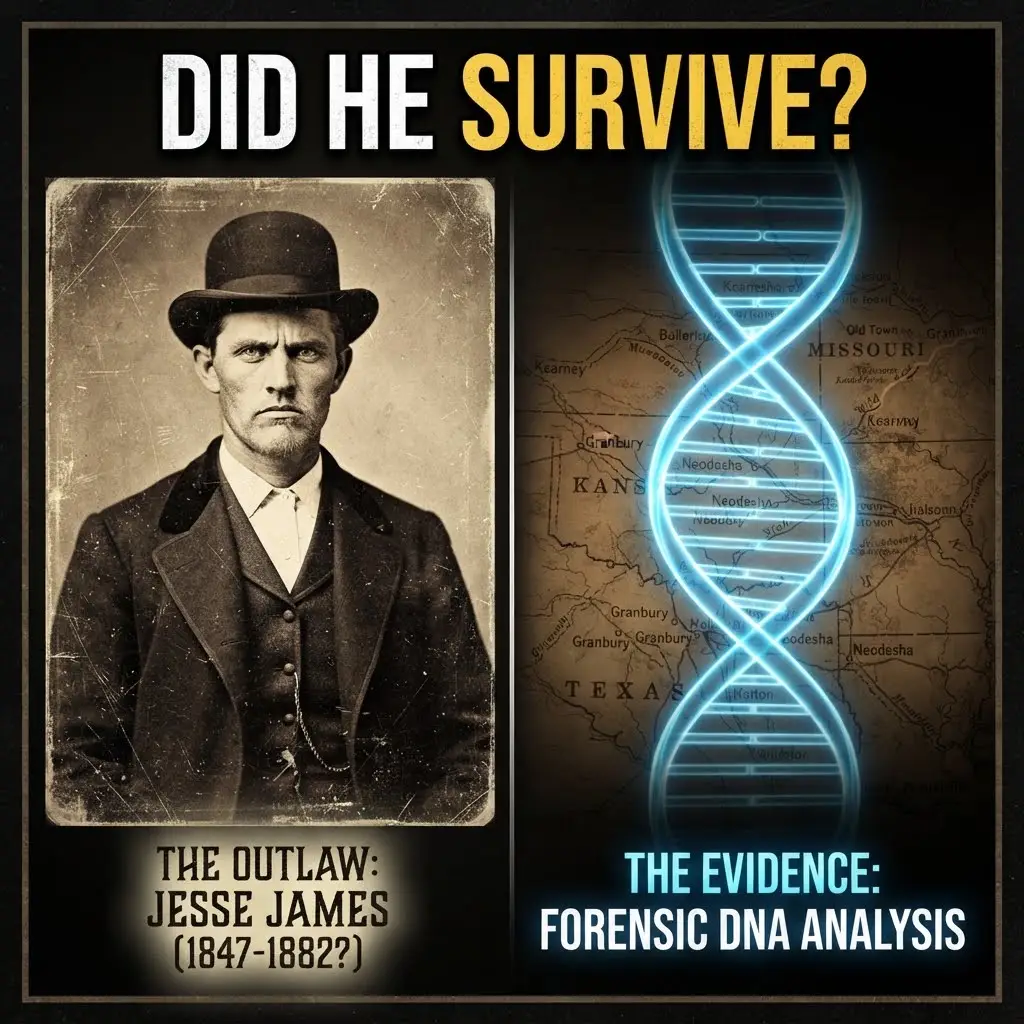
The Jesse James DNA Myth: Why Are There 3 Graves?
FAQs
1. Was Jesse James really killed in 1882 or did he escape to Texas?
There are theories and claims that Jesse James faked his death in 1882 and escaped to Texas to live under an assumed name.
2. What evidence supports the theory that Jesse James escaped to Texas?
Supporters of the theory point to similarities between known photographs of Jesse James and a man named J. Frank Dalton who claimed to be the outlaw living in Texas.
3. Did J. Frank Dalton’s claims of being Jesse James hold any credibility?
While some believed J. Frank Dalton was Jesse James, DNA testing conducted in the 1990s on Dalton’s remains did not match James’ known living relatives, casting doubt on his claims.
4. Are there any historical records or documents that confirm Jesse James’ escape to Texas?
There is no concrete historical evidence or documentation that definitively proves Jesse James escaped to Texas after his reported death in 1882.
5. What is the general consensus among historians regarding Jesse James’ alleged escape to Texas?
Most historians consider the theory of Jesse James escaping to Texas to be unlikely and lacking substantial evidence, viewing it as more of a legend or myth surrounding the infamous outlaw.