
The legend of Jesse James, the notorious outlaw whose life and death are shrouded in myth and speculation, continues to captivate imaginations more than a century after his supposed demise. For decades, the prevailing narrative, cemented by sensationalized newspaper accounts and dime novels, has been that James was gunned down by Robert Ford, a disgruntled member of his own gang, on April 3, 1882, in St. Joseph, Missouri. Yet, a persistent undercurrent of doubt has always flowed beneath this accepted truth, fueled by inconsistencies, tantalizing clues, and the sheer romantic allure of a criminal mastermind who might have outwitted even death. Did Jesse James truly meet his end that fateful spring day, or did the legendary outlaw engineer one final, masterful escape, leaving behind a doppelganger to face the firing squad of history? Uncovering the truth behind Jesse James’s legend requires a deep dive into the historical record, the forensic evidence, and the enduring power of myth.
The Assassination of Jesse James: The Official Account and its Cracks
The accepted story of Jesse James’s death is remarkably detailed, painting a picture of betrayal and violence. Robert and Charley Ford, weary of James’s tyrannical leadership and seeking the substantial reward offered for his capture or death, had meticulously planned his demise. The scene is often described with chilling precision: Jesse, seeking to clean himself, removed his pistol belt and climbed a table to dust a picture frame. In that vulnerable moment, Robert Ford leveled his weapon and fired, striking James in the back of the head. The immediate aftermath was a whirlwind of official pronouncements, sensational reporting, and the quick apprehension and conviction of the Ford brothers. However, even within the contemporary accounts, fissures began to appear, raising questions about the certainty of the event.
The Conflicting Witness Testimonies
While Robert Ford was the one who pulled the trigger, other individuals were present in the St. Joseph home that day, or at least in close proximity. The accounts of these witnesses, however, were not entirely uniform. Some described the body as unmistakably Jesse James, while others offered less definitive identifications. The passage of time, the shock of the event, and the inherent difficulty in identifying a man known for constantly changing his appearance and aliases could have contributed to these discrepancies. Furthermore, the intense pressure to solve the “case of the century” and collect the reward may have subtly influenced what witnesses recalled or chose to emphasize. The rapid pace of events, from the shooting to the public display of the body, left little room for meticulous, unbiased verification.
The Lingering Doubts of Contemporaries
It was not just later generations that questioned the official story. Even in 1882, whispers and rumors began to circulate about Jesse James’s survival. Some contemporaries, familiar with his cunning and penchant for elaborate schemes, found it difficult to believe he would have been caught so unprepared or that he would allow himself to be killed by men he so thoroughly controlled. The speed with which the body was displayed and buried, almost as if to quell any lingering doubts, also struck some as suspicious. The idea that Jesse James, a master of disguise and evasion, would fall victim to such a basic lapse in security seemed, to many, out of character. This early skepticism, however, was often drowned out by the more sensational and widely disseminated narrative of his violent end.
The legend of Jesse James, the infamous outlaw, has sparked numerous debates and theories regarding his supposed survival after his reported death in 1882. Many enthusiasts and historians have explored various narratives surrounding his life and demise, leading to a plethora of intriguing articles. One such article that delves into the mysteries of historical figures and their legacies can be found at The Mystery of Lost Ancient Technology, which discusses how myths and legends can shape our understanding of history.
The Anatomy of a Legend: Why the Myth Endures
The legend of Jesse James is a potent cocktail of outlaw bravado, perceived social justice, and the enduring American fascination with the rebel. He was more than just a bank robber and train hijacker; he became a folk hero, a symbol of defiance against corrupt railroads and oppressive authorities. This romanticized image, heavily embellished by popular culture, made the idea of his death, especially by the hand of a trusted associate, somewhat incongruous with the untamable spirit he represented. The possibility of his survival offered a continuation of that spirit, a wink and a nod from beyond the grave.
The Appeal of the “Robin Hood” Outlaw
Jesse James was often portrayed as a modern-day Robin Hood, stealing from the rich (banks and railroads, which were perceived as powerful and exploitative entities) and occasionally, though less consistently, from the poor. This narrative, whether entirely accurate or not, resonated deeply with the common folk who felt marginalized by the burgeoning industrial capitalism of the late 19th century. The idea that a man could stand up to these powerful forces and escape their clutches fueled a deep-seated desire for justice and rebellion. A Jesse James who survived and continued to operate, perhaps in secret, only amplified this appeal.
The Power of Popular Culture and Dime Novels
The dime novel industry, a booming sector of late 19th-century publishing, seized upon the Jesse James story with gusto. These cheap, sensationalized publications, often featuring lurid illustrations and exaggerated tales, were instrumental in shaping the public’s perception of the outlaw. They painted Jesse as a dashing, heroic figure, a cunning strategist, and an almost mythical being. These narratives, more than historical accuracy, cemented his place in American folklore. In this context, a dramatic and definitive death, while sensational, also risked ending the lucrative storytelling. The notion of a hidden survival provided fertile ground for continued adventures and kept the legend alive, even if the actual man was gone.
The Evidence for Survival: A Closer Look at the Anomalies
Over the years, various individuals and groups have come forward with claims and evidence suggesting that the man shot in St. Joseph was not Jesse James. These claims, ranging from eyewitness accounts to purported confessions and even forensic analysis, have kept the debate alive and continue to be scrutinized by historians and researchers. While no single piece of evidence has definitively proven Jesse James survived, the accumulation of these anomalies has created a compelling counter-narrative.
The “Man in the Coffin” Controversy
One of the most enduring pieces of evidence cited by survival theorists is the alleged discrepancy between the man buried in St. Joseph and the known physical characteristics of Jesse James. Photographs of Jesse James, particularly from earlier in his life, show a man with certain distinct features. When the body believed to be Jesse James was exhumed in 1995 for forensic examination, researchers noted several inconsistencies with these known photographs. The teeth structure, for instance, did not perfectly match the dental records and photographs available. While time and decay can alter appearances, the magnitude of some of these differences has led many to believe that the man in the coffin was not Jesse James.
The Claims of Former Associates and Unidentified Individuals
Over the decades, several individuals have surfaced claiming to be Jesse James, or to have known him in his later years after his supposed death. Some of these claims came from former members of the James-Younger gang who, for reasons of their own, may have either been complicit in a deception or genuinely believed James had escaped. Perhaps the most famous of these was the man known as “J. Frank Dalton,” who in the early 20th century, claimed to be Jesse James. His story, while often dismissed, contained specific details about James’s life and exploits that lent it a degree of credibility for some. The existence of such claims, even if ultimately unsubstantiated, contributes to the persistent doubt.
The Forensic Investigation: Science Weighs In
The modern era has brought scientific tools to bear on this age-old mystery. The exhumation of the body in St. Joseph in 1995, and subsequent DNA testing, represented a significant attempt to resolve the question definitively. The results of this investigation, however, proved to be far from conclusive, and in some ways, only deepened the enigma.
DNA Testing and Its Ambiguities
The 1995 exhumation was conducted with the hope that DNA analysis could definitively identify the remains. Researchers obtained DNA samples from the exhumed body and compared them with DNA from known relatives of Jesse James, specifically his great-grandson. The initial findings were that the DNA from the St. Joseph grave was not a close match to the direct paternal line of Jesse James. However, the quality of the DNA recovered from the grave was degraded due to age, making definitive conclusions challenging. Furthermore, the possibility of maternal lineage or other indirect relationships could complicate the interpretation. The ambiguity of the DNA results meant that the scientific verdict was not a clear-cut “yes” or “no.”
Skeletal Analysis and Anthropological Findings
Beyond DNA, anthropologists and forensic scientists also examined the skeletal remains for any identifying characteristics. These analyses focused on factors such as bone structure, height, and signs of past injuries that might have been documented for Jesse James. While some aspects of the skeletal remains were consistent with the general description of Jesse James, other features, as mentioned earlier, raised questions. The teeth, in particular, became a focal point of debate. The condition and arrangement of the teeth in the exhumed skeleton did not precisely align with the available photographic evidence of Jesse James’s smile and dental structure. This ongoing forensic debate continues to fuel the speculation.
The legend of Jesse James has captivated many, leading to various theories about his fate. Some believe he survived his infamous shootout and lived under a different identity, while others argue that he met his end that fateful day. For those interested in exploring more about historical mysteries, a fascinating article discusses the ancient astronomical marvel of Nabta Playa and its significance in understanding early civilizations. You can read more about it here.
The Enduring Enigma: Why the Truth Remains Elusive
| Metric | Data |
|---|---|
| Historical Death Date | April 3, 1882 |
| Reported Cause of Death | Gunshot wound by Robert Ford |
| Survival Theories | Multiple claims of survival and sightings post-1882 |
| Most Credible Evidence | Death certificate and contemporary newspaper reports |
| DNA Testing | Tests on alleged descendants support historical death |
| Popular Culture Impact | Numerous books and films exploring survival myths |
Despite the persistent efforts of historians, amateur sleuths, and even forensic scientists, the question of whether Jesse James survived his supposed assassination remains largely unanswered. The very nature of his life and legend, characterized by deception, evasion, and romanticized storytelling, has created a potent brew of uncertainty that is difficult to untangle. The lack of irrefutable proof, coupled with the compelling allure of the myth, ensures that Jesse James will likely remain a figure of enduring mystery.
The Challenge of Historical Documentation
The era in which Jesse James lived was one of rapid change and limited standardized record-keeping, especially when it came to individuals operating outside the law. While newspapers of the time avidly reported on his exploits and alleged death, these accounts were often sensationalized and driven by the pursuit of circulation rather than strict accuracy. Official documents, where they exist, can be incomplete or subject to interpretation. The difficulty in obtaining unimpeachable, contemporary documentation for many aspects of Jesse James’s life, including his final moments, provides fertile ground for speculation and the persistence of alternative narratives.
The Power of Belief and the Appeal of the Unknown
Ultimately, the enduring question of Jesse James’s survival may also be a testament to the power of belief and the inherent human fascination with the unknown. The idea that a legendary outlaw could have orchestrated his own vanishing act, escaping justice and disappearing into obscurity, is a far more romantic and captivating notion than a simple tale of betrayal and death. This enduring appeal ensures that even if definitive proof of his death were to emerge, some would likely still cling to the possibility of his survival, a testament to the potent magic of the legend itself. The story of Jesse James, whether he lived or died that day in St. Joseph, will forever be intertwined with the myths he inspired and the questions he left behind.
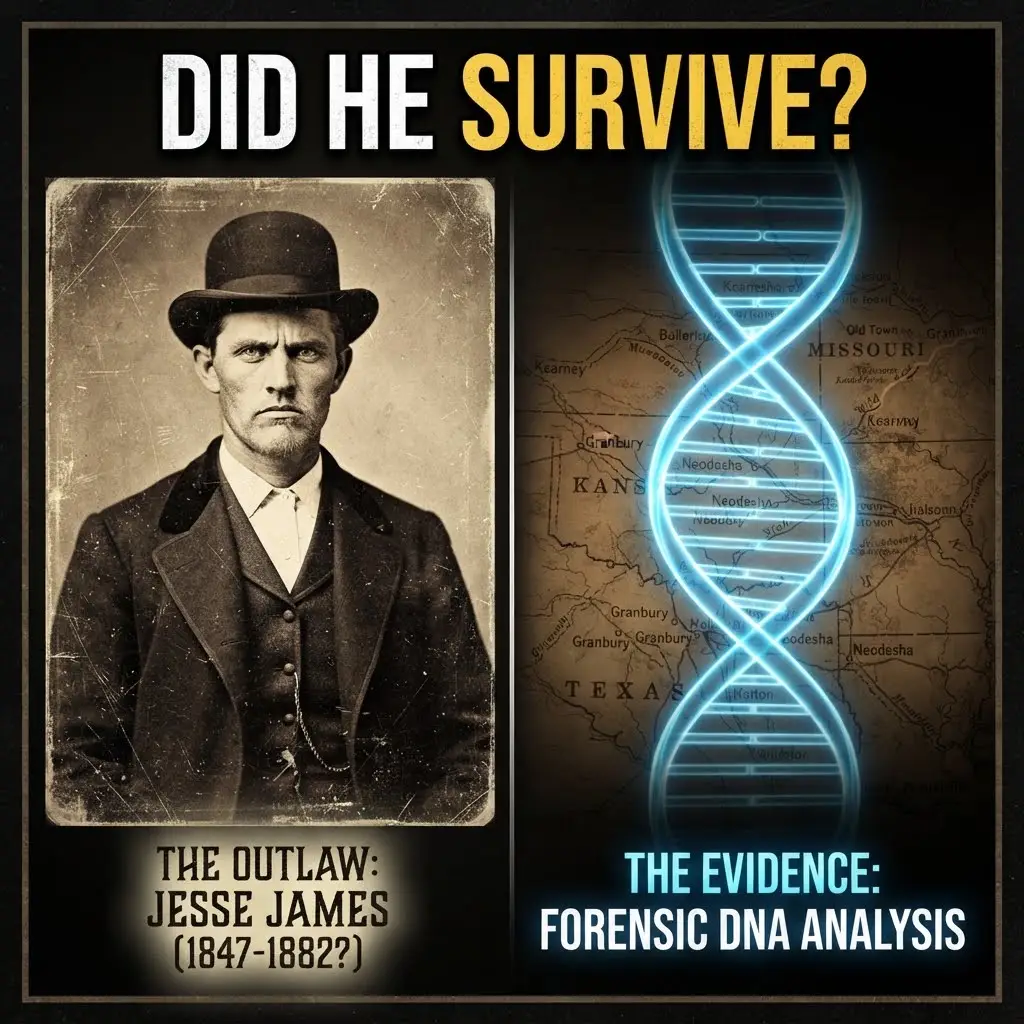
The Jesse James DNA Myth: Why Are There 3 Graves?
FAQs
1. Did Jesse James survive the shooting?
There are conflicting theories about whether Jesse James survived the shooting. Some believe he was killed by Robert Ford in 1882, while others claim he faked his death and lived under an assumed name.
2. What evidence supports the theory that Jesse James survived?
Supporters of the theory that Jesse James survived point to inconsistencies in the identification of his body, lack of a positive identification by family members, and alleged sightings of him after his reported death.
3. Where did Jesse James allegedly live after faking his death?
According to some accounts, Jesse James lived in various locations under different aliases after faking his death, including in Texas, Missouri, and even in South America.
4. Why would Jesse James have faked his death?
Some believe that Jesse James faked his death to escape the law and live a quiet life away from the public eye. Others suggest he may have wanted to start fresh and leave his outlaw past behind.
5. Is there any conclusive evidence proving whether Jesse James survived or not?
As of now, there is no definitive evidence that conclusively proves whether Jesse James survived the shooting or not. The debate continues among historians and enthusiasts who study the life and death of the infamous outlaw.