
The allure of rock crystal, a transparent, colorless variety of quartz, has captivated humanity for millennia. Beyond its aesthetic appeal as a gemstone and decorative material, this seemingly simple mineral possesses a fascinating array of optical properties that have intrigued scientists and artisans alike. Understanding these properties unlocks a deeper appreciation for rock crystal, revealing its role in ancient technologies, its potential in modern scientific applications, and the fundamental physics that govern light’s interaction with matter.
The Genesis and Structure of Pure Quartz
Rock crystal, scientifically known as macrocrystalline quartz, is a mineral composed of silicon dioxide (SiO₂). Its formation typically occurs in igneous and metamorphic rocks, often within pegmatites and hydrothermal veins. The slow crystallization process allows for the development of large, well-formed crystals, contributing to its clarity and transparency. The characteristic hexagonal crystal system of quartz dictates its internal atomic arrangement, forming a tightly packed lattice of silicon and oxygen atoms. This ordered structure is crucial to understanding its optical behavior. The piezoelectric properties of quartz, where mechanical stress generates an electric charge and vice versa, are also directly linked to this precise crystalline framework. While impurities can lead to a spectrum of colored quartzes (amethyst, citrine, smoky quartz, etc.), true rock crystal is defined by its near-perfect absence of such color-inducing elements, allowing light to pass through with minimal absorption or scattering. The purity of the material is paramount for observing its intrinsic optical phenomena.
Factors Influencing Crystal Formation
The growth of rock crystal crystals is a complex geological process influenced by several key factors. Temperature and pressure play significant roles, dictating the rate of silica precipitation and the size and perfection of the resulting crystals. The presence of suitable mineral-rich fluids, often superheated water containing dissolved silica, is essential. The rate at which these fluids cool and the availability of nucleation sites for crystal growth determine the final characteristics of the rock crystal. Slower cooling rates generally favor larger, more well-formed crystals, while rapid cooling can lead to smaller, less perfect specimens or even amorphous silica. The absence of significant foreign ions within the growing crystal lattice is critical for achieving the clarity and transparency associated with true rock crystal. Any trace elements present can begin to absorb or scatter light, altering the crystal’s optical properties.
The Atomic Lattice and Light Interaction
At the atomic level, the regular, repeating structure of the silicon dioxide lattice in rock crystal is the foundation of its optical properties. The strong covalent bonds between silicon and oxygen atoms create a rigid framework that is largely transparent to visible light. The energy levels of electrons within these bonds are such that they require higher energy photons (like ultraviolet light) to be excited. Visible light photons do not possess sufficient energy to be absorbed by the electrons, allowing them to pass through the crystal unimpeded. However, the ordered nature of the lattice also influences how light propagates through it. The refractive index, a measure of how much light bends when entering a material, is a consequence of the interaction between the electromagnetic field of light and the electrons within the crystal. In a crystalline material like quartz, the refractive index can vary depending on the direction of light propagation relative to the crystal axes, a phenomenon known as birefringence.
Rock crystal, also known as clear quartz, exhibits fascinating optical properties that have intrigued scientists and gem enthusiasts alike. Its ability to refract and reflect light makes it a popular choice in various optical applications, from lenses to prisms. For those interested in exploring how advancements in technology and materials science are influencing various fields, including optics, a related article can be found here: SpaceX Starship: Shifting Space Geopolitics. This article delves into the broader implications of technological advancements, which can also encompass developments in optical materials like rock crystal.
Transparency and Refraction: The Basic Optical Behaviors
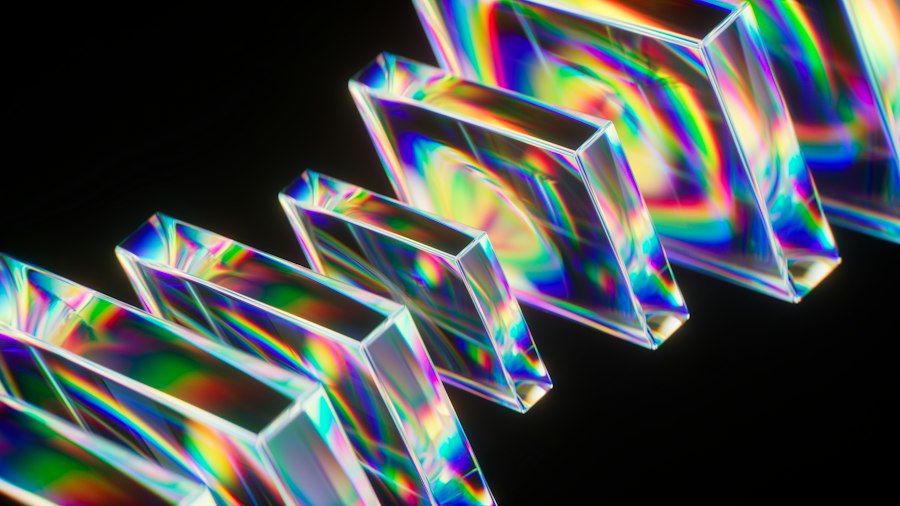
The most immediately apparent optical property of rock crystal is its exceptional transparency. This clarity allows light to pass through with minimal attenuation, making it appear clear and colorless. This transparency is a direct result of the electronic structure of silicon dioxide, as mentioned earlier, where the energy gap between the valence and conduction bands is large, preventing the absorption of visible light photons. Coupled with its transparency is its ability to refract light. Refraction is the bending of light as it passes from one medium to another, caused by a change in the speed of light. Rock crystal has a relatively high refractive index, meaning light slows down significantly upon entering the crystal, causing it to bend. This bending is the principle behind lenses and prisms, and while rock crystal isn’t typically used for sophisticated optical instruments today, its historical use in rudimentary magnifying lenses is well-documented.
The Phenomenon of Birefringence
Rock crystal, like many crystalline materials, exhibits birefringence, also known as double refraction. This means that a single ray of light entering the crystal will, in most cases, split into two rays that travel at different speeds and are polarized in perpendicular directions. This occurs because the crystal lattice is anisotropic, meaning its properties vary with direction. For uniaxial crystals like quartz, there is a unique axis, the optical axis, along which light travels without splitting. Light propagating perpendicular to this axis experiences the highest refractive index, while light propagating parallel to it experiences the lowest. This difference in refractive indices for different polarization directions causes the two split rays to refract at different angles, leading to the observed double image. The magnitude of birefringence is a specific property of quartz and can be measured by the difference between its extraordinary refractive index (n_e) and its ordinary refractive index (n_o).
Polarization and Optical Activity
The birefringence of rock crystal leads to another significant optical property: optical activity. Due to the chiral nature of the quartz crystal structure (specifically, the arrangement of silicon-oxygen tetrahedra), it can rotate the plane of polarization of linearly polarized light. This phenomenon is called optical activity. Quartz crystals can be either dextrorotatory (rotating the plane clockwise) or levorotatory (rotating it counterclockwise), depending on the handedness of their crystal structure. This property is intrinsic to the crystal lattice and is not a surface effect. Historically, optical activity was a key characteristic that distinguished quartz from other clear minerals. While not a property that affects the macroscopic appearance of a rock crystal, it is a fundamental optical characteristic that can be measured and used for identification and characterization.
Light Scattering and Luminescence in Rock Crystal

While rock crystal is primarily known for its transparency, under certain conditions, it can also exhibit light scattering and luminescence. Light scattering occurs when light waves interact with imperfections or structural anomalies within the crystal. These imperfections can range from microscopic inclusions to subtle variations in the crystal lattice. Rayleigh scattering, the same phenomenon that gives the sky its blue color, can occur to a minor extent within highly transparent materials, but it is typically overshadowed by other optical effects in rock crystal. More significant scattering can arise from the presence of tiny air bubbles or fluid inclusions trapped during crystallization. These inclusions act as scattering centers, causing the light to deviate from its straight path.
Inclusions and Their Optical Impact
The presence of inclusions within rock crystal can dramatically alter its optical appearance. Tiny, needle-like inclusions of other minerals, such as rutile or actinolite, can create a star-like or cat’s-eye effect when light is reflected off their surfaces. These phenomena, known as asterism and chatoyancy, respectively, are due to the collective reflection of light from parallel arrays of inclusions. While these effects are often desirable in gemstones, their presence deviates from the ideal pure rock crystal. Microscopic cracks or fractures within the crystal can also scatter light, leading to a milky or cloudy appearance. These are often referred to as “feathers” or “frosty inclusions.” The size, shape, and distribution of these inclusions are critical in determining the resulting optical effect.
Luminescence Under Excitation
Rock crystal can also display luminescence, the emission of light by a substance that has absorbed energy. While pure quartz is generally not strongly luminescent, trace impurities or structural defects can act as activators, leading to emission of light when excited by ultraviolet (UV) radiation or other forms of energy. This luminescence can manifest in various colors, including blue, green, or yellow. The specific color and intensity of the luminescence depend on the nature and concentration of the activating impurities. For instance, some impurities can create defects in the crystal lattice that trap electrons, and upon excitation, these electrons can release their energy as photons of visible light. Studying the luminescence properties of rock crystal can provide insights into its formation environment and the presence of specific trace elements.
Historical and Modern Applications of Rock Crystal’s Optics
The optical properties of rock crystal have been recognized and exploited since ancient times. Early civilizations utilized its clarity and refractive capabilities for rudimentary optical devices. The Greeks and Romans are believed to have used polished rock crystal spheres as magnifying lenses, aiding in tasks such as reading and fine craftsmanship. The renowned orator Cicero reportedly used a lens made of rock crystal to read small text. Beyond magnification, rock crystal was also employed for decorative purposes, its transparency and ability to capture and refract light making it ideal for carvings, amulets, and ceremonial objects. The belief in the mystical properties of rock crystal, often linked to its clarity and perceived connection to purity, further fueled its widespread use.
Ancient Optical Devices and Beliefs
The earliest evidence of rock crystal’s use as an optical tool dates back to the Sumerians, who used polished crystal lenses around 2000 BCE. The Vikings were also known to have used “sunstones,” believed to be pieces of calcite or rock crystal, to navigate by polarizing sunlight, a testament to their understanding of light’s behavior. In ancient Egypt, rock crystal was carved into statues, bowls, and jewelry, valued for its beauty and its perceived ability to channel spiritual energy. The Egyptians believed that rock crystal contained the “water of life” and could ward off evil spirits. The Romans also attributed healing properties to rock crystal, and it was commonly used in jewelry and as decorative elements in homes. The inherent clarity and ability to transmit light made it a material associated with purity, divinity, and clarity of thought across various ancient cultures.
Contemporary Relevance in Technology and Science
While its use in rudimentary lenses has been superseded by manufactured glass and advanced optical materials, rock crystal continues to hold relevance in modern science and technology, primarily due to the piezoelectric properties of quartz. Although not strictly an optical property, the precise atomic arrangement that gives rise to its optical transparency also enables its piezoelectric effect. This means that when subjected to mechanical stress, quartz crystals generate an electric voltage, and conversely, when an electric field is applied, they deform. This property is fundamental to the operation of quartz oscillators, which are used in virtually all electronic devices, from watches and computers to radios and telecommunications equipment, for precise timekeeping and frequency generation. Research is also ongoing into the potential use of nanostructured quartz for advanced optical applications, such as in optical computing and sensors, where its unique optical and electrical properties could be harnessed in novel ways.
Rock crystal, a form of quartz, exhibits fascinating optical properties that have intrigued scientists and gem enthusiasts alike. Its clarity and ability to refract light make it a popular choice in various applications, from jewelry to optical instruments. For those interested in exploring the broader implications of natural resources and their value, a related article discusses the potential impact of inflation on asset security. You can read more about this topic in the article linked here: asset seizure. Understanding these connections can provide valuable insights into the significance of materials like rock crystal in today’s economy.
The Physics of Light Propagation Through Crystalline Structures
| Property | Value | Unit | Notes |
|---|---|---|---|
| Refractive Index (n) | 1.544 – 1.553 | unitless | Varies slightly with wavelength |
| Optical Transparency | High | — | Transparent to visible and near-UV light |
| Dispersion (Abbe number) | 67.8 | unitless | Indicates low dispersion |
| Birefringence | 0.009 | unitless | Difference between ordinary and extraordinary rays |
| Optical Band Gap | ~7.0 | eV | Wide band gap semiconductor |
| Transmission Range | 0.2 – 3.0 | µm | Ultraviolet to mid-infrared |
| Crystal System | Trigonal | — | Hexagonal crystal family |
The way light propagates through rock crystal is a fundamental demonstration of wave-particle duality and the interaction of electromagnetic radiation with matter. When a photon of visible light encounters the silicon dioxide lattice, its energy is insufficient to excite the electrons to a higher energy state. Instead, the electromagnetic field of the light wave interacts with the charged particles within the crystal, causing them to oscillate. These oscillating charges then re-radiate electromagnetic waves, which interfere with the incoming wave. This process effectively slows down the light, leading to the phenomenon of refraction. The degree to which light is slowed down is quantified by the refractive index of the material.
Wave Propagation and Refractive Index
In a homogeneous, isotropic material, the refractive index is a single value. However, in crystalline materials like rock crystal, the arrangement of atoms is not uniform in all directions. This anisotropy means that the speed of light, and therefore the refractive index, can vary depending on the direction of propagation relative to the crystal’s crystallographic axes. This directional dependence of the refractive index is the root cause of birefringence. For a uniaxial crystal like quartz, there are two principal refractive indices: the ordinary refractive index (n_o), experienced by light polarized perpendicular to the optical axis, and the extraordinary refractive index (n_e), experienced by light polarized parallel to the optical axis. The difference between n_e and n_o is the measure of the crystal’s birefringence. Light rays entering the crystal at an angle to the optical axis will experience different refractive indices for their two perpendicular polarization components, causing them to split and travel along different paths.
Anomalous Dispersion and Interference Effects
While pure rock crystal is largely transparent across the visible spectrum, slight variations in transparency and refractive index can occur, leading to phenomena like anomalous dispersion. This refers to instances where the refractive index changes unusually rapidly with wavelength over a specific region of the spectrum. While less pronounced in rock crystal compared to some other materials, it can contribute to subtle color effects or distortions in light passing through thicker sections. Furthermore, the interaction of light waves within the crystal can lead to interference effects, particularly when light reflects off the internal surfaces of inclusions or the crystal’s own facets. Constructive interference can enhance certain wavelengths of light, while destructive interference can diminish them. These subtle interplay of wave phenomena, governed by the crystal’s structure and the properties of light, contribute to the rich optical tapestry of rock crystal. The precision of its atomic lattice, while enabling transparency, also lays the groundwork for a complex dance between light and matter, revealing a world of optical phenomena that continues to fascinate and inform scientific inquiry.

Did This Ancient Crystal Help People See?
FAQs
What are the optical properties of rock crystal?
Rock crystal, also known as clear quartz, has excellent optical properties such as high transparency, low dispersion, and a vitreous luster.
How does rock crystal interact with light?
Rock crystal exhibits a phenomenon called birefringence, where light passing through the crystal is split into two rays that travel at different speeds, resulting in double refraction.
What colors can be seen in rock crystal?
Rock crystal is typically colorless, but impurities can give it a variety of colors such as pink, yellow, or purple. In rare cases, it can also exhibit a phenomenon called asterism, where a star-like pattern is visible when light is reflected off the crystal.
What are some common uses of rock crystal in optics?
Rock crystal is commonly used in lenses, prisms, and other optical components due to its high transparency and low dispersion. It is also used in laser technology and in the production of optical filters.
How is the clarity of rock crystal determined?
The clarity of rock crystal is determined by the absence of inclusions, fractures, and other imperfections that can affect its optical properties. Gemologists use tools like magnification and light sources to assess the clarity of rock crystal.