The drilling rig, a behemoth of steel and ambition, stood sentinel over a scar in the Earth’s crust, a testament to humanity’s insatiable curiosity. This was the Kola Superdeep Borehole, a project that dared to penetrate the planet’s hidden depths, an endeavor that pushed the boundaries of science and engineering to their absolute limits. For over two decades, a dedicated team of geologists, engineers, and scientists toiled relentlessly, driven by the singular goal of understanding what lay beneath the familiar surface. Their efforts culminated in the creation of the world’s deepest artificial point, a hole that plunged an astonishing 12,262 meters (over 7.6 miles) into the Earth’s crust. This wasn’t just a hole; it was a window, a meticulously crafted aperture into the planet’s complex internal structure, revealing secrets that had remained concealed for millennia.
The idea of drilling deep into the Earth was not entirely new, but the Kola Superdeep Borehole represented a monumental leap forward in both aspiration and execution. Born from a confluence of Cold War geopolitical tensions and a burgeoning scientific interest in geophysics, the project was initiated by the Soviet Union in the late 1960s. The primary motivations were manifold, ranging from scientific exploration to the potential discovery of valuable mineral resources, and even a speculative interest in understanding the Earth’s composition for defense-related purposes.
Geopolitical Underpinnings and the Space Race Parallel
The era in which the Kola Superdeep Borehole project was conceived was marked by an intense rivalry between the United States and the Soviet Union, a period often referred to as the Cold War. While the Space Race captivated public attention with its dramatic celestial voyages, a parallel, less publicized race was unfolding beneath the surface of the Earth. Both superpowers recognized the strategic and scientific advantages of understanding the Earth’s interior. For the Soviets, the Kola Peninsula, a remote and geologically stable region in northwestern Russia, offered an ideal location for such a monumental undertaking. The project, in many ways, mirrored the ambition of the Space Race, showcasing a nation’s technological prowess and its commitment to scientific advancement. The sheer scale and complexity of the endeavor were designed to impress, a powerful statement of Soviet engineering capability.
Scientific Drivers: Unlocking Earth’s Secrets
Beyond the geopolitical motivations, the scientific impetus for the Kola Superdeep Borehole was profound. Geologists and geophysicists had long been intrigued by the Earth’s internal processes, seeking to understand the composition of the mantle, the dynamics of plate tectonics, and the origin of seismic activity. Existing seismic data provided tantalizing clues, but direct observation and sample collection from such extreme depths remained elusive. The Kola Superdeep Borehole offered an unprecedented opportunity to acquire direct evidence, to move from theoretical models to tangible data. Scientists hoped to answer fundamental questions about the Earth’s formation, its thermal history, and the processes that shape its surface.
Technological Hurdles and Innovations
Drilling to such extreme depths presented a formidable array of technological challenges. The immense pressure, the escalating temperatures, and the abrasive nature of the rocks at significant depths pushed existing drilling technology to its breaking point. The Soviet engineers and scientists had to innovate, developing specialized drill bits, advanced drilling fluids, and novel methods for casing the borehole to prevent collapse. The material science alone required significant advancements, as conventional materials would have failed under the extreme conditions. This project became a crucible for technological innovation, spurring developments that had applications far beyond the realm of deep drilling.
The exploration of the world’s deepest hole, the Kola Superdeep Borehole, has unveiled fascinating insights into the Earth’s crust and its geological history. For those interested in the intersection of science and ancient climate studies, a related article titled “Uncovering the Secret Inscription of Ancient Climate” provides an intriguing perspective on how geological formations can reveal past environmental conditions. You can read more about this captivating topic by following this link: Uncovering the Secret Inscription of Ancient Climate.
The Descent into the Unknown: Drilling Challenges and Triumphs
The journey to the Earth’s mantle was a grueling marathon, fraught with technical difficulties and requiring unwavering persistence. The Kola Superdeep Borehole was not a straight, effortless plunge; it was a series of incremental advancements, each meter representing a hard-won victory against the forces of nature. The project spanned 24 years, a testament to the enduring dedication of its team.
The Drill Bits and the Rock Face
The primary tool for penetrating the Earth’s crust was the drill bit, a specialized piece of engineering designed to grind through rock. At Kola, these bits had to withstand immense pressures and temperatures exceeding 180°C (356°F) at the deepest points. The rock types encountered varied significantly, from sedimentary layers in the upper reaches to metamorphic and eventually igneous rocks as the borehole descended. The hardness and composition of these rocks dictated the speed of drilling and the wear on the drill bits. Replacing worn-out bits at such depths was a complex and time-consuming operation, often requiring the entire drill string to be brought back to the surface.
The exploration of the world’s deepest hole, the Kola Superdeep Borehole, has fascinated scientists and researchers for decades, revealing insights into the Earth’s crust and the conditions beneath our feet. For those interested in understanding the implications of deep drilling and its impact on various industries, a related article discusses how Chinese companies are exploiting loopholes in Mexico, shedding light on the complexities of resource extraction. You can read more about this intriguing topic in the article found here.
Managing Pressure and Temperature Extremes
As the borehole plunged deeper, the ambient pressure and temperature increased exponentially. The pressure at the bottom of the hole was estimated to be thousands of times that at the surface. This immense pressure threatened to crush the borehole walls and make drilling impossible. To counteract this, engineers developed sophisticated drilling fluids that not only lubricated the drill bit but also helped to stabilize the borehole walls by exerting counter-pressure. The extreme temperatures posed another significant challenge. Conventional lubricants and equipment would have failed. Special heat-resistant materials and cooling systems were developed to ensure the functionality of the drilling machinery.
Casing the Borehole: A Lifeline Against Collapse
A critical aspect of deep drilling is preventing the borehole from collapsing. As the drill bit removed rock, the surrounding earth, under immense pressure, would naturally try to close the opening. To combat this, a system of steel casings was progressively lowered into the borehole. These casings, each progressively narrower than the last, acted as a reinforced liner, providing structural integrity. The precise engineering and welding of these casing segments were paramount to the project’s success, ensuring the stability of the hole over its immense depth.
Scientific Discoveries: A Glimpse into the Deep Earth

The Kola Superdeep Borehole proved to be a treasure trove of scientific data, yielding discoveries that fundamentally altered our understanding of the Earth’s crust and upper mantle. The core samples brought to the surface, painstakingly extracted from unimaginable depths, provided direct evidence for geological processes previously understood only through indirect observation.
Unveiling the Continental Crust’s Secrets
One of the most significant revelations from the Kola Superdeep Borehole was the detailed composition and structure of the continental crust. Scientists were able to analyze rock samples dating back billions of years, providing a clearer picture of the crust’s evolution. They discovered that the Earth’s crust was not a uniform entity but a complex layering of different rock types, each telling a story of ancient geological events. The borehole confirmed that the lower continental crust was significantly denser and more varied than previously assumed by many models.
The Surprise of Water at Extreme Depths
Perhaps one of the most astonishing findings was the discovery of water at depths previously thought to be arid. At approximately 10 kilometers (6.2 miles) below the surface, in a zone where temperatures reached an astounding 300°C (572°F), scientists found significant quantities of water trapped within mineral structures. This water was not in liquid form as we commonly understand it, but rather bound within the crystal lattice of minerals like granite. This discovery challenged existing theories about the limits of water’s presence within the Earth and had implications for understanding the Earth’s hydrological cycle and the potential for life in extreme environments.
Unexpected Mineral Discoveries and Formation
The extreme pressures and temperatures at depth also led to the discovery of novel mineral formations and evidence of mineral transformations. Scientists observed minerals that had undergone significant changes in their crystalline structure due to the immense geological forces. They also identified minerals that are rarely, if ever, found at shallower depths, providing insights into the conditions under which they form. The study of these deep-Earth minerals offered a unique perspective on the geological processes that shape the planet’s interior.
The “Granite Layer” Re-evaluation
The prevailing geological model of the Earth’s crust, particularly the distinction between the upper “granite” layer and the lower “basalt” layer, was significantly challenged by the Kola data. While granite was indeed found, the borehole revealed a much more complex and varied composition throughout the crust, blurring the lines between these theoretical layers. The geological strata were not as neatly defined as anticipated, suggesting a more intricate and dynamic interplay of forces within the crust.
Beyond the Borehole: Legacy and Future Implications
The Kola Superdeep Borehole, though no longer actively drilling, left an indelible mark on the scientific landscape. Its legacy extends far beyond the data collected, influencing future research and inspiring a new generation of explorers. The project’s closure did not signify the end of its impact but rather a transition to a new phase of analysis and application.
The End of an Era and Data Analysis
In the early 1990s, due to a combination of dwindling funding, technological obsolescence, and the collapse of the Soviet Union, drilling at the Kola Superdeep Borehole ceased. The site, once a hive of activity, fell into disrepair. However, the scientific work did not stop. The vast amounts of data collected, including core samples, geophysical logs, and seismic readings, continued to be analyzed by researchers worldwide. This ongoing analysis has yielded countless publications and continues to contribute to our understanding of Earth science. The sheer volume of information represents a long-term scientific resource.
Inspiring Future Deep Drilling Projects
The success and the challenges encountered at Kola provided invaluable lessons for future deep drilling endeavors. The technological innovations developed for the project, from specialized drill bits to advanced pressure management systems, have been adopted and refined for subsequent projects. While no single project has replicated the sheer depth of Kola, its success demonstrated the feasibility and the scientific rewards of pushing the boundaries of terrestrial exploration. It served as a blueprint and a benchmark for subsequent deep drilling campaigns globally.
Implications for Resource Exploration and Geothermal Energy
The Kola Superdeep Borehole, while not primarily an economic venture, offered insights relevant to resource exploration. Understanding the composition and thermal gradients of the Earth’s crust at such depths can inform strategies for locating mineral deposits and for harnessing geothermal energy. The project highlighted the immense thermal energy stored within the Earth’s interior, reinforcing the potential for sustainable energy solutions derived from this source. While specific resource discoveries were not the main focus, the project’s geological mapping provided valuable context.
The Unanswered Questions and the Road Ahead
Despite the immense progress made, the Kola Superdeep Borehole left many questions unanswered. The Earth’s mantle, the layer beneath the crust, remained largely unexplored by this project. The mysteries of the deep Earth, including the precise mechanisms of plate tectonics, the generation of Earth’s magnetic field, and the true composition of the lower mantle and core, still beckon. The Kola project, therefore, represents not an endpoint, but a crucial stepping stone in humanity’s ongoing quest to comprehend our planet. It ignited a renewed sense of wonder and a clear directive for future scientific exploration. The data collected continues to fuel hypotheses and guide the design of future ambitious scientific undertakings aimed at unraveling the planet’s deepest enigmas.
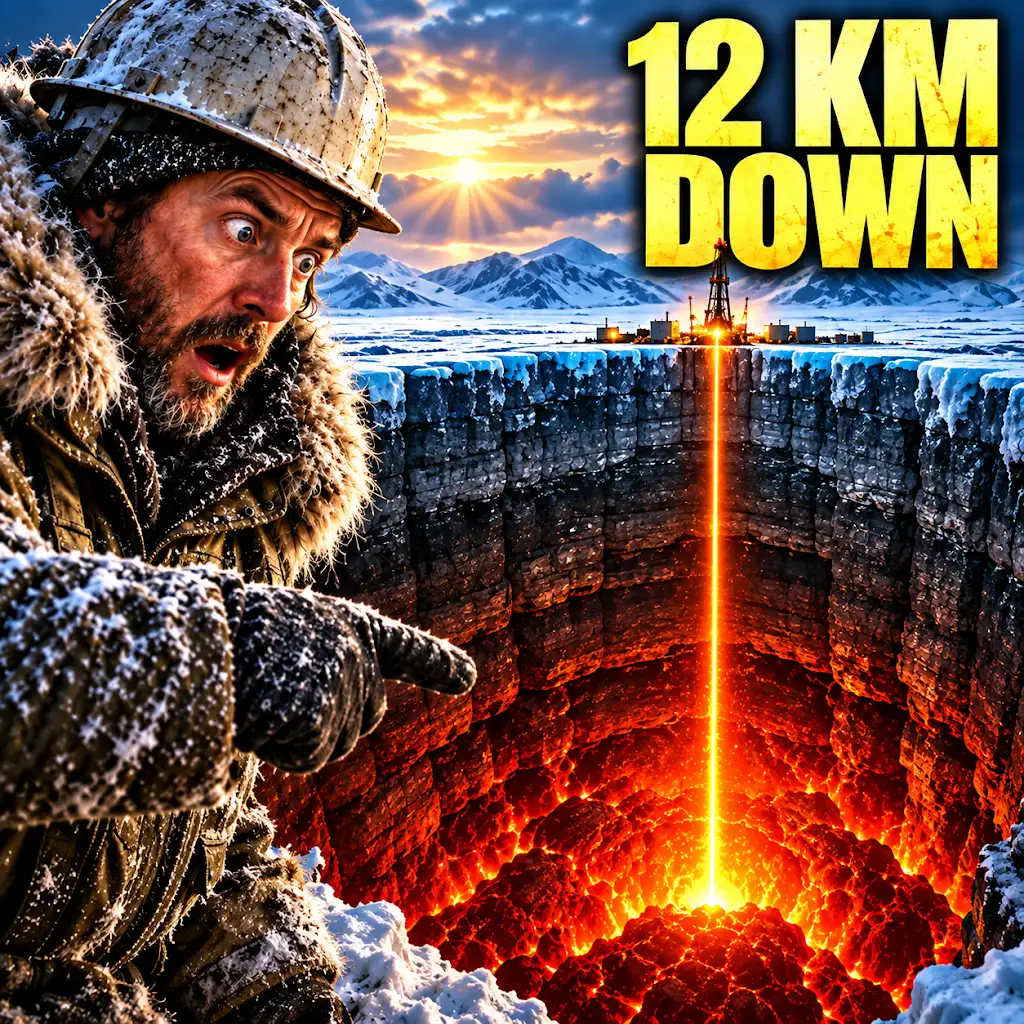
They Drilled 12 KM Into Earth — Then Everything Changed
FAQs
What is the world’s deepest hole?
The world’s deepest hole is the Kola Superdeep Borehole in Russia, reaching a depth of 7.5 miles (12 kilometers).
What was the purpose of drilling the Kola Superdeep Borehole?
The main purpose of drilling the Kola Superdeep Borehole was to study the Earth’s crust and mantle, as well as to explore the possibility of drilling to unprecedented depths.
What scientific discoveries were made from the Kola Superdeep Borehole?
The Kola Superdeep Borehole provided valuable insights into the Earth’s geology, including the discovery of microscopic fossils at depths of over 6 miles (10 kilometers) and the confirmation of the existence of a transition zone between the Earth’s crust and mantle.
What challenges were faced during the drilling of the Kola Superdeep Borehole?
Some of the challenges faced during the drilling of the Kola Superdeep Borehole included high temperatures and pressures at extreme depths, as well as technical difficulties in maintaining the structural integrity of the borehole.
Is the Kola Superdeep Borehole still being used for scientific research?
No, the Kola Superdeep Borehole was officially closed in 2008, and since then, it has not been actively used for scientific research.