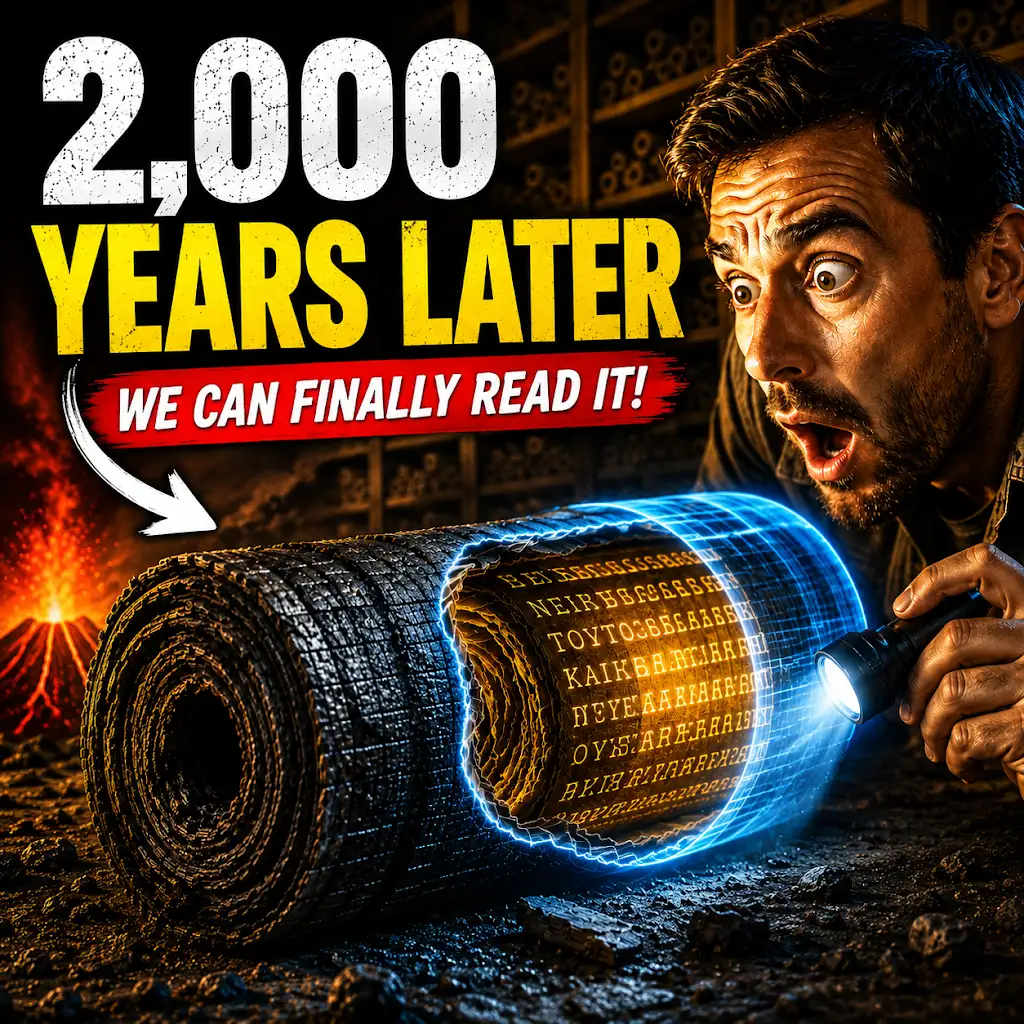
Luke Farritor, a young scholar whose name may soon echo through the halls of history, achieved a remarkable feat in 2024: the successful deciphering of a Herculaneum papyrus scroll, a task that had confounded experts for centuries. This monumental discovery, born from a combination of cutting-edge technology and a keen intellect, opens a new window into the ancient world, promising to unlock lost knowledge and reshape our understanding of classical literature and philosophy.
The story of Luke Farritor’s breakthrough is inextricably linked to the fate of Herculaneum, a Roman city tragically buried by the eruption of Mount Vesuvius in 79 AD. Unlike its more famous neighbor, Pompeii, Herculaneum was not merely covered in ash but encased in a dense, solidified pyroclastic flow. This unique preservation, while catastrophic for its inhabitants, created an environment where organic materials, including papyrus scrolls, could survive for millennia, albeit in a carbonized and extremely fragile state.
The Eruption and its Aftermath
The cataclysmic eruption of Vesuvius unleashed a torrent of superheated gas, ash, and volcanic debris that swept down the slopes, obliterating everything in its path. Herculaneum, situated closer to the volcano, bore the brunt of this destructive force. The city was engulfed by a pyroclastic surge, a wave of incandescent gas and volcanic matter that traveled at immense speeds, incinerating and then compacting everything it touched. This rapid burial under a thick layer of volcanic material, estimated to be up to twenty meters deep in places, effectively sealed the city from the ravages of time and decay.
The Discovery of the Villa dei Papiri
The rediscovery of Herculaneum began in the 18th century. Accidental findings during well-digging led to systematic excavations, revealing an astonishingly well-preserved ancient city. The most significant discovery, however, came in 1750 with the unearthing of the so-called “Villa dei Papiri” (Villa of the Papyri). This sprawling luxury villa, believed to have belonged to the father-in-law of Julius Caesar, contained an unprecedented collection of over 1,800 papyrus scrolls. These scrolls, carbonized by the heat of the eruption, were found stacked in rooms and libraries, a testament to the intellectual pursuits of its inhabitants.
The Challenge of Decipherment
The discovery of the Villa dei Papiri was met with immense excitement, but the promise of unlocking the wisdom contained within these scrolls was soon overshadowed by an immense technical challenge. The papyri were so brittle that any attempt to unroll them would cause them to disintegrate into dust. For centuries, scholars and technicians employed various methods, from gentle mechanical attempts to chemical treatments, all with limited success. Many scrolls remained stubbornly fused, their texts an indecipherable mystery. The sheer volume of intact, yet unreadable, scrolls made this one of the most tantalizing archaeological puzzles of modern times.
Early Attempts and Limited Successes
The initial efforts to read the Herculaneum scrolls were painstaking and often destructive. In the 18th century, the Venetian priest Antonio Piaggio developed a rudimentary unrolling machine, a complex apparatus that managed to reveal fragments of text from a few scrolls. However, the process was slow, and the fragility of the papyrus meant that significant portions were still lost. Throughout the 19th and 20th centuries, various techniques, including X-rays and photographic methods, were explored. While some advancements were made, enabling the reading of a small percentage of the scrolls, the vast majority remained inaccessible, their secrets locked away.
The Dawn of a New Era: Technological Advancements
The 21st century brought with it a revolution in imaging and computational technology, creating new possibilities for tackling the Herculaneum scrolls. Traditional methods of unrolling and reading had reached their limits, and a new paradigm was needed. The advent of advanced imaging techniques, coupled with sophisticated algorithms, offered the potential to “see” through the carbonized layers without physically disturbing the fragile papyrus.
Non-Invasive Imaging Techniques
The key to unlocking the Herculaneum scrolls lay in developing non-invasive methods of imaging. Researchers explored various wavelengths of light and forms of radiation, searching for a way to differentiate the ink from the carbonized papyrus. Techniques such as synchrotron X-ray fluorescence and terahertz imaging showed promise, as they could detect subtle differences in material composition and density. The goal was to capture detailed images of the ink residues, even when they were embedded within the densely packed layers of the scroll.
Machine Learning and Artificial Intelligence
The sheer volume of data generated by these advanced imaging techniques presented its own challenge. Processing and interpreting these complex datasets required powerful computational tools. This is where artificial intelligence (AI) and machine learning (ML) entered the picture. Algorithms could be trained to recognize patterns in the images, identifying the subtle variations that indicated the presence of ink. These AI-powered systems could analyze vast amounts of data far more efficiently than human researchers, accelerating the decipherment process.
The Role of Computation
The computational aspect of this endeavor cannot be overstated. Sophisticated algorithms were developed to reconstruct the damaged and obscured text. These algorithms needed to account for factors such as the warping of the papyrus, the smudging of the ink, and the inherent noise in the imaging data. The process involved complex mathematical models and iterative refinement, aiming to produce the most accurate and coherent reading of the ancient text.
Luke Farritor: A Scholar’s Journey
Luke Farritor, a graduate student at the time of his breakthrough, represented the new generation of scholars equipped with the tools and mindset to tackle seemingly insurmountable challenges. His involvement in the Herculaneum project was not one of immediate genius but a culmination of dedicated study, innovative thinking, and persistent effort.
Early Interest and Education
Farritor’s fascination with the ancient world was sparked early on. His academic journey led him to pursue classical studies, with a particular interest in Roman history and literature. He immersed himself in the existing knowledge surrounding the Herculaneum scrolls, understanding the history of their discovery and the long-standing difficulties in deciphering them. His education provided him with a strong foundation in ancient languages, paleography, and historical context, essential for interpreting any recovered text.
The Computational Paleography Approach
Recognizing the limitations of traditional methods, Farritor embraced a computational paleography approach. This interdisciplinary field combines the study of ancient writing with computational tools and techniques. He understood that the future of deciphering the Herculaneum scrolls lay in leveraging the power of modern technology, particularly in the realm of imaging and artificial intelligence. He began to explore how machine learning could be applied to the problem of identifying ink on carbonized papyrus.
Collaboration and Mentorship
Farritor’s breakthrough was not achieved in isolation. He benefited from collaborations with leading researchers in digital humanities, imaging science, and artificial intelligence. Mentorship from established scholars in these fields provided him with guidance, resources, and intellectual stimulation. This collaborative environment was crucial, allowing him to combine diverse expertise and tackle the multifaceted challenges of the project.
The Breakthrough: Unlocking a Lost Text
The moment of breakthrough was not a sudden flash of inspiration but the result of meticulous work and the application of a novel approach. Farritor, working with the advanced imaging data of a specific Herculaneum scroll, developed an AI model that could identify the subtle differences between ink and papyrus.
The Genesis of the AI Model
Farritor’s AI model was trained on a dataset of previously deciphered fragments and known patterns of carbonized ink. The model learned to recognize the specific spectral signatures and textural characteristics of the ink, even when obscured by the carbonized layers of the papyrus. The key innovation was its ability to work with the three-dimensional structure of the scroll, accounting for the curvature and density variations.
The “Scroll 140” Discovery
The specific scroll that yielded the monumental breakthrough was informally designated “Scroll 140.” This scroll, like many others, had resisted previous attempts at decipherment. Farritor applied his AI model to the high-resolution X-ray images of Scroll 140, and the results were immediate and astonishing. The model began to highlight areas of potential ink, presenting a starkly different pattern from the surrounding papyrus.
The Content of the Deciphered Text
The initial decipherment of Scroll 140 revealed a philosophical treatise, believed to be the work of a previously unknown ancient philosopher. While the full extent and significance of the text are still being analyzed, early indications suggest it deals with Stoic philosophy, offering new perspectives on concepts of virtue, happiness, and the nature of the cosmos. The language and style of the text are consistent with other known works from the Roman period, adding to its credibility.
The Implications of the Discovery
The decipherment of Scroll 140 is far more than just the reading of a single ancient text. It represents a paradigm shift in how we can approach the entirety of the Herculaneum papyri. The success of Farritor’s method suggests that many, if not all, of the unreadable scrolls can now be unlocked, potentially revealing a wealth of lost literature, historical accounts, and philosophical insights. This discovery has the potential to rewrite entire chapters of ancient history and thought.
The Future of Herculaneum Research
Luke Farritor’s groundbreaking achievement has not only solved a centuries-old puzzle but has also paved the way for a new era of research into the Herculaneum scrolls. His innovative approach promises to unlock the vast repository of knowledge that has been buried for nearly two millennia.
Applying the Method to Other Scrolls
The immediate next step is to apply Farritor’s AI-driven decipherment method to the remaining unreadable scrolls from the Villa dei Papiri. Researchers are already working to process more scrolls using the same techniques, with the expectation of uncovering more lost texts. This systematic approach has the potential to exponentially increase our understanding of ancient Roman intellectual life.
New Insights into Ancient Philosophy and Literature
The philosophical treatise from Scroll 140 is just the beginning. The broader implications of this breakthrough are immense. The discovery could shed light on previously unknown schools of thought, offer new interpretations of existing philosophical ideas, and potentially reveal lost literary masterpieces. The sheer volume of material suggests that we might encounter entirely new genres or authors previously unknown to us.
The Role of Interdisciplinary Collaboration
The success of this project highlights the critical importance of interdisciplinary collaboration. The combination of classical scholarship, computer science, imaging technology, and artificial intelligence proved to be the key to unlocking this ancient mystery. Future research will undoubtedly continue to foster these partnerships, bringing together experts from diverse fields to tackle complex challenges.
Preserving and Disseminating Knowledge
Beyond decipherment, the long-term future of Herculaneum research involves the careful preservation and dissemination of this newly recovered knowledge. Digital archives and open-access platforms will be crucial for sharing the deciphered texts with scholars and the public worldwide. The ethical considerations of handling these fragile artifacts and making their content accessible will remain a priority.
A New Chapter for Classical Studies
Luke Farritor’s discovery marks a turning point for classical studies. It demonstrates that the pursuit of ancient knowledge is far from over and that groundbreaking discoveries are still possible. This success will undoubtedly inspire a new generation of scholars to engage with classical texts and artifacts, armed with the latest technological tools and a spirit of innovation. The Herculaneum scrolls, once a symbol of an intractable enigma, are now poised to become a vibrant source of new understanding, thanks to the vision and perseverance of individuals like Luke Farritor.