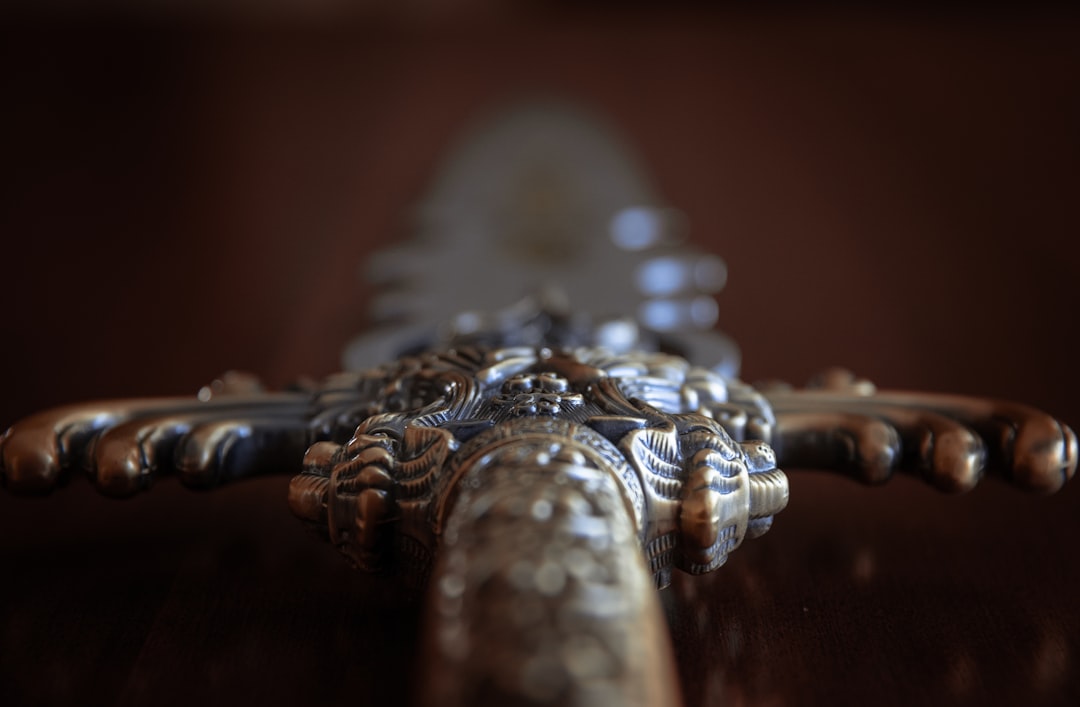
A hush fell over the assembled geologists and archaeologists, a tangible mixture of awe and disbelief. Before them, cradled on a velvet cushion, lay an object that defied conventional understanding. It was a dagger, undeniably ancient in its craftsmanship, yet composed of a material that whispered of cosmic origins. This was the Nickel Cobalt Meteorite Dagger, a relic so extraordinary it threatened to rewrite chapters of our understanding of early metallurgy and extraterrestrial encounters.
The dagger’s hilt, intricately carved from a dark, dense material, seemed to absorb the very light around it. Its blade, however, was the true marvel. Gleaming with a steely, yet subtly iridescent sheen, it possessed a purity of metal that was astonishing. Initial spectroscopic analysis confirmed the unbelievable: the blade was predominantly composed of a unique alloy of nickel and cobalt, not found in any terrestrial ore deposit in such a refined state naturally. This was not just a rare find; it was a paradigm-shifting discovery.
The discovery of the Nickel Cobalt Meteorite Dagger was not a product of a meticulously planned expedition, but rather a serendipitous encounter that unfolded during an unrelated excavation. A team led by Dr. Aris Thorne, a respected archaeologist known for his work on ancient Anatolian civilizations, was meticulously unearthing a previously unknown burial site near the Capadocian region of Turkey. The site, estimated to date back to the early Bronze Age, had already yielded a significant cache of pottery and bronze implements, hinting at a sophisticated society.
The dagger was found not in a place of honor, but in a remarkably well-preserved wooden chest, tucked away in a smaller, secondary chamber. Its placement suggested it might have been a personal possession of the deceased, perhaps a token of immense value or significance. It was its unusual weight and the peculiar luster of its blade that first drew the attention of the excavation team.
Initial Observations and Anomalies
It was a young graduate student, Maya Chen, who first noticed the dagger’s abnormalities. While cataloging the unearthed artifacts, she struggled to accurately weigh the dagger, its density far exceeding that of typical iron or bronze blades of comparable size. Her initial assessment was that it might be a much older, perhaps even a novel form of iron meteorite that had been worked by ancient smiths.
“It felt… wrong, somehow,” Chen recounted later, her voice still tinged with wonder. “The metal was so uniformly dark, and yet it had this strange, almost ethereal shimmer. It wasn’t oxidized like iron would be after millennia. It was pristine.”
The hilt itself presented a different enigma. Carved with an almost impossibly fine detail, it depicted swirling celestial patterns and constellations that, upon closer examination by an archaeoastronomer, appeared to align with celestial observations from approximately 5,000 years ago. This temporal correlation, while intriguing, was soon overshadowed by the revelations about the blade’s composition.
The Astonishing Metallurgical Analysis
The decision was made to transport the dagger to a specialized metallurgical laboratory for in-depth analysis. The initial results were met with stunned silence. Spectroscopic analysis, electron microscopy, and X-ray diffraction all pointed to a startling conclusion: the blade was an extraterrestrial alloy of nickel and cobalt, present in a ratio and purity that could only have originated from a meteorite. The nickel content was exceptionally high, alongside a significant, and unusually uniform, presence of cobalt.
Dr. Thorne himself, a seasoned professional who had unearthed countless artifacts, admitted to being overwhelmed. “I’ve seen meteoric iron before, but never anything like this. The cobalt content, the incredible refinement of the alloy… it suggests a level of metallurgical sophistication that is simply unbelievable for the period. Or, more accurately, it suggests an entirely different source of material and perhaps even a different understanding of metallurgy than we’ve ever attributed to ancient peoples.”
The fascinating discovery of the nickel cobalt meteorite dagger has sparked interest not only in the realm of archaeology but also in discussions about resource management and regional autonomy. For a deeper understanding of how local governance can impact resource allocation and community empowerment, you can explore the article on regional autonomy found here: Empowering Regions: The Case for Regional Autonomy. This article provides insights into how regions can better manage their resources, much like the unique materials found in the meteorite dagger.
The Cosmic Pedigree: Tracing Extraterrestrial Origins
The identification of the dagger’s blade as meteoric in origin immediately sparked intense scientific inquiry into its potential source. The presence of both nickel and cobalt in such significant quantities is a hallmark of certain types of meteorites, particularly iron meteorites. However, the specific ratio and the exceptional purity of the alloy presented a unique challenge.
Meteorites: Gifts from the Void
Meteorites are remnants of asteroids or comets that survive passage through Earth’s atmosphere and land on the surface. They are invaluable scientific tools, offering direct insights into the composition and evolution of the early solar system, and sometimes even the building blocks of life itself. Iron meteorites, in particular, are rich in iron and nickel, formed in the cores of differentiated asteroids billions of years ago.
The rarity of meteorites with such a high cobalt content, especially in conjunction with the significant nickel proportions, suggests that the parent body of this particular meteorite was likely a very specific type of celestial object. Scientists theorize that it could be a fragment from a differentiated asteroid that experienced a unique geological history, or perhaps even from the core of a protoplanet that was disrupted during the early stages of planetary formation.
Isotopic Fingerprinting: A Cosmic Identity Card
The key to pinpointing the potential origin of the nickel-cobalt meteorite lay in isotopic analysis. Isotopes of elements have different numbers of neutrons, and their relative abundances can act as unique “fingerprints” that distinguish meteorites from different locations in the solar system. By analyzing the ratios of different isotopes of nickel and cobalt, scientists could potentially narrow down the origin of the parent meteorite.
Early isotopic analysis revealed patterns that were not immediately familiar. While some isotopes aligned with known classes of meteorites, others presented anomalies. This suggested that the parent body might have been a rare type of meteorite, or a fragment from a celestial body whose composition was unusual. The scientific community hypothesized that the meteorite likely originated from a region of the asteroid belt or even further out, where such unique metallic compositions might have formed. Speculation also arose about the possibility of the meteorite being significantly older than typical iron meteorites used by ancient smiths, suggesting a more direct and possibly earlier celestial event impacting Earth.
Ancient Metallurgy Reimagined: A Sophisticated Craftsmanship

The existence of the Nickel Cobalt Meteorite Dagger compels a radical re-evaluation of ancient metallurgical capabilities. The ability to work with such a dense, hard, and unique alloy in a way that resulted in a finely crafted weapon suggests a degree of skill and knowledge that has never before been attributed to cultures of the early Bronze Age.
Working the Unworkable: Challenges and Techniques
Nickel-cobalt alloys are notoriously difficult to work. They are incredibly hard and brittle, making them resistant to traditional forging and shaping techniques. The clean, sharp edge of the dagger, as well as the intricate carvings on its hilt, imply that the ancient smiths possessed methods for annealing, quenching, and perhaps even tempering that were far beyond what was previously understood for that era.
The pristine condition of the blade, devoid of the stress fractures or imperfections typically found when working such difficult metals, points to a profound understanding of the material’s properties. This raises questions about whether these ancient smiths stumbled upon these techniques through trial and error, or if they possessed a more advanced theoretical knowledge base that has been lost to time.
The Mystery of the Hilt’s Carving
While the blade is the most scientifically remarkable aspect of the dagger, the hilt is no less intriguing from an archaeological perspective. The detailed carvings, as mentioned, appear to depict celestial patterns. However, the artistry also suggests an understanding of form and texture not commonly seen in contemporary artifacts.
The material of the hilt itself is still under investigation. Initial analysis suggests it is an exceptionally dense, petrified wood or a remarkably preserved form of ebony, but its exact origin and the method used to achieve such intricate detail remain subjects of ongoing research. The precision of the carving, especially given the supposed limitations of tools available at the time, further deepens the mystery of the dagger’s creation. It’s possible that the artisans used tools made from other, exceptionally hard, meteorite fragments, or developed entirely new methods of shaping and carving organic materials.
Societal Significance: Power, Prestige, and Spiritual Connection

Beyond its material composition and metallurgical marvels, the Nickel Cobalt Meteorite Dagger holds immense implications for understanding ancient societies. The possession of such an object, undoubtedly rare and powerful, would have conferred immense status and prestige upon its owner.
A Symbol of Elite Status and Authority
In most ancient societies, rare and exotic materials were reserved for the ruling elite. The sheer uniqueness of the nickel-cobalt meteorite would have made this dagger an unparalleled symbol of power and authority. Its discovery in a high-status burial suggests that its owner was likely a person of significant importance, possibly a chieftain, a religious leader, or a revered warrior.
The dagger may have been more than just a weapon; it could have been a symbol of divine favor, a token of a celestial connection, or a tangible manifestation of the owner’s otherworldly influence. The sheer effort and ingenuity required to create such an object would have solidified its status as an object of immense value, not just in monetary terms, but in cultural and spiritual significance.
Ritualistic and Spiritual Interpretations
The celestial carvings on the hilt strongly suggest a ritualistic or spiritual purpose for the dagger. In many ancient cultures, the heavens were seen as a source of power and guidance, and celestial events often held deep religious meaning. The fact that the dagger’s hilt depicts specific constellations that would have been visible millennia ago adds another layer of complexity, suggesting a deep understanding of astronomical cycles and their potential connection to earthly events.
It is plausible that the dagger was used in important ceremonies, perhaps as a symbol of a pact with celestial deities, or as a tool for divination or prophecy. The presence of cobalt, a metal with unique magnetic properties, could also have played a role in its perceived mystical or spiritual significance, although such theories are purely speculative at this stage. The potential for the dagger to have been used in rituals that involved alignment with celestial events further enhances its mystique.
The discovery of the nickel cobalt meteorite dagger has sparked significant interest among historians and archaeologists, particularly in relation to ancient metallurgy and its impact on civilizations. This fascinating artifact not only showcases the advanced skills of early metalworkers but also raises questions about the resources and technologies available during that time. For those intrigued by the broader implications of resource management in ancient societies, a related article discusses the mysterious causes of the Bronze Age collapse, shedding light on how environmental and social factors intertwined to shape history. You can read more about it in this insightful piece here.
Rethinking Ancient Civilizations: Implications for History and Science
| Attribute | Value |
|---|---|
| Material | Nickel Cobalt Meteorite |
| Type | Dagger |
| Origin | Unknown |
| Age | Estimated to be millions of years old |
| Weight | Varies |
The Nickel Cobalt Meteorite Dagger is not merely an anomaly; it is a profound challenge to our established narratives of human history and technological development. Its existence forces a re-evaluation of what we thought we knew about the capabilities and understanding of ancient peoples.
Bridging the Gap Between Myth and Reality
The discovery opens up a tantalizing possibility: could some of the myths and legends of ancient cultures that speak of celestial visitors or gifts from the gods have a basis in tangible, albeit misunderstood, historical events? The dagger itself is a physical testament to a cosmic encounter, an artifact that bridges the gap between the ethereal realm of celestial objects and the terrestrial world of human craft.
The sophisticated craftsmanship, combined with the extraterrestrial origin of the material, suggests a level of interaction or knowledge that current historical models do not accommodate. It prompts questions about whether there were forgotten periods of advanced knowledge, or whether ancient peoples possessed access to resources and technologies that were lost to subsequent generations.
The Future of Discovery: Unlocking Further Secrets
The Nickel Cobalt Meteorite Dagger is not the end of the story, but rather the beginning of a new chapter in archaeological and scientific exploration. Further research into the dagger’s composition, its isotopic signature, and the context of its discovery promises to unlock even more secrets.
Scientists are eager to conduct more detailed isotopic analysis to pinpoint the precise origin of the parent meteorite within the solar system. Metallurgists are striving to understand the exact techniques used by the ancient smiths to work such a challenging alloy, potentially leading to revolutionary advancements in material science. Archaeologists will continue to explore the burial site and surrounding regions, searching for other artifacts that might shed light on the civilization that possessed such an extraordinary object and the knowledge it represents. The Nickel Cobalt Meteorite Dagger stands as a powerful reminder that our understanding of the past is constantly evolving, and that the universe still holds many profound mysteries waiting to be unearthed. The implications for understanding early human interaction with extraterrestrial elements are immense, and the dagger serves as a tangible prompt for a re-examination of the narrative of human technological and cultural development.

The Pharaoh’s Dagger Came From Outer Space
FAQs
What is a nickel cobalt meteorite dagger?
A nickel cobalt meteorite dagger is a type of dagger made from a meteorite that contains high levels of nickel and cobalt. These daggers are known for their unique and striking appearance, as well as their historical and cultural significance.
How are nickel cobalt meteorite daggers made?
Nickel cobalt meteorite daggers are made by forging and shaping a meteorite that contains high levels of nickel and cobalt. The process involves heating and hammering the meteorite to create the desired shape and design, resulting in a unique and durable dagger.
What are the properties of nickel cobalt meteorite daggers?
Nickel cobalt meteorite daggers are known for their high strength, durability, and distinctive Widmanstätten pattern, which is a unique crystalline structure that forms in meteorites over millions of years. These daggers also have a high resistance to corrosion, making them suitable for both display and practical use.
What is the historical significance of nickel cobalt meteorite daggers?
Nickel cobalt meteorite daggers have a rich historical significance, as they have been used by various cultures and civilizations throughout history. They are often associated with royalty, nobility, and ceremonial purposes, and are considered valuable and prestigious artifacts.
Where can one find nickel cobalt meteorite daggers?
Nickel cobalt meteorite daggers can be found in specialty stores, online retailers, and at auctions or exhibitions featuring rare and unique artifacts. They are often sought after by collectors, enthusiasts, and individuals interested in historical and cultural artifacts.