The Legacy of Menkaure: A Pharaoh’s Enduring Influence
Menkaure, the fifth pharaoh of the Fourth Dynasty of Egypt, ascended to the throne at a pivotal moment in Egyptian history. His reign, though perhaps less extensively documented and visually monumental than those of his immediate predecessors, Khufu and Khafre, has left a substantial and enduring legacy. This influence reverberates through the archaeological record, the religious beliefs of his time, and the very fabric of Egyptian monumental architecture, even centuries after his passing. Understanding Menkaure’s impact requires a deep dive into the context of his era and the specific achievements that have solidified his place in the annals of pharaonic power.
Menkaure’s most tangible imprint on eternity rests in his pyramid complex at Giza. Unlike the colossal scale of the Great Pyramid of Khufu or the imposing stature of Khafre’s pyramid, Menkaure’s pyramid, often referred to as the “Third Pyramid,” is notably smaller. This difference in scale, however, does not diminish its significance. Instead, it suggests a shift in architectural priorities and potentially a more focused approach to the pharaoh’s afterlife.
The Subtlety of Scale: A Deliberate Choice?
The dimensions of Menkaure’s pyramid, standing at approximately 65 meters (213 feet) tall with a base of about 103.4 meters (339 feet) square, stand in stark contrast to Khufu’s 146.6-meter (481 feet) height. Some scholars have posited that this reduction in size might reflect resource limitations, a shortened reign, or a conscious decision to prioritize other aspects of the project. The pyramid was originally intended to be cased in granite, a testament to the ambition of its construction, but this ambitious plan was not fully realized, with the lower courses being of granite and the upper courses of the more common limestone. It is like a masterful sculptor choosing to leave some areas intentionally unfinished, allowing the viewer’s imagination to fill the gaps.
The Accompanying Structures: A Complete Funerary Landscape
The pyramid itself was merely one component of a larger, meticulously planned funerary landscape. Adjacent to the main pyramid were three smaller “queen’s pyramids,” a satellite pyramid, and a mortuary temple. The presence of these satellite structures underscores the importance of the royal consort and the interconnectedness of the royal family within the afterlife. The mortuary temple, in particular, was a focal point for the cult of the deceased king, where priests would perform rituals and offer sacrifices to sustain his ka (life force) in the next world. The valley temple, connected to the mortuary temple by a causeway, served as a place for purification rites and the reception of offerings. This entire complex, even in its weathered state, serves as a blueprint for royal burial practices, demonstrating a continuity of belief and a sophisticated understanding of ritualistic architecture.
Menkaure, the ancient Egyptian pharaoh known for his pyramid at Giza, has been the subject of various scholarly articles that explore his reign and contributions to Egyptian architecture. For a deeper understanding of Menkaure’s significance in the context of ancient Egyptian history, you can read a related article that discusses his pyramid complex and its unique features. For more information, visit this article.
The Divine King: Menkaure in Religious and Political Context
Menkaure’s reign occurred during a period when the concept of the divine pharaoh was deeply entrenched in Egyptian society. He was not merely a ruler but a divine intermediary, a god-king whose actions ensured the stability and prosperity of the land. His legacy is thus intertwined with the evolution of religious thought and the consolidation of royal authority.
The Cult of Ra and Amun: A Developing Pantheon
While the Old Kingdom saw a strong emphasis on the sun god Ra, further developments in Egyptian theology began to incorporate other deities. The cult of Ra remained preeminent, and Menkaure’s pyramid complex, aligned with astronomical observations, reflects this solar worship. However, the seeds of later theological developments, which would see Amun rise to prominence, were already being sown. Menkaure’s own cartouches and inscriptions, though not as extensive as those of his predecessors, provide valuable glimpses into the prevailing religious ideologies that shaped his rule and his afterlife aspirations.
The Pharaoh as Mediator: Maintaining Ma’at
The fundamental principle of Ma’at—truth, justice, order, and cosmic balance—was the cornerstone of Egyptian governance. The pharaoh was the principal guarantor of Ma’at, and his reign was judged by his success in upholding it. Menkaure, like all pharaohs, was expected to rule with wisdom and fairness, ensuring the harmony between the divine and mortal realms. His legacy, therefore, is also a testament to the enduring ideals of just rulership that resonated throughout Egyptian civilization. His actions, whether in constructing his tomb or in his governance, were all part of a grand cosmic play, designed to keep the world from descending into chaos.
Artistic Expressions: Sculptural Masterpieces and Shifting Styles

The art of the Fourth Dynasty is renowned for its naturalism and serene idealism, and Menkaure’s reign is no exception. While fewer individual sculptures have been definitively attributed to him compared to Khufu or Khafre, the pieces that have survived offer crucial insights into artistic conventions and the pharaoh’s depiction.
The Triad Sculptures: A Glimpse of Royal Family
Perhaps the most famous artistic representations from Menkaure’s reign are the so-called Triad sculptures from his valley temple. These diorite statues depict Menkaure in the company of goddesses, most notably Hathor and the personification of one of the nomes (provincial divisions) of Upper or Lower Egypt. The pose is consistent: the pharaoh stands firm, looking forward, while the goddesses stand beside him, one placing a hand on his arm, the other often crowning him. These sculptures were not mere portraits; they served a symbolic function, asserting the pharaoh’s divine authority, his connection to the divine feminine principle, and his dominion over the land. They are like snapshots of power, frozen in stone for eternity.
The “Diorite Group” and the Queen: A Shared Divine Status
Another significant discovery from Menkaure’s reign is a pair of diorite statues depicting the pharaoh with his queen. These portrayals suggest a level of shared divine status or at least a significant acknowledgement of the queen’s importance. The queen is depicted with dignity and presence, standing alongside her royal consort. The artistic style, characterized by its refinement and precision, demonstrates the high level of craftsmanship achieved by Egyptian artisans during this period. These sculptures stand as silent witnesses to a deeply ingrained societal structure where the royal family was central to the spiritual and political health of the nation.
The Giza Plateau: A Monumental Continuum
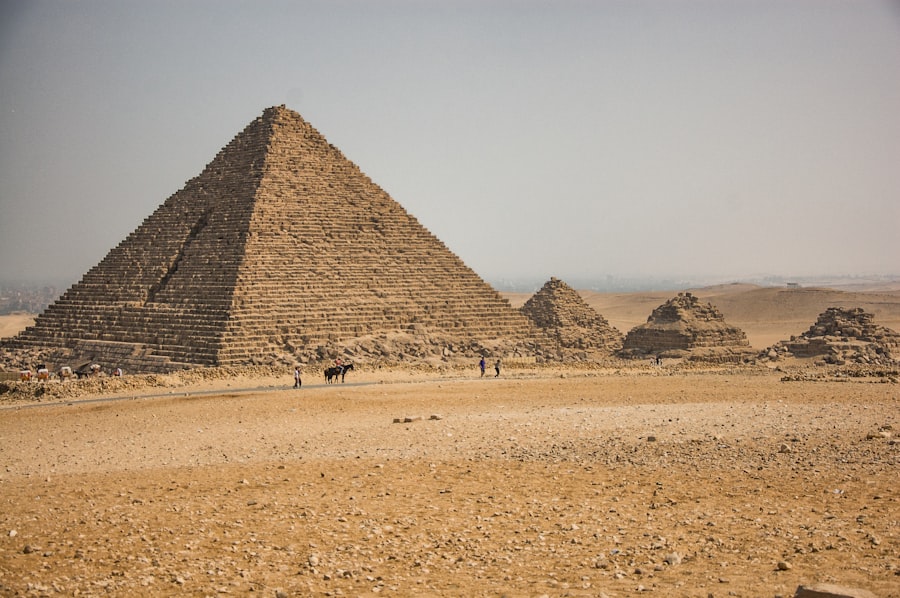
Menkaure’s pyramid complex is an integral part of the Giza plateau, a landscape already dominated by the monumental achievements of his predecessors. His presence there signifies a continuation and a culmination of the Giza pyramid-building tradition, albeit with subtle variations.
The Masterpiece of the Plateau: A Harmonious Ensemble
The Giza plateau, with its three main pyramids, the Great Sphinx, and numerous associated structures, represents one of the most significant archaeological sites in the world. Menkaure’s pyramid, positioned at the southern end of the plateau, completes the grand visual narrative of Old Kingdom pharaonic power. While distinct in its architectural details, it harmonizes with the overall design of the site. It is as if each pyramid is a note in a grand symphony, contributing to the overall composition.
The Unfinished Granite Casing: A Puzzle and a Promise
The unfinished granite casing of Menkaure’s pyramid has been a subject of much speculation. The presence of massive granite blocks, some still showing tool marks, suggests that the project was intended to be even more imposing than its current state. Perhaps a sudden event, a shift in resources, or even a change in the pharaoh’s plan interrupted the final stages of construction. This incomplete element adds a layer of mystery to Menkaure’s legacy, a reminder that even the most powerful rulers were subject to the vagaries of time and circumstance.
Menkaure, the ancient Egyptian pharaoh known for his pyramid at Giza, has long intrigued historians and archaeologists alike. His reign, which marked a significant period in the Fourth Dynasty, is often discussed in relation to the other great pyramids of Giza. For those interested in exploring more about the fascinating history of ancient Egypt, a related article can be found at this link, which delves into the broader context of the Giza plateau and its monumental structures.
The Enduring Echo: Menkaure’s Place in History
| Metric | Data |
|---|---|
| Name | Menkaure |
| Reign | c. 2510 BC – 2475 BC |
| Dynasty | 4th Dynasty of Egypt |
| Monument | Third Pyramid of Giza |
| Pyramid Height | 65 meters (213 feet) |
| Pyramid Base Length | 108.5 meters (356 feet) |
| Known For | Last of the three main pyramids at Giza |
| Successor | Shepseskaf |
The legacy of Menkaure, though perhaps less thunderous than that of Khufu, is undeniably profound. His pyramid complex stands as a testament to the enduring power of pharaonic ideology, artistic achievement, and architectural innovation. His reign provides crucial data points for understanding the evolution of Egyptian religious beliefs and the complex relationship between the divine and the earthly ruler.
The Archaeological Evidence: A Window to the Past
Archaeological excavations at Giza have unearthed invaluable information about Menkaure’s reign, from the inscriptions on his tomb to the artifacts found within his temples. These discoveries are not static relics; they are active participants in our understanding of the past, allowing us to reconstruct the life, beliefs, and impact of this ancient pharaoh. Each shard of pottery, each inscribed stone, is a whisper from the past.
Menkaure’s Place in the Fourth Dynasty Pantheon: A Quiet Giant
While Khufu and Khafre often overshadow him in popular imagination due to the sheer scale of their constructions, Menkaure’s contribution is no less significant. He represents a crucial stage in the development of the Fourth Dynasty, a period of immense power and cultural florescence. His enduring influence lies not just in stone and mortar, but in the ongoing dialogue between his time and ours. His legacy is a seed that continues to bear fruit in our persistent quest to decipher the mysteries of ancient Egypt. Readers might find themselves drawn to Giza wanting to see the colossal, but it is often in the subtler details, like those found within Menkaure’s complex, that a deeper understanding of this civilization can be truly unearthed.
FAQs
Who was Menkaure?
Menkaure was an ancient Egyptian pharaoh of the Fourth Dynasty during the Old Kingdom period. He is best known for building the third and smallest of the three famous pyramids at Giza.
When did Menkaure rule Egypt?
Menkaure ruled Egypt approximately from 2490 to 2472 BCE, succeeding his father Khafre and preceding Shepseskaf.
What is Menkaure famous for?
Menkaure is most famous for constructing the Pyramid of Menkaure at the Giza plateau, which is the smallest of the three major pyramids but notable for its complex mortuary temple and statues.
Where is Menkaure’s pyramid located?
Menkaure’s pyramid is located on the Giza Plateau near Cairo, Egypt, alongside the pyramids of Khufu and Khafre.
What artifacts are associated with Menkaure?
Artifacts associated with Menkaure include statues, such as the famous triad statues depicting him with goddesses, as well as various inscriptions and reliefs found in his mortuary temple and tomb complex.