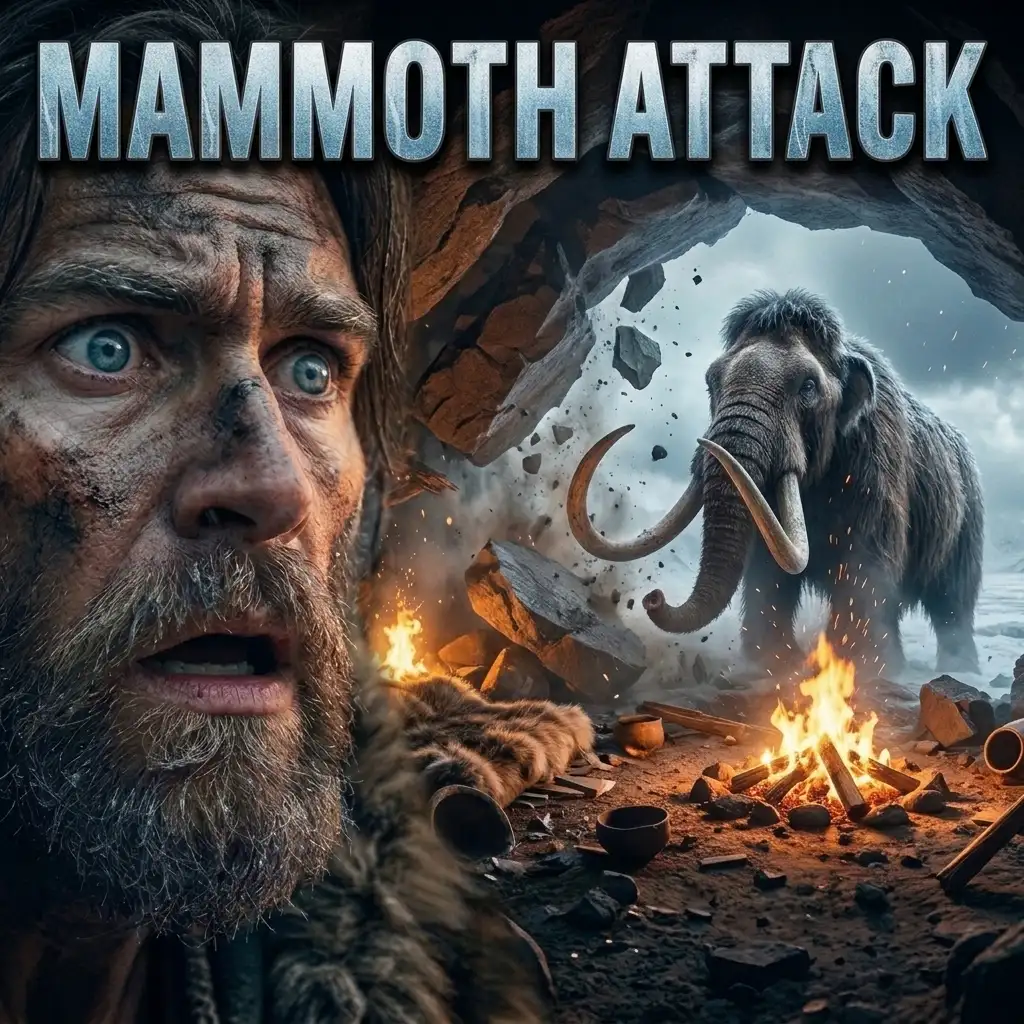
The biting wind howled, a relentless sonic assault that tore at Elara’s tattered furs. Snow, thick and cloying, swirled in a blinding blizzard, reducing visibility to mere inches. Every breath was a searing agony, each step a Herculean effort through drifts that reached her knees. She huddled deeper into the meager shelter of a snow-laden pine, her muscles screaming from the exertion and the gnawing cold. It had been three days since the avalanche, three days since she’d been separated from her hunting party, three days of desperate, solitary survival. But the immediate threat of frostbite and starvation, while omnipresent, was not what sent icy tendrils of pure terror coiling around her heart. It was the tracks.
The Unseen Terror
The discovery had been made on the second day, a chilling anomaly amidst the otherwise unremarkable signs of winter’s reign. Massive, clawed footprints pressed deep into the compacted snow, each one larger than her own gloved hand. They were unlike anything she had ever seen, or heard of, in the relatively familiar fauna of the Northern Reaches. The creature that had made them moved with a heavy, deliberate gait, yet there was a certain predatory grace suggested by the spacing of the prints, a silent promise of speed and lethal efficiency. Elara knew, with a certainty that settled like a stone in her gut, that she was not alone in this frozen, desolate expanse. She was being stalked.
Whispers of the Glacial Maw
The elders spoke of creatures that dwelled in the deepest ice, ancient beings that predated the current age. These were not mere beasts of tooth and claw, but entities imbued with an almost elemental malice, born from the heart of the glaciers themselves. Stories of the Glacial Maw, the Frost Serpent, the Ice Strider – names whispered around flickering fires, tales meant to instill caution, but which now felt chillingly prescient. These legends spoke of creatures that could move through snow with unnatural silence, whose breath could freeze a man solid in an instant, and whose hunger was as vast and unforgiving as the frozen landscape itself. Elara had always dismissed them as folklore, the fanciful imaginings of a people too often confronted by the raw power of nature. Now, those dismissals felt like the height of arrogance.
The Subtle Signs of Pursuit
The footprints were the most undeniable evidence, but as the days wore on, other signs began to manifest. A rustle in the undergrowth that was too heavy for a rabbit. A shadow that flickered at the periphery of her vision, only to vanish when she turned her head. The eerie silence that descended upon the forest whenever she stopped to listen – a silence so profound it felt like the world was holding its breath, anticipating the predator’s next move. She started to see the creature’s presence not as a distinct event, but as a pervasive atmosphere, a chilling aura that clung to the air like hoarfrost. It was the feeling of being watched, a primal instinct that screamed danger, amplified a thousandfold by the immense, indifferent beauty of the ice.
In exploring the fascinating world of ancient predators, the article “Trapped by an Ice Age Predator” delves into the chilling encounters between early humans and formidable creatures of the past. For those interested in further understanding the technological advancements of lost civilizations that may have influenced survival strategies during such perilous times, you can read more in this insightful piece on ancient innovations found at Uncovering Ancient Tech: Lost Civilizations’ Innovations.
The Strategy of Desperation
Survival, Elara knew, was not just about enduring the physical hardships. It was about outthinking her adversary, about leveraging her knowledge of the wild against a creature she barely understood. Her training as a hunter, honed over years of tracking game and surviving in the wilderness, became her only weapon. Every decision was a calculated risk, every movement a deliberate step away from potential disaster.
Adapting to the Arctic Canvas
The blizzard, while a hindrance, also offered a fleeting advantage. It obscured her tracks, making it harder for the predator to follow her precise path. Elara utilized this to her full advantage, frequently doubling back on her own trail, or deliberately crossing frozen streams to break the scent trail. She learned to read the subtle shifts in the wind, using its direction to gauge where the predator might be or to mask her own scent. She became a ghost in the whiteout, a fleeting anomaly in the frozen landscape. Her furs, once a simple means of warmth, were now a canvas for her survival strategy, her movements dictated by the need to blend, to disappear, to become one with the swirling snow.
The Lure of the Bait
A desperate gamble, but one that seemed to offer a slim chance of disrupting the predator’s hunt. Elara, recalling tales of territorial beasts, decided to create a distraction. She found a small, sheltered clearing, where she carefully prepared a makeshift trap. Using the remnants of her ration pack – dried meat and a piece of hardened cheese – she created a scent trail leading away from her intended escape route. She then tied a strip of her own fur, imbued with her scent, to a low-hanging branch, hoping to draw the predator’s attention. It was a risky maneuver, potentially leading her pursuer directly to her, but the alternative – being hunted relentlessly – was a far more certain death. She hoped to buy herself time, to create a window of opportunity to put more distance between herself and the monstrous presence.
Confrontation in the Frozen Expanse
The moment of reckoning arrived not with a roar, but with a chilling silence that preceded the storm. Elara had managed to evade direct confrontation for what felt like an eternity, her every sense attuned to the faintest whisper of danger. But the predator was relentless, its patience a terrifying testament to its predatory nature.
The Glacial Predator Revealed
As Elara crested a small ridge, her breath caught in her throat. There, emerging from the swirling snow, was the creature. It was a terrifying spectacle, a being sculpted by the very ice it inhabited. Its fur was the color of bleached bone, blending seamlessly with the snow, save for the darker streaks that hinted at ancient scars. Its body was elongated, serpentine, but built with the powerful musculature of a great cat. The most striking feature, however, were its eyes – twin shards of glacial blue, devoid of warmth, reflecting the stark, unfeeling light of the arctic sun. It moved with an unnerving fluidity, its massive paws barely disturbing the snow. A low, guttural growl rumbled in its chest, a sound that vibrated through the very air, promising a swift and brutal end. Elara felt a primal fear, a terror so profound it threatened to paralyze her, but her training, her will to survive, kicked in.
A Dance of Survival
The creature lunged, a blur of white and ice. Elara reacted instinctively, rolling to the side, the impact of its claws tearing through the snow where she had been moments before. The air was filled with the stench of ozone and something metallic, a scent she couldn’t quite place but which spoke of immense power. She scrambled to her feet, her bow, already nocked, aimed at the beast. Her arrows, tipped with obsidian, were her only chance. The first shot went wide, deflected by a glancing blow from its powerful tail. The second, however, found its mark, embedding itself in the creature’s thick shoulder. It roared, a sound of pure agony and fury, and charged again. Elara dodged and weaved, her movements dictated by a lifetime of instinct and the desperate need to stay alive. She was a small, fragile creature against a titan of the ice, but she fought with the ferocity of a cornered wolf.
The Frozen Breath of Death
The predator, wounded but far from defeated, unleashed its most terrifying weapon. A cloud of icy vapor billowed from its maw, a freezing mist that crackled with an unseen energy. Elara shielded her face with her forearm, the cold biting deep even through her thick furs. The snow around her began to crystalize, forming fragile, sharp-edged formations. She knew this was its ultimate attack, the one that could freeze her solid in an instant. Her heart pounded against her ribs, a frantic drumbeat against the encroaching chill. She needed to break the stalemate, to find an opening.
The Edge of the Abyss
With her body numb and her spirit flagging, Elara found herself pushed to the absolute limit of her endurance. The constant threat, the relentless pursuit, had worn her down, both physically and mentally. But in the face of ultimate despair, a spark of defiance ignited.
The Last Stand
Trapped against a sheer ice cliff, her escape routes dwindling, Elara braced herself. The predator loomed, its eyes burning with an ancient hunger. She had no more arrows, her strength was fading, and the biting cold was seeping into her very bones. Yet, as she met the creature’s terrifying gaze, a strange calm settled over her. She was a hunter, and this was her hunt. She had outmaneuvered it, outlasted it, and now, she would face it. She tightened her grip on her hunting knife, its small blade feeling utterly inadequate against the behemoth before her.
A Glimmer of Hope in the Whiteout
Just as the predator gathered itself for a final, devastating lunge, a sound pierced the blizzard. A distant horn, faint but distinct, carried on the wind. It was the call of her hunting party, searching for her. The predator, its senses honed to the subtle nuances of the wild, paused, its head cocked, its glacial blue eyes flicking towards the direction of the sound. It was a creature of instinct, and the sound of other beings, of potential competition or threat, momentarily disrupted its singular focus on Elara. This fleeting hesitation, this minuscule window of opportunity, was all she needed.
In exploring the fascinating dynamics of prehistoric ecosystems, the article “Trapped by an Ice Age Predator” delves into the survival strategies of ancient species. For those interested in the broader implications of survival and competition, a related article discusses the militarization of the moon and its strategic advantages in modern times. You can read more about this intriguing topic by following this link. Understanding how both ancient and contemporary environments shape survival can provide valuable insights into the challenges faced by species throughout history.
The Long Road Home
| Metric | Value | Description |
|---|---|---|
| Predator Species | Smilodon (Saber-toothed cat) | Common apex predator during the Ice Age |
| Average Size of Predator | 1.2 meters (shoulder height) | Height of Smilodon at the shoulder |
| Estimated Weight | 160-280 kg | Weight range of Ice Age predators like Smilodon |
| Typical Prey | Large herbivores (e.g., mammoths, bison) | Common prey animals hunted by Ice Age predators |
| Hunting Strategy | Ambush predator | Method used to trap prey during the Ice Age |
| Ice Age Period | 2.58 million to 11,700 years ago | Timeframe when these predators thrived |
| Survival Rate of Prey | Approximately 30% | Estimated chance of prey escaping an ambush |
| Predator Territory Range | Up to 100 km² | Typical hunting territory size for Ice Age predators |
The sounds of her companions grew louder, their shouts cutting through the wind. The predator, perhaps sensing the shift in its environment, the intrusion of a larger force, melted back into the swirling snow, its white form disappearing as quickly as it had appeared. Elara, her body wracked with tremors, stumbled towards the approaching voices.
Rejoining the Fold
Her companions found her collapsed in the snow, barely conscious, but alive. They wrapped her in fresh furs, their faces etched with relief and concern. The journey back to the village was a slow, arduous one, but Elara was no longer alone. The silence of the wilderness was replaced by the comforting presence of her people, the biting wind softened by the warmth of shared humanity. The memory of the ice age predator, however, would forever be etched into her mind, a stark reminder of the raw, untamed power that lay hidden within the frozen heart of the world.
The Scarred Survivor
Back in the warmth of her village, Elara recovered, her physical wounds slowly healing. But the encounter had left an indelible mark, a psychological scar as deep as any physical injury. She had faced a primal terror and survived, a testament to her resilience and the strength of the human spirit. The stories of the ancient creatures of the ice no longer seemed like mere folklore; they were chilling realities, and Elara, the woman who had stared into the glacial maw and lived to tell the tale, was now a part of those legends herself. Her survival was a beacon of hope, a story of courage against unimaginable odds, a testament to the enduring will to live, even in the face of the frozen fury.