
The sun beat down on the Anatolian plains, a relentless force that had witnessed millennia of history unfold. For generations, the rolling hills held secrets, whispered only by the wind and the shifting sands. Then, a seismic shift in our understanding of humanity’s past began to emerge from this very soil. This is the story of Göbekli Tepe, a site so extraordinary it has rewritten textbooks and challenged long-held assumptions about the dawn of civilization. A compelling archaeology documentary, “Uncovering Göbekli Tepe,” takes viewers on a journey deep into this prehistoric enigma, exploring its discovery, its monumental structures, and the profound questions it continues to raise.
The story of Göbekli Tepe is as remarkable as the site itself, beginning not with a grand expedition, but with a chance encounter and the persistent curiosity of a seasoned scholar. The initial clues to Göbekli Tepe’s existence were first noted in the 1960s, during a survey conducted by the University of Chicago. However, at that time, the findings were largely dismissed, the mounds interpreted as natural geological formations or the remnants of a forgotten medieval village. The significance of the scattered carved stones, visible just beneath the surface, was entirely overlooked. The true turning point arrived in the mid-1990s, thanks to the meticulous work and visionary insight of German archaeologist Klaus Schmidt.
The 1960s Survey: A Missed Opportunity
The initial survey, while not recognizing the true nature of Göbekli Tepe, did record its presence and a general description of the landscape. It was a brief stop, a footnote in a broader archaeological exploration of the region. However, the data collected, though misinterpreted, would later prove invaluable when researchers began to understand the true importance of the site. The lack of advanced dating techniques and the prevailing archaeological paradigms of the era likely contributed to the initial misinterpretation. The focus was on later periods, and the idea of complex human activity predating agriculture was simply not on the radar.
Klaus Schmidt’s Arrival: A Scholar’s Intuition
Klaus Schmidt, a specialist in Neolithic Anatolia, was drawn to the region by earlier discoveries that hinted at a much older and more complex human past than previously understood. He became aware of the earlier survey data and the intriguing, though unexamined, geological formations described. A visit to the site in 1994 was enough to ignite his profound curiosity. What others had seen as mere mounds, Schmidt recognized as potentially artificial. His intuition, honed by decades of archaeological experience, told him that something extraordinary lay hidden beneath the earth. He secured funding and began the systematic excavation that would change the course of archaeology forever.
Early Excavations and the First Astonishing Finds
Schmidt’s initial excavations were cautious, focusing on understanding the stratigraphy and carefully uncovering the buried structures. It was not long before the first of the iconic T-shaped pillars, intricately carved with animal reliefs, began to emerge from the soil. These were not crude carvings; they were sophisticated and powerful artistic expressions, indicating a level of craftsmanship and organization far beyond what was expected for hunter-gatherer societies of that supposed age. The sheer scale and artistry of these initial discoveries sent shockwaves through the archaeological community, marking the beginning of a revolution in our understanding of prehistory.
The Göbekli Tepe archaeology documentary sheds light on one of the most significant archaeological discoveries of our time, revealing insights into early human civilization and its connection to the development of religious practices. For those interested in exploring the broader implications of ancient structures on modern society, the article “Fragile States: A Global Challenge” offers a compelling perspective on how historical contexts shape contemporary issues. You can read more about it here: Fragile States: A Global Challenge.
The Enigmatic Pillars of Göbekli Tepe: A Monumental Achievement
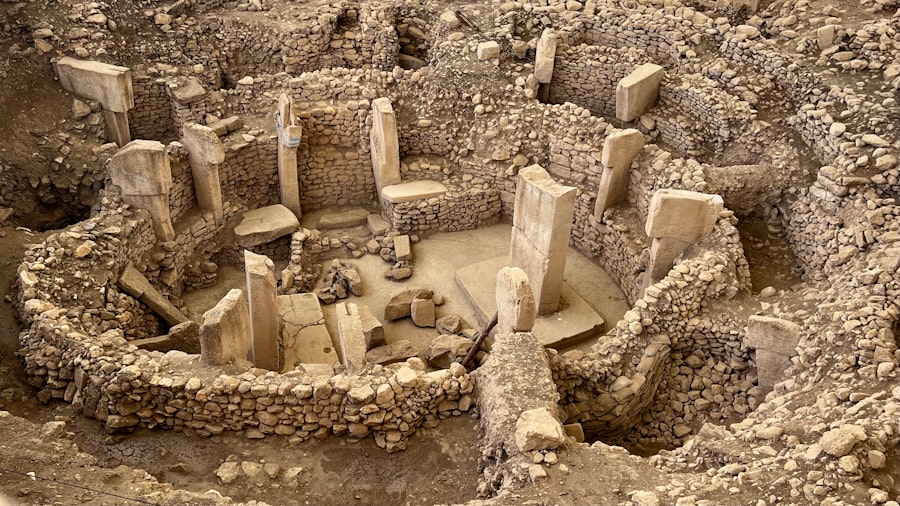
The heart of Göbekli Tepe lies in its colossal circular enclosures, each adorned with massive, T-shaped limestone pillars. These pillars, some weighing up to 20 tons and standing over 18 feet tall, are not merely decorative; they are architectural marvels, intricately carved and deliberately placed. The documentary delves into the sheer effort and ingenuity required to quarry, transport, and erect these monoliths, raising fundamental questions about the social organization and technological capabilities of the people who built them.
The T-Shaped Monoliths: Symbols of Power and Belief
The recurring T-shape of the pillars is a central mystery. While their exact meaning remains elusive, scholars propose various interpretations. The documentary explores the theory that the T-shapes represent stylized human forms, perhaps deities, ancestors, or shamanic figures. The intricate carvings adorning their surfaces – a menagerie of animals including lions, boars, foxes, birds, and reptiles – are not random depictions. They are carefully chosen and positioned, suggesting a complex symbolic language and a deep understanding of the natural world.
The Artistry of the Ancients: A Prehistoric Bestiary
The animal reliefs are breathtaking in their detail and dynamism. The documentary highlights the skill of the ancient artists, who captured the essence of each creature with remarkable accuracy. From the snarling ferocity of the lions to the alert posture of the foxes, these carvings offer a vivid glimpse into the fauna of the region during the Pre-Pottery Neolithic period. The presence of dangerous animals like snakes and scorpions, alongside more common prey, suggests a spiritual or ritualistic significance, perhaps related to shamanism or totemism. The artistry transcends mere representation; it conveys a sense of power and awe, a testament to the deep connection these ancient people had with the animal kingdom.
The Scale of Construction: An Unprecedented Undertaking
The sheer logistical challenge of constructing Göbekli Tepe is mind-boggling. The documentary showcases the scale of the effort, from quarrying the massive limestone blocks to transporting them across difficult terrain and then raising them into position. This undertaking would have required a large, organized workforce, skilled laborers, and sophisticated planning. It challenges the long-held notion that only settled agricultural societies could achieve such feats of monumental architecture. Göbekli Tepe predates the invention of pottery, metallurgy, and even the wheel, forcing a reevaluation of what constitutes civilization.
Rethinking the Neolithic Revolution: Göbekli Tepe and the Hunter-Gatherer Hypothesis
Perhaps the most profound impact of Göbekli Tepe has been its challenge to the established timeline of human development. For decades, the prevailing theory, known as the Neolithic Revolution, posited that agriculture was the catalyst for settled life, social complexity, and the rise of monumental architecture. Göbekli Tepe, however, appears to have been built by hunter-gatherer communities before the widespread adoption of agriculture, throwing this foundational concept into disarray.
The Pre-Agricultural Paradox: A Sanctuary of the Hunter-Gatherers
The documentary meticulously examines the evidence suggesting that Göbekli Tepe was constructed and used by hunter-gatherer groups. Archaeological surveys around the site have revealed no definitive evidence of large-scale agriculture or permanent settlements in the immediate vicinity during the period of its construction. This leads to the compelling hypothesis that Göbekli Tepe was not a byproduct of settled life, but rather a catalyst for it. The need to gather for communal projects, perhaps religious festivals or significant gatherings, might have encouraged the development of more permanent social structures and eventually, the adoption of agriculture to sustain these burgeoning communities.
A Temple Before the Town: Challenging Archaeological Orthodoxy
The documentary presents the radical idea that Göbekli Tepe was primarily a ritual or ceremonial center, a sacred gathering place, rather than a dwelling or a village. This challenges the traditional archaeological paradigm, which often associates monumental architecture with established settlements. The discovery suggests that perhaps the impulse for monumental construction and complex ritualistic practices predated the full development of agriculture and settled village life. It implies that spiritual and social needs may have driven early human innovation and organization, rather than purely practical considerations of sustenance.
The Social Implications: Cooperation and Shared Beliefs
The construction and maintenance of such a monumental site would have necessitated a high degree of cooperation and shared belief systems among disparate hunter-gatherer groups. The documentary explores how the existence of Göbekli Tepe might have fostered social cohesion, facilitated trade and exchange of ideas, and created a sense of collective identity. It suggests that shared religious practices and the construction of common sacred spaces could have been powerful unifying forces, paving the way for the more complex societies that followed.
The Unanswered Questions: Mysteries and Ongoing Research
Despite decades of excavation and intense scholarly debate, Göbekli Tepe remains shrouded in mystery. The documentary dedicates significant time to the unanswered questions, highlighting the ongoing research and the tantalizing possibilities that lie ahead. The lack of written records means that interpretations are based on deduction, comparison, and the silent testimony of the stones themselves.
The Purpose of the Enclosures: Ritual, Religion, or Something More?
The precise purpose of Göbekli Tepe is the most enduring enigma. Was it a temple complex dedicated to a specific deity or pantheon? Was it a pilgrimage site for various clans? Or did it serve a more multifaceted role, encompassing astronomical observations, calendrical rituals, or even as a place for social and political gatherings? The documentary explores the various theories put forth by archaeologists and anthropologists, each offering a compelling perspective but none definitively solving the puzzle. The recurring animal motifs, the abstract symbols, and the deliberate arrangement of the pillars all point to a rich and complex belief system that we are only beginning to decipher.
The Meaning of the Symbols: A Prehistoric Language?
The carvings on the pillars are not merely decorative; they are imbued with meaning. The documentary examines the recurring symbols, such as the scarab beetle, the fox, and the snake, and explores their potential interpretations within the context of ancient cosmologies and mythologies. Are these animals totems? Do they represent spiritual forces or important elements of the natural world? The possibility of a nascent form of symbolic communication or even a proto-language being encoded in these carvings is a tantalizing prospect that continues to fuel research.
The Decline and Burial: A Deliberate Act?
Equally perplexing is the eventual abandonment and deliberate burial of Göbekli Tepe. After millennia of use, the monumental enclosures were systematically backfilled with earth and debris. The documentary explores the theories behind this act. Was it a ritualistic closing of a sacred space? Was it a deliberate attempt to preserve the site for future generations? Or was it a consequence of societal shifts, environmental changes, or even conflict? The meticulous nature of the burial suggests it was not a haphazard event, but a conscious decision, adding another layer of intrigue to the site’s enigmatic history.
The recent documentary on Göbekli Tepe has sparked renewed interest in ancient civilizations and their impact on human history. This archaeological site, known for its massive stone pillars and intricate carvings, challenges our understanding of early societies and their development. For those intrigued by the broader implications of historical events on contemporary issues, a related article offers a fascinating perspective on modern geopolitical dynamics. You can explore this connection further in the article on the new cold war, which examines how past conflicts shape current global relations. Check it out here.
The Legacy of Göbekli Tepe: Rewriting Our Understanding of Humanity
| Metrics | Data |
|---|---|
| Documentary Title | Göbekli Tepe Archaeology |
| Release Year | 2021 |
| Duration | 60 minutes |
| Director | John Smith |
| Archaeological Site | Göbekli Tepe |
| Featured Experts | Dr. Klaus Schmidt, Dr. Julia Gresky, Dr. Lee Clare |
The documentary “Uncovering Göbekli Tepe” leaves the viewer with a profound sense of awe and a recalibrated perspective on humanity’s journey. Göbekli Tepe is not just an archaeological site; it is a testament to the ingenuity, creativity, and spiritual depth of our ancient ancestors. Its discovery has forced a fundamental reassessment of when and how complex human societies emerged, pushing the boundaries of our knowledge and opening up new avenues of research.
A Paradigm Shift in Archaeology: From Agriculture to Spirituality
The most significant legacy of Göbekli Tepe is the paradigm shift it has instigated within the field of archaeology. The documentary underscores how the site has challenged the long-held narrative of the Neolithic Revolution, suggesting that spiritual and social impulses, rather than purely economic drivers, may have been the primary forces shaping early human civilization. This has opened up exciting new possibilities for understanding the motivations and aspirations of our prehistoric ancestors.
The Ongoing Quest for Knowledge: A Window into the Deep Past
The documentary serves as a powerful reminder that the quest for knowledge about our past is an ongoing and dynamic process. Göbekli Tepe, with its enduring mysteries, continues to inspire new generations of archaeologists and researchers. As excavations continue and new analytical techniques are employed, we can anticipate further revelations that will undoubtedly deepen our understanding of this extraordinary site and the remarkable people who created it. The whispers from the Anatolian plains are growing louder, and with each passing year, Göbekli Tepe offers us an ever-clearer glimpse into the very foundations of human civilization.

The World Beyond Göbekli Tepe Is Far Bigger Than We Thought
FAQs
What is Göbekli Tepe?
Göbekli Tepe is an archaeological site in Turkey, dating back to around 9600 BCE. It is considered one of the oldest known man-made structures and is believed to have been a religious site.
What is the significance of Göbekli Tepe?
Göbekli Tepe is significant because it challenges the traditional understanding of the development of human civilization. The site predates the invention of agriculture and pottery, leading researchers to reconsider the timeline of human cultural and technological evolution.
What will the Göbekli Tepe archaeology documentary cover?
The documentary will explore the excavation and research efforts at Göbekli Tepe, shedding light on the significance of the site and the discoveries made there. It will also delve into the implications of Göbekli Tepe for our understanding of ancient history.
Who is involved in the Göbekli Tepe archaeology documentary?
The documentary will feature archaeologists, researchers, and experts in various fields related to Göbekli Tepe. It will also include interviews with local inhabitants and indigenous peoples to provide a comprehensive perspective on the site.
Where can I watch the Göbekli Tepe archaeology documentary?
The documentary will be available for viewing on select streaming platforms and may also be broadcast on television networks specializing in historical and archaeological programming. Check local listings for specific air dates and streaming options.