The scent of aged paper and forgotten stories often hangs heavy in the air of ancestral homes. For many, these archives of family history are limited to faded photographs, brittle letters, and whispered anecdotes passed down through generations. But what happens when these tangible remnants hint at a deeper, more elusive narrative – one that lies not in written words, but encoded within our very DNA? This is the compelling journey undertaken by Sarah Jenkins, a historian and amateur genealogist, as she embarked on the ambitious task of unraveling a decades-old family mystery, a puzzle whose origins were shrouded in the shadows of unspoken truths and the stark realities of a bygone era. The mystery centered around a peculiar branch of her family tree, a lineage that seemed to vanish from records around the turn of the 20th century, leaving behind only tantalizing clues and a persistent question: what had become of them?
The Seeds of Doubt: An Unsettling Anomaly
Sarah’s genealogical quest began, as it often does for many, with a desire to connect with her past, to flesh out the skeletal frameworks of names and dates that populated her family tree. She had meticulously traced her paternal line back to England, uncovering a respectable lineage of farmers, tradesmen, and artisans. However, a peculiar anomaly began to surface when she delved into her maternal grandmother’s side of the family, the descendants of Irish immigrants who had settled in the United States during the late 19th century.
A Shadowy Branch
Within this Irish branch, Sarah encountered a perplexing gap. Her great-grandmother, Eleanor O’Malley, had a younger sister, Brigid, whose existence was confirmed through census records and a handful of brief mentions in family correspondence. Brigid O’Malley had married a man named Thomas Murphy, and together they had a son, Patrick. What was unusual, however, was the apparent disappearance of this O’Malley-Murphy family from any subsequent records after the early 1900s. No death certificates, no marriage records for Patrick, no further census entries for Brigid or Thomas could be found. It was as if they had simply ceased to exist.
The Fading Footprints
Sarah’s initial research attempts yielded little. She scoured birth, marriage, and death indexes for the years following Brigid’s last known record. She explored city directories, cemetery records, and even contacted historical societies in the regions where the family was last known to reside. Each avenue, however, led to a dead end, amplifying the unsettling nature of their vanishing act. The lack of any official documentation was not just a research hurdle; it felt like a deliberate erasure, a void that Sarah felt compelled to fill.
The exploration of historical family tree DNA mysteries has captivated researchers and genealogists alike, shedding light on our ancestral connections and the stories that shape our identities. A fascinating article that delves into the intricacies of ancient history and its implications for modern genetics can be found at The Day of Two Suns: Ancient History Unveiled. This piece not only highlights the significance of DNA in tracing lineage but also uncovers the rich tapestry of human history that intertwines with our genetic heritage.
Whispers of a Scandal: The Unspoken Truths
The mystery of the O’Malley-Murphy disappearance was not merely an abstract genealogical puzzle for Sarah. It was also tinged with hushed family whispers and a vague sense of shame that had, for reasons unclear, permeated certain conversations about this particular branch of the family. These were not outright condemnations, but rather subtle shifts in tone, averted gazes, and the convenient redirection of questions when Brigid or her immediate family were mentioned.
The Unspoken Shame
Sarah’s maternal grandmother, a woman of strong character and deep Catholic faith, would often sigh and say, “Ah, Brigid. She had her troubles.” This cryptic statement, delivered with a sorrowful air, was the most direct acknowledgment Sarah had ever received of any difficulty associated with Brigid. Her grandmother would offer no further details, leaving Sarah to infer a narrative of hardship, perhaps an unhappy marriage, financial ruin, or a social transgression that had led to ostracization.
The Weight of Prohibition
As Sarah’s research progressed, she began to consider the societal context of the early 20th century. The era of Prohibition in the United States, with its widespread speakeasies and the burgeoning organized crime that often accompanied it, presented a plausible, albeit unsavory, backdrop. Could Thomas Murphy have been involved in illicit activities? The O’Malley family, while not wealthy, was known for its strong community ties and upright reputation. The potential for scandal, especially within the context of a conservative Irish Catholic community, could have been significant enough to lead to a deliberate distancing from this particular branch.
The DNA Revelation: A Paradigm Shift
Frustrated by the limitations of traditional genealogical research, Sarah, like many modern genealogists, turned to the power of DNA testing. She had already tested herself and a few close relatives, but the results had offered little insight into the O’Malley-Murphy enigma. The breakthrough came when she convinced her elderly aunt, a first cousin once removed of Brigid’s son Patrick, to submit her DNA for analysis.
Unlocking the Ancestral Code
The results of her aunt’s DNA test were, at first, bewildering. They confirmed the expected European heritage, with a strong emphasis on Irish and British Isles ancestry. However, nestled within the data were unexpected matches – individuals with whom Sarah’s aunt shared a significant amount of DNA, yet who did not appear anywhere in their known family tree. These matches were predominantly from the eastern United States, with a surprising clustering in a specific region that did not directly align with the O’Malley or Murphy family’s known historical locations.
The Unexpected Kin
Further investigation into these unexpected matches revealed a common thread: many of them traced their ancestry back to a specific surname, one that Sarah had never encountered in her O’Malley or Murphy research. This surname, let’s call it “Carolan,” appeared to be a significant presence in the ancestral records of these new DNA cousins. The genetic proximity suggested a close familial relationship, indicating that Sarah’s aunt, and by extension Sarah, shared a direct ancestor with these Carolan descendants.
The Search for the Carolans: A New Trail
The presence of the Carolan surname, entirely absent from Sarah’s known family tree, presented a new and perplexing avenue of investigation. The DNA evidence strongly suggested that the O’Malley-Murphy disappearance was not a simple case of assimilation or relocation without a trace, but rather something far more complex, involving a relationship or event that had effectively erased one name from the family narrative.
The Genetic Fingerprint
Sarah meticulously examined the shared DNA segments with the Carolan descendants. This detailed analysis allowed her to pinpoint the likely point of divergence – the generation at which the O’Malley-Murphy line and the Carolan line had branched off from a common ancestor. The genetic fingerprint pointed towards a sibling or cousin relationship between an O’Malley or Murphy and an individual within the Carolan family.
Bridging the Gap
The challenge now was to find a genealogical record that could connect Brigid O’Malley or her husband Thomas Murphy to the Carolan family. Sarah refocused her research efforts, this time specifically looking for any instances of intermarriage or close familial association between the O’Malley and Carolan families, or between the Murphy and Carolan families, in the late 19th and early 20th centuries. She scoured newspaper archives for marriage announcements, obituaries, and even social notices, hoping for a mention that might bridge the gap.
The exploration of historical family tree DNA mysteries has gained significant attention in recent years, particularly as advancements in genetic testing reveal surprising connections among individuals and their ancestral roots. This fascinating topic is intricately linked to the broader implications of how ancient technologies influenced societal structures and governance. For a deeper understanding of these connections, you can read more about it in this insightful article on the influence of ancient technology on political control. Such discussions not only shed light on our past but also highlight the ways in which our lineage shapes contemporary identities.
The Unveiling: A Father’s Secret and a Mother’s Choice
After months of diligent searching, armed with the insights gleaned from her DNA matches and a renewed focus on the Carolan surname, Sarah finally stumbled upon a crucial piece of information. In an obscure local newspaper archive from a town near where Brigid O’Malley was last documented, she found a brief notice of a marriage that had occurred in 1905. The notice detailed the union of a Brigid O’Malley to a man named “Patrick Carolan.”
The Astonishing Discovery
The name “Patrick Carolan” sent a shiver down Sarah’s spine. It was a name that had surfaced repeatedly in her DNA matches. The implications were staggering. Brigid O’Malley had not married Thomas Murphy, as her family believed and as official records suggested. Instead, she had married a Patrick Carolan. This immediately raised a host of new questions: why the deception? What happened to Thomas Murphy? And who was Patrick Carolan?
The Unraveling Narrative
Delving deeper into the Carolan family history, Sarah discovered that Patrick Carolan was a respected local businessman. She also found records indicating that Brigid O’Malley and Patrick Carolan had a son, born in 1906, named – to no surprise – Patrick. This confirmed that the Patrick mentioned in the original family lore was indeed the son of Brigid O’Malley, but his father was not Thomas Murphy.
The mystery began to solidify around a powerful and tragic narrative. It became clear that Brigid O’Malley had likely been in a relationship with Thomas Murphy, and perhaps had even been engaged or briefly married to him. However, for reasons unknown – perhaps a change of heart, a sudden attraction, or even a pregnancy that complicated matters – she had ended her relationship with Thomas and married Patrick Carolan. The “troubles” her grandmother had alluded to were not necessarily about personal failing, but the profound social and emotional fallout of such a situation.
The deception, Sarah theorized, was likely a collective effort to protect Brigid and her son. In the conservative social climate of the time, a broken engagement or a sudden remarriage, especially if there was a perceived slight or scandal involved with Thomas Murphy, could have been a source of great shame. The family, perhaps out of a desire to maintain their reputation or to shield Brigid from gossip, had deliberately obscured the truth. Thomas Murphy’s name may have been substituted for Patrick Carolan in records, or perhaps the initial marriage to Murphy was briefly officiated and later annulled or unacknowledged in favor of the union with Carolan. The son, Patrick, would have carried the surname Carolan, but within the family narrative, he was perhaps still referred to as “Murphy’s son” or simply associated with his mother’s maiden name to create confusion, effectively erasing his true paternal lineage from common knowledge.
The reason for Brigid’s son, Patrick, vanishing from records as a Murphy was now clear: he was a Carolan. The family’s deliberate misdirection had been so effective that for generations, Sarah’s family believed Brigid had married Thomas Murphy and that their lineage had ended. The subsequent generations of Carolans, living their lives under a different surname, had no idea of their O’Malley connection.
The Legacy of Silence: Reconnecting the Threads
Sarah’s journey to unravel the O’Malley-Murphy mystery was not just about uncovering historical facts; it was about understanding the motivations behind them, the pressures that led to the silencing of truth, and the profound impact of such secrets on subsequent generations.
The Weight of Lies and Love
The realization that her family had lived with a carefully constructed narrative for over a century was both humbling and enlightening. The “troubles” were not a testament to Brigid’s weakness but to her agency in navigating a difficult situation. The silence was not born of malice, but of a complex mix of societal pressures, familial protection, and perhaps a desire to protect Brigid from further heartache.
The New Family Ties
Sarah reached out to some of the Carolan descendants identified through her DNA matches. To her delight, they were welcoming and eager to learn about their O’Malley heritage. They shared photographs, stories, and records that filled in the missing pieces of Brigid’s life. Sarah discovered that Brigid had lived a full life, raising her son Patrick and becoming a beloved matriarch within the Carolan family. Her son, Patrick Carolan, had gone on to have his own children, thus creating the branching lines that Sarah’s DNA had so powerfully revealed.
The descendants of Brigid O’Malley and Patrick Carolan, unaware of their O’Malley roots, had been living their lives independently, their families’ histories intertwined by a secret that had been carefully guarded for generations. Sarah’s genealogical detective work, aided by the revolutionary advancements in DNA technology, had finally brought these two branches of the family back together, bridging a gap created by love, circumstance, and the enduring power of a well-kept secret. The mystery was unraveled, not with a dramatic exposé, but with the quiet dignity of reconnection, a testament to the fact that sometimes, the deepest family histories are not found in written words, but in the very fabric of our being.
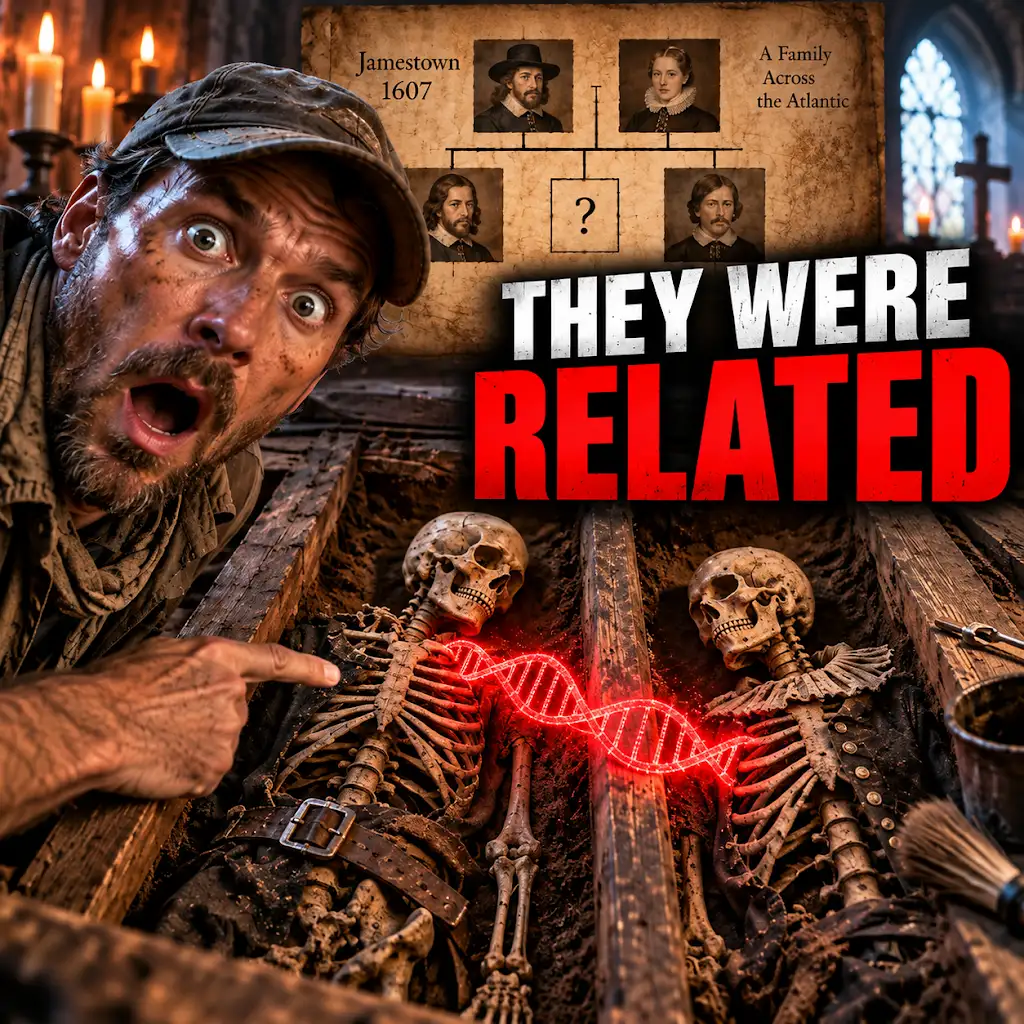
Jamestown DNA Revealed a Family Secret Hidden for 400 Years
FAQs
What is the historical family tree DNA mystery about?
The historical family tree DNA mystery revolves around uncovering unknown or unexpected connections within a family’s genealogy through DNA testing.
How can DNA testing help solve historical family tree mysteries?
DNA testing can provide insights into a person’s ancestry, reveal genetic connections to distant relatives, and help identify potential discrepancies or surprises in a family’s historical lineage.
What are some common reasons for historical family tree DNA mysteries?
Common reasons for historical family tree DNA mysteries include adoption, unknown paternity, undisclosed family secrets, genetic mutations, and errors in genealogical records.
How accurate are DNA tests in uncovering historical family tree mysteries?
DNA tests are generally considered to be reliable in identifying genetic relationships and connections within a family tree. However, the interpretation of results and understanding of genetic genealogy may vary.
What steps can be taken to unravel a historical family tree DNA mystery?
To unravel a historical family tree DNA mystery, individuals can start by taking a DNA test, analyzing the results, building a comprehensive family tree, collaborating with genetic genealogists, and conducting thorough research into historical records and documents.